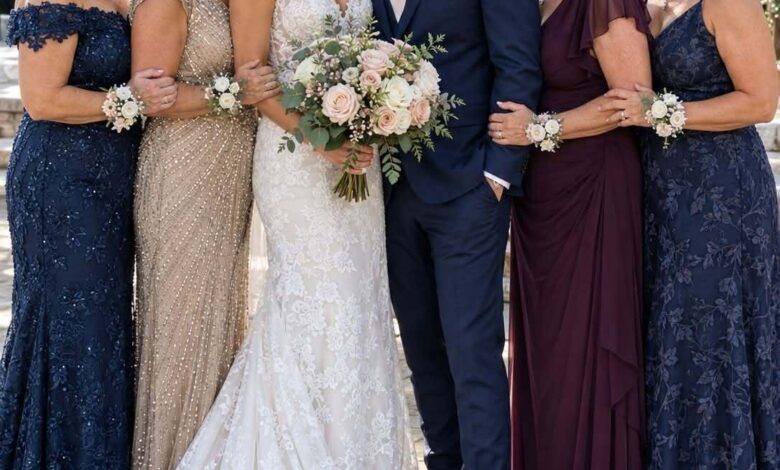
My Son’s Fiancée Asked Me Not to Wear Blue to Her Wedding—Then I Discovered Why
“I didn’t know, Mom. I really didn’t.”
He explained that he had been considering making a public announcement about ending the marriage before it even began. He felt embarrassed, confused, and deeply disappointed.
I asked him one important question.
“Do you love Vanessa?”
He took a long breath.
“Yes. But I don’t know whether I can trust her right now.”
I nodded.
“Then don’t make a permanent decision tonight. Speak with her tomorrow. Ask her to explain everything. Listen carefully, and then decide what you want. But remember that love should never require either person to disappear.”
Grant looked at me for a long time.
Then he hugged me.
When we returned to the ballroom, he approached the microphone again.
“I want to say something,” he announced.
The guests became quiet.
“I love my wife, and I am grateful that everyone came to celebrate with us. But there is someone here who deserves recognition tonight.”
He looked directly at me.
“My mother raised me, supported me, and taught me how to care about other people. I haven’t always been good at showing her how important she is to me. But I want everyone to know that she is part of my family, and nothing should make her feel otherwise.”
He smiled and began singing a few lines of You Are My Sunshine, the song I had sung to him when he was little.
Several guests joined in.
I covered my mouth, trying not to cry.
Then Grant walked toward me and held out his hand.
“Mom, would you dance with me?”
I accepted.
For the first time that evening, I felt that my son was making a decision because he wanted to, not because someone else expected it.
As we danced, Vanessa approached us.
“Joan, could I speak with you?”
Grant stepped back slightly.
Vanessa looked genuinely uncomfortable.
“I owe you an apology. I shouldn’t have asked you to change your dress. And I shouldn’t have interfered with your calls.”
She admitted that Margot had repeatedly told her I was too involved in Grant’s life. Over time, Vanessa had started believing that keeping me at a distance would make their marriage easier.
She also admitted that she had blocked my number and deleted messages because she didn’t want Grant questioning her decisions.
“I thought I was protecting our relationship,” she said quietly. “But I understand now that I was damaging it.”
Margot had been listening nearby.
After a long pause, she approached us.
“I need to tell you something too,” she said.
She explained that her own mother-in-law had excluded her from family traditions many years earlier. At an important family celebration, Margot had been asked to wear pink while the other women wore blue.
She had carried the memory for thirty-seven years.
When Vanessa became engaged, Margot promised herself that her daughter would never experience the same disappointment.
But somewhere along the way, she had repeated the very behavior that had hurt her.
“I wanted to protect my daughter,” she said, “but I forgot that you are also someone’s mother.”
I looked at her.
“Margot, what color do you actually like?”
She seemed surprised by the question.
“Green,” she answered.
I smiled.
“Then perhaps you should wear green more often.”
Vanessa removed the corsage from her mother’s wrist. She looked at me, then gently pinned it beside the flower on my dress.
“You’re family, Joan,” she said.
This time, I believed she was beginning to understand what those words meant.
The wedding did not magically solve every problem. The following morning, Grant and Vanessa sat down together and had the conversation they should have had before their ceremony.
They discussed the blocked number, the deleted messages, the canceled honeymoon, and the decisions that had been made without Grant’s agreement.
Vanessa accepted responsibility for her actions. She also admitted that she had spent much of her life following her mother’s expectations and had never learned how to establish healthy boundaries.
Grant explained that he needed honesty and respect if their marriage was going to work.
They agreed to begin couples counseling and individual therapy.
A few months later, they moved out of Margot’s house and into a small bungalow in Clintonville. It wasn’t a large property, but they loved having a place where they could make their own decisions.
Grant changed his phone passcode, and our Sunday calls returned.
Every Sunday at five, my phone rang.
Sometimes Grant called alone. Other times, Vanessa joined the conversation. She even began asking me for recipes.
One afternoon, she told me my pot roast needed more salt.
I laughed.
“Well, sweetheart, next time you’re welcome to make it yourself.”
She laughed too.
It was a small exchange, but it meant something. We were finally speaking honestly instead of pretending that everything was perfect.
Months later, Margot called me.
She apologized again and told me she had spent years carrying resentment toward her late mother-in-law.
I listened without interrupting.
Then I told her something I had learned during my own marriage.
“We cannot change how people treated us in the past, but we can decide whether we want to repeat those same choices.”
She agreed.
On Grant and Vanessa’s first wedding anniversary, they decided to renew their vows in their backyard.
This time, Vanessa personally asked me to wear blue.
I went into my closet and found the navy dress I had returned before their original wedding. I had purchased it again after discovering that the store still had my size.
I wore it proudly.
Margot arrived in an elegant emerald-green outfit. Vanessa wore a beautiful cream dress, and Grant looked relaxed and happy beside her.
When the photographer asked everyone to gather, nobody was separated into different groups.
We stood together.
Everyone wore the colors they had chosen for themselves.
The photograph now hangs in my yellow kitchen. Whenever I look at it, I remember that wedding and everything it taught us.
I also remember the woman I used to be: someone who believed that keeping quiet was the same as keeping peace.
I still believe in kindness. I still believe in compromise. But I no longer believe that love requires someone to surrender their voice.
Grant is learning that lesson too.
Our family isn’t perfect, and we still have disagreements. The difference is that we now talk about them instead of allowing silence to create distance.
At fifty-nine, I have learned something I wish I had understood much earlier.
Being a loving mother does not mean accepting every decision without question. Being a loving partner does not mean giving up your own identity. And being part of a family should never depend on the color of a dress, the number of photographs you appear in, or how quietly you can sit in a room.
Sometimes, the most important thing a family can do is make room for everyone to be heard.
And sometimes, a yellow kitchen, a navy dress, and one honest conversation can become the beginning of something beautiful.