My sister said I was charging family for dirt so on the morning of her wedding I left Grandpas name in the hay behind her altar
Four in the Morning
It was four in the morning when I started.
The stars were still out over the east ridge, hard and white, the way they get in Tennessee in June before the humidity rolls in. The field was black and silver. Every blade of grass held a drop of dew, and when I stepped off the gravel and into the hay, it soaked my jeans to the thigh before I’d taken ten steps.
June timothy. Gold at the tips. Up to my knee.
I could smell it. Sweet and green and a little like summer rain on hot pavement. That smell has been in my lungs since I was four years old.
I had the mower deck set low on the little Ford and crawling.
First gear. Barely above idle. The headlights threw two pale beams across the hay, and the sound of the engine was the only noise for a mile in any direction except the frogs down at the pond.
Behind me, the white arbor waited in the dark.
Two hundred folding chairs sat in wet rows on the mowed grass in front of it. Wooden chairs, white, rented. I’d helped set them up the night before, every one of them, while my sister stood on the porch with a clipboard and told me where they went.
Two big white tents stood at the edge of the field. Forty by sixty. Sides rolled up. Strings of lights waiting in the dark for somebody to plug them in.
By two o’clock that afternoon, my sister would marry Scott Hendricks right there. Under that arbor. With this field behind her.
My name is Laney Tidwell. I’m thirty-four years old.
I own eighty acres of hay ground outside Shelbyville, Tennessee. Timothy and orchardgrass on the bottom forty, fescue and clover on the hill. Two cuttings a year if the rain cooperates, three if God’s in a good mood.
I sell square bales to horse people from Nashville and round bales to the cattle men in Bedford County. I teach agriculture at Cascade High School to pay the bills that the hay won’t.
I inherited the land fourteen months ago.
From my grandfather.
Part Two: Grandpa Earl
Earl Tidwell worked that ground for fifty-one years.
He bought it in 1972 with money he’d saved from driving a milk truck. It was worn out then. Grown up in sedge grass and blackberries. He cleared it by hand. He limed it and seeded it and fenced it. He built the barn himself, the one at the top of the lane, with oak he cut off the back of the property.
He loved that land the way some men love a woman. Quietly. Without making a fuss about it. He’d walk the fields every evening after supper with his hands in his pockets, just looking.
He raised me and Megan after our dad walked out.
I was nine. Megan was six. Dad had a job driving long-haul for a trucking company in Nashville. One day he drove a load to Texas and didn’t drive back.
Mama didn’t know what to do. She was twenty-nine with two little girls and a job at the Walmart deli counter. She couldn’t pay rent. She couldn’t pay day care.
So we moved in with her daddy.
Grandpa Earl had been a widower for three years by then. He lived alone in the farmhouse at the end of Tidwell Lane. Four bedrooms. A wraparound porch. A kitchen that hadn’t changed since 1975.
He gave Mama the downstairs bedroom. He gave me and Megan the two rooms upstairs. He moved himself into the little room off the kitchen that used to be a pantry.
He never once complained about it.
I followed him everywhere.
From the first week, I was out the door before breakfast. In the barn. In the fields. On the tractor seat beside him, holding on to the fender. He taught me to drive the little Ford when I was eleven. He taught me to rake hay at twelve. He taught me to run the baler at fourteen.
He taught me to read the sky. To know when the hay was dry enough to bale by twisting a handful and listening to it crackle. To set the mower deck high enough to leave something for the second cutting.
He taught me everything I know.
Megan never came to the field.
I used to think it was because she didn’t want to. That she thought farm work was beneath her. She liked clean clothes and painted nails and sleepovers in town. She liked the mall in Murfreesboro and the movie theater in Shelbyville.
She stayed in the house with Mama.
I didn’t think much about it. We were different. That’s all.
I was the one in the field with Grandpa. She was the one in the kitchen with Mama.
That was just how it was.
Part Three: The Will
Grandpa died last April.
He was eighty-seven. His heart. He’d been slowing down for a couple of years. He couldn’t run the baler anymore, so I ran it. He couldn’t climb up on the tractor, so I did that too. But he’d still sit in his lawn chair at the edge of the field every evening and watch me work.
One night in April, he didn’t come out to the field.
I found him in his chair on the porch. He’d been watching the sunset over the hay.
His will was simple. One page. He’d written it himself and had it notarized at the bank in Shelbyville.
He left the house to Mama. She’d lived in it for twenty-five years. It was hers.
He left me the eighty acres.
The lawyer read the reason out loud, because Grandpa had written it right there in the will.
I leave the land to Laney because she will keep it hay. She won’t sell it to the developers. She won’t put houses on it. She’ll keep it the way I kept it.
He left Megan his savings account.
Eleven thousand dollars. And his watch. A gold Hamilton he’d worn every day for sixty years.
Megan didn’t say anything at the lawyer’s office. She took the envelope with the bank papers. She took the watch. She thanked the lawyer.
She didn’t look at me.
On the drive home, Mama said, “Well, that’s fair. Earl always did love you two the same.”
Megan stared out the window.
I didn’t say anything.
I didn’t think it was about fair. I thought it was about who would take care of the land. Grandpa knew Megan didn’t want it. She’d never wanted it. She’d never once set foot in the hayfield.
At least, that’s what I thought.
Part Four: The Asking
Megan got engaged in October.
Scott Hendricks. He’s a pharmacist at the Walgreens in Murfreesboro. Quiet, polite, with glasses and a dry sense of humor. He coached middle school basketball on the side.
I liked him. Everybody did.
In November, Megan called me.
It was a Tuesday evening. I was grading papers at the kitchen table in my little house at the end of the lane. I’d moved out of the farmhouse when I was twenty-five and built a small place on the back corner of the property, overlooking the hay.
“Laney,” Megan said. “Can I ask you something?”
“Sure.”
There was a pause.
“Scott and I want to get married on the farm,” she said. “In June. In the hayfield. Behind the house.”
I said yes before she’d even finished asking.
I didn’t think about it. I didn’t need to. It was my sister. It was Grandpa’s land. It was a wedding.
“Of course,” I said. “Whatever you need.”
Megan was quiet for a moment.
“Really?” she said.
“Really,” I said. “Grandpa would’ve loved that.”
She didn’t say anything else. She just said thank you, quietly, and hung up.
I bush-hogged the clearing twice that spring. Once in April and once in late May. The flat area at the bottom of the slope behind the farmhouse, where the hay meets the yard.
I hauled off a dead cedar tree. I filled in a groundhog hole with a wheelbarrow of gravel. I mowed a path from the parking area down to where the arbor would go.
I gave up the whole first cutting on the bottom forty for her day.
That’s the part people don’t understand.
The first cutting is the best hay of the year. It’s what pays my bills. Timothy and orchardgrass, cut in early June at the boot stage, when the protein’s highest. The horse people in Franklin and Brentwood pay twelve dollars a square bale for first cutting timothy. Sometimes more.
The bottom forty usually makes about two thousand bales.
But the bottom forty is the field behind the farmhouse. The field where Megan wanted to get married.
If I cut it in early June, like I should, it’d be stubble and windrows on her wedding day. Bare dirt and drying hay. Not the picture she wanted.
So I left it standing.
All of it. Forty acres of timothy, gold at the tips, waving in the wind behind her altar.
I’d cut it the Monday after the wedding. It would be past its prime by then. Stemmy. Lower protein. I’d lose about half the value.
Eleven or twelve thousand dollars.
I never told Megan any of that.
I never asked her for a dime for the land. I never asked her to pay me for the hay. I never mentioned it at all.
Part Five: The Tents
The only real bill was the tents.
Megan wanted two big white tents. One for the reception and one for the food and the bar. In case of rain. In case of too much sun.
Bedford County Party Rentals in Shelbyville had them. Forty by sixty, white vinyl, with sidewalls and string lights. Delivered and set up the day before. Taken down the day after.
Fourteen hundred dollars.
In April, the rental company called me.
Because the wedding was on my property, they needed the landowner to sign the delivery agreement. They needed somebody to be responsible for the stakes and the damage.
“And who’s paying the invoice?” the woman asked.
“My sister,” I said. “I’ll have her call you.”
I called Megan that night.
“Hey,” I said. “Bedford Rentals called. They need the deposit for the tents. Can you and Scott cover that?”
There was a long pause.
“Since it’s at your place,” Megan said, “I figured that would be your part.”
I sat at my kitchen table.
I thought about the forty acres of first-cutting timothy I was leaving standing. The twelve thousand dollars I’d lose.
I thought about bush-hogging twice. Hauling off the cedar. Filling the groundhog hole.
I didn’t say any of that.
“The tents should be yours, Meg,” I said quietly. “Think about it.”
There was another long pause.
“Fine,” she said.
It was the kind of fine that isn’t fine. The kind our mother says when she’s about to stop speaking to you for three days.
Megan hung up.
Part Six: Dirt
Two days later, Mama called me.
I was in the barn, changing the oil in the little Ford. My hands were black to the wrist. I wiped one on a rag and answered.
“Laney,” Mama said. “Are you charging your sister to get married on the farm?”
I stopped wiping my hands.
“No, Mama,” I said. “I asked her to pay a rental company for two tents.”
“She called me crying,” Mama said. “Last night. For an hour.”
I didn’t say anything.
“She said you’re charging family,” Mama said.
She paused.
“She said you’re charging family for dirt.”
Dirt.
I sat down slow on the step of the barn.
The concrete was cold through my jeans. The barn swallows were going in and out of the hayloft door over my head. Out past the lane, I could see the bottom forty, green and tall, the first heads of timothy just starting to show.
Dirt.
That dirt fed us when Dad quit.
That dirt paid for my school clothes and Megan’s braces and the electric bill every month for twenty-five years. That dirt bought Megan’s prom dress. That dirt paid for her first car, a used Honda Civic Grandpa found on a lot in Lewisburg.
That dirt was fifty-one years of my grandfather’s hands.
I didn’t say anything for a long time.
“Maybe be the bigger person, Laney,” Mama said. “You’re the one who got it.”
You’re the one who got it.
There it was.
I didn’t yell.
I wanted to. Believe me. I wanted to tell Mama about the twelve thousand dollars in first-cutting hay. I wanted to tell her about the two days of bush-hogging and the dead cedar and the groundhog hole.
I wanted to ask her if Megan had told her about the eleven thousand dollars Grandpa left her. And the gold watch.
I didn’t.
“Okay, Mama,” I said. “I’ll take care of it.”
Part Seven: Decent and Doormat
I paid the fourteen hundred that night.
I called Bedford County Party Rentals and gave them my credit card number over the phone. The woman thanked me. She said the tents would be delivered the Friday before the wedding.
I hung up and sat at my kitchen table for a long time.
I wasn’t going to let two tents ruin her wedding. I couldn’t. It was my sister. My only sister.
When we were little, after Dad left, she used to crawl into my bed every night. For two years. She’d put her cold feet on my legs and whisper, Is Daddy coming back?
I’d tell her no. Then I’d tell her it was okay. Then I’d tell her stories until she fell asleep.
But I wasn’t going to swallow the whole thing either.
Not the word dirt. Not charging family. Not you’re the one who got it.
Grandpa Earl used to say something. When somebody tried to take advantage of him. A neighbor who wanted to borrow the baler and never brought it back. A cattle buyer who tried to short him on weight.
He’d stand there with his hands in his pockets and say, real quiet, “Decent is one thing. Doormat is another.”
Then he’d politely go get his baler back.
Decent is not the same as doormat.
I sat at my kitchen table and looked out the window at the bottom forty.
At the timothy standing tall. At the place by the farmhouse where the arbor would go.
And I thought about something.
The field had a voice.
You just had to cut it.
Part Eight: Four Letters
I knew where the photographer would stand. Megan had told me. She’d shown me the whole plan on her phone, back in February, before the tents.
The arbor at the bottom of the slope. The guests seated facing it. The photographer at the back, shooting down the aisle.
Behind the arbor, the bottom forty. Standing hay, rising up the hill toward the tree line. Gold and green.
It would be in every photo.
Two hundred phones, all pointed the same way.
I thought about it for a week.
I didn’t want to be mean. I want to be clear about that. I never once thought of a mean word. Not dirt. Not ungrateful. Not anything that would embarrass her in front of two hundred people.
I wasn’t trying to ruin her wedding.
I just wanted the field to say what I couldn’t.
Just the only word that belonged in that field.
Four letters.
Forty feet tall.
I measured it out in the evenings that week.
I walked the slope behind the arbor with a hundred-foot tape and a bundle of orange survey flags from the co-op. I figured out where the letters needed to sit so they’d read clean from the guest seating. Where the slope would tip them toward the crowd like a billboard.
I sketched it out on graph paper at my kitchen table. Grandpa used to do that when he laid out a new fence line. Graph paper and a carpenter’s pencil.
Forty feet tall. Twenty-five feet wide per letter. Eight feet between them. Two passes wide on the mower for each stroke.
I flagged the corners on Thursday evening, after the tents went up. Little orange flags hidden down in the hay, so nobody would see them.
On Friday night, at the rehearsal dinner, I ate fried chicken under the tent I’d paid for and smiled at my sister and didn’t say a word.
Part Nine: The Cutting
So I ran the knock-down pass with the little Ford first.
The same little Ford Grandpa taught me to drive when I was eleven. A 1968 Ford 3000. Blue and gray, with the paint worn off the fenders where his hands used to rest.
I’d hooked the old sickle mower to it. The narrow one. Five feet wide. It cut the hay down flat and laid it over in a neat swath.
I started at the bottom of the first letter. The long stroke.
Headlights on. First gear. The mower clattering. The hay falling over in a perfect line behind me, silver in the dark.
I went up the hill. I turned at the top flag. I came back down, overlapping the first pass by a foot.
Then the cross strokes.
Then the second letter.
I worked by the headlights and by the flags and by what I’d memorized off the graph paper. I didn’t need to check. I’d been mowing this field since I was twelve. I knew every dip in it.
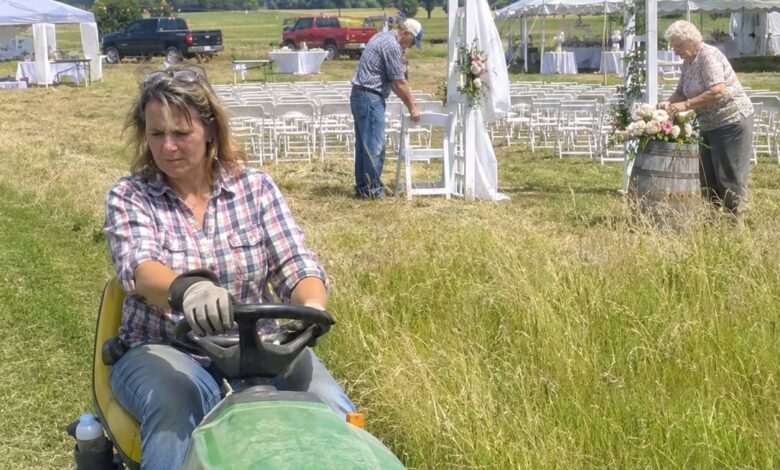
Then I unhooked the Ford and got on the green lawn tractor.
Grandpa’s old John Deere riding mower. The one he used on the yard. Forty-two-inch deck. I’d sharpened the blades on Thursday.
I used it for the clean edges.
Going back over every letter. Squaring the corners. Cutting the stubble down short and even, so the letters would show dark green against the gold of the standing hay.
I wore his old barn coat against the cold.
Brown canvas. Carhartt. Lined with blanket flannel that had worn thin at the elbows. It still hung on the nail by the barn door, where he’d left it the last time he wore it.
It still smelled like him. Diesel and hay and the peppermints he kept in the left pocket.
There were still two peppermints in there.
The wet hay clogged the chute every few feet.
I’d have to shut it off, climb down, and dig the wet grass out of the deck with my hands. Then climb back on and start again.
My fingers went green to the knuckle. My jeans were soaked to the waist. My boots squished.
I didn’t stop.
The sun came up over the east ridge at five-forty.
It came up slow and gold, the way it does in June. It spilled down the hill and across the bottom forty, and it caught the dew on every blade of hay and turned the whole field to fire.
It lit the first letter. Then the second.
The sun lit the E and the A.
I stopped the lawn tractor for a minute and just looked at them. Two letters, forty feet tall, cut clean and dark in the shining hay.
I thought about Grandpa on the porch in April. Watching the sunset over this field.
I started the tractor again.
By a quarter to eight, I was on the last letter.
I cut the long stroke and backed up.
Then I shut the mower off.
The silence came down over the field like a blanket. No engine. No clatter. Just the frogs at the pond and a mourning dove somewhere in the tree line and my own heart pounding.
I climbed down off the tractor.
I walked into the middle of the word.
I stood there for a long time.
In the cut grass, with the standing hay rising on all sides of me. In Grandpa’s barn coat, soaked through, with green fingers and two peppermints in the pocket.
I took one of the peppermints out. I unwrapped it. I put it in my mouth.
It tasted like being nine years old.
Part Ten: One O’Clock
The cars came down the road at one.
I was standing behind the second tent, where nobody could see me, in a navy dress I’d bought at Belk in Murfreesboro. I’d showered and scrubbed my hands for twenty minutes, but you could still see the green in the creases of my knuckles.
I’d hung Grandpa’s barn coat back on its nail in the barn.
They parked in the hay stubble along the lane. Fifty cars, then a hundred. Pickups and minivans and a few nice cars from Nashville. Scott’s people from Murfreesboro. Megan’s friends from the salon where she works in Shelbyville.
They came walking down from the parking strip in their nice clothes. Women in sundresses and sandals. Men in khakis and button-downs. Kids in clip-on ties.
They came down the mowed path I’d made from the lane to the clearing. Past the farmhouse. Past the big oak tree.
And then they came around the side of the house, where the slope opened up and you could see the whole field.
A woman in a blue dress stopped dead.
She was maybe sixty. Silver hair. A big hat with a flower on it. She’d been talking to her husband, and she stopped mid-sentence and stood there on the path.
She put her hand over her mouth.
Then the people behind her stopped.
Then the people behind them.
Then all of them turned.
A whole crowd. Two hundred people. Heads all turned in the same direction. Looking past the white arbor and the folding chairs.
Up the hill. Into the hay.
Phones started going up.
One, then ten, then fifty.
From the slope they came in on, the letters lined up and read clean. Just like I’d planned on the graph paper.
Forty feet tall. Cut dark green into the gold of the standing timothy. The sun was right overhead, and every letter was sharp as a stamp.
EARL
Part Eleven: The Guests
Nobody said anything for a long time.
Then I heard somebody near the front say it out loud. A man. Older. Maybe seventy. In a feed store cap and a pressed shirt.
“Earl,” he said. “That’s Earl Tidwell.”
It was Harlan Pruitt. He’d farmed the ground across the road from Grandpa for forty years. He and Grandpa had traded work every summer since 1973.
He took off his cap.
People started whispering.
Earl Tidwell.
Megan’s granddad.
He raised those girls.
Who did that?
It’s cut right into the hay.
I heard a little girl ask her mother, “Who’s Earl?”
Her mother bent down.
“That’s the man who used to own this farm,” she said. “He passed away last year. He was the bride’s grandpa.”
The little girl looked up at the field.
“Is he watching?” she asked.
Her mother didn’t answer right away.
“Maybe,” she said.
Scott was already standing at the arbor with the preacher and his groomsmen. He was looking up at the field too.
His face had gone very still.
He looked at the letters for a long time. Then he looked around at the crowd. Then he found me, standing behind the tent.
He didn’t say anything. He just nodded once.
My mother came out of the farmhouse.
She was wearing a pale yellow dress and a corsage. She’d been inside helping Megan get ready. She came out on the back porch to see if the guests were seated.
She saw the field.
She stopped on the porch steps.
She held on to the railing.
She didn’t look at the guests. She didn’t look at the arbor.
She looked at the letters for a long time.
Then she looked for me.
When she found me behind the tent, she didn’t say anything. She just stood on the porch with her hand over her heart and tears running down her face.
Part Twelve: Megan
Then Megan came around the house in her dress.
She was beautiful. I want to say that clearly. She was the most beautiful bride I’d ever seen.
Ivory lace. Long sleeves. A train that dragged in the grass. Her dark hair pinned up with little white flowers from Mama’s garden.
She was on Uncle Jeff’s arm.
Mama’s younger brother. Fifty-eight. A mechanic at the Ford dealership in Shelbyville. A big man with a gray beard and hands like shovels.
Because there was no dad to walk her.
She came around the corner of the house with her eyes down. Watching her feet. Watching the grass so she wouldn’t trip on her train.
She didn’t see the crowd. She didn’t see the phones.
She didn’t see the field.
Uncle Jeff saw it.
He stopped walking……………..CONTINUED ON NEXT PAGE ⬇️