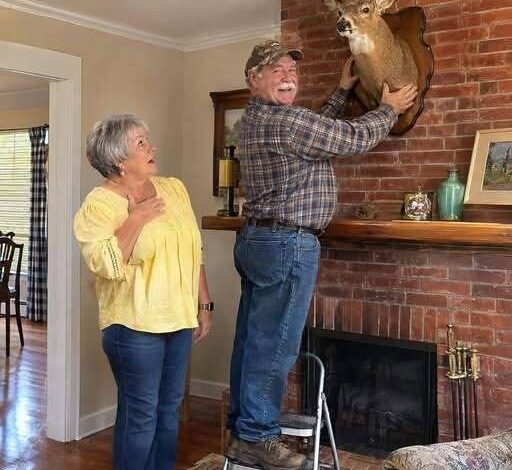
My new husband hung his daddy’s deer head over my fireplace and said, “Mama and Sis
“Maybe we should start over.”
“Start over how?”
“We can forget Sunday happened.”
I looked at him.
“Can you forget what you planned?”
He stared at me.
“I didn’t mean for it to go this far.”
“That’s not the same as saying you didn’t mean to do it.”
He stepped closer.
“Look, Mama’s upset. Patricia’s upset. Everybody is making me out to be some kind of villain.”
I almost felt sorry for him.
Almost.
“Lamont, you don’t need to worry about what everybody thinks. You need to worry about what you did.”
His face hardened.
“So that’s it?”
“That’s it.”
He threw the flowers onto the porch.
“You’re going to regret losing me.”
I looked down at the roses.
Then I looked back at him.
“Lamont, I spent thirty-one years working in a hospital laundry. I washed sheets, towels, blankets, and clothes for people who were sick and dying. I worked holidays. I worked weekends. I worked double shifts. I came home with aching hands and tired feet. I saved every dollar I could because I wanted a home of my own.”
I paused.
“This house wasn’t given to me. It wasn’t bought by a husband. It wasn’t inherited from somebody else. I earned it.”
His eyes dropped.
“And if you think I will hand it over because you put a ring on my finger, then you never understood the woman you married.”
I closed the door.
That evening, I put the roses in a vase.
Not because I wanted to remember Lamont.
Because I didn’t believe flowers deserved to die just because the man who brought them had disappointed me.
PART 5 – The Sunday Nobody Expected
A week passed.
Then another.
I heard from Miss Clementine regularly.
She called every Sunday afternoon.
Sometimes we talked about the weather.
Sometimes we talked about recipes.
Sometimes she told me stories about Lamont as a little boy.
She never defended his behavior.
But she never stopped loving her son either.
One afternoon, she said, “Dorinda, I hope you don’t think I raised him to be this way.”
I told her, “Miss Clementine, people become responsible for their own choices.”
She sighed.
“Your heart is bigger than mine.”
“No, ma’am. I just know what it’s like to make mistakes.”
Then she laughed.
“Well, if you ever make coconut cake, save me a slice.”
I promised I would.
Meanwhile, Patricia found a small apartment near her workplace.
She sent me a photograph of the living room after she moved in.
It was small, but it had sunlight and a little balcony.
I sent her a message.
I’m glad you found a place of your own.
She replied:
Thank you for not blaming me for everything my brother did.
I smiled.
Because that was the truth.
I had no reason to punish Patricia for Lamont’s decisions.
But I also had no obligation to solve her housing problems.
There was a difference.
One Saturday, Miss Clementine invited me to lunch.
I drove to her little house on the edge of town.
She had fried catfish, collard greens, cornbread, and sweet tea waiting.
After lunch, she brought out an old family photo album.
There were pictures of Lamont as a baby.
Lamont in school.
Lamont holding his first fishing rod.
Then she showed me a photograph of her late husband, Earl.
He stood beside an old pickup truck, smiling proudly.
“That man was the best thing that ever happened to me,” she said.
I studied the photograph.
“He looks like a good man.”
“He was. Not perfect, but good.”
She turned another page.
“One thing Earl always said was that a man’s character shows most clearly when he thinks nobody can tell him no.”
I looked at her.
She nodded.
“Lamont never learned that lesson.”
Then she reached into the album and removed a small photograph.
It was of Wardell and me.
I stared.
“Where did you get this?”
She smiled.
“You left it on my kitchen table the day we first met. I asked Patricia to make a copy because I wanted to remember your face.”
I held the picture.
Wardell had his arm around my shoulders.
I was laughing.
We looked so young.
Miss Clementine touched my hand.
“I know you loved that man.”
“I did.”
“Then don’t feel guilty about wanting happiness again. But don’t confuse being lonely with needing somebody.”
I felt tears sting my eyes.
She continued.
“You deserved love the first time. You deserve it now. And if it never comes again, you still have a life worth living.”
I hugged her.
And we sat together for a long time.
A month after Lamont moved out, I received a letter from his attorney.
He wanted to discuss the division of marital property.
My attorney handled everything.
There were no joint bank accounts.
No shared mortgage.
No jointly purchased property.
The house remained mine.
After reviewing the circumstances, we reached an agreement regarding the marriage. I would keep my property, and we would handle the separation according to the applicable legal requirements.
I didn’t fight for anything Lamont owned.
I didn’t want his truck.
I didn’t want his furniture.
I didn’t want his money.
I wanted my peace.
The divorce process took time, but eventually it was finalized.
On the day I received the final papers, I sat on my porch with a glass of lemonade.
Nedra came over carrying a pie.
“Well?”
I held up the envelope.
“It’s official.”
She smiled.
“You’re free.”
I looked at the house.
The white porch.
The rocking chairs.
The flowerpots.
The front door Wardell and I had painted together.
“Yes,” I whispered. “I am.”
That Sunday, I invited Miss Clementine and Patricia over for dinner.
This time, I made fried chicken.
I made coconut cake too.
Miss Clementine arrived wearing her blue Sunday dress.
Patricia brought a bouquet of flowers.
Nedra brought potato salad.
We ate at my dining table.
Nobody asked for my bedroom.
Nobody demanded my sewing room.
Nobody told me what to do with my furniture.
After dinner, Miss Clementine stood by the fireplace.
She looked at Wardell’s wedding-ring quilt.
Then she looked at the photograph of Wardell.
“That’s a beautiful man,” she said.
“He was.”
She smiled.
“Then let’s leave him his place.”
I nodded.
We sat together until the sun went down.
And I realized something.
My house was no longer just a building I had paid off.
It was a place where people could visit without trying to own me.
A place where kindness didn’t come with a price.
A place where I could finally be myself.
PART 6 – The Last Thing Lamont Said
Six months later, I was watering my flowers when a familiar truck pulled into my driveway.
Lamont stepped out.
He looked older.
His shoulders seemed smaller, and the confident smile I’d once found charming was gone.
I stood on the porch.
“What do you need, Lamont?”
He took a breath.
“I wanted to apologize.”
I didn’t answer.
He continued.
“I know you probably don’t want to hear from me.”
“You’re right.”
He nodded.
“I’ve had a lot of time to think.”
“That’s good.”
He looked toward the living room window.
“Did you take Daddy’s deer head down?”
I almost laughed.
“Yes.”
He looked disappointed.
“I figured.”
He shifted his weight.
“Mama doesn’t talk to me the same way anymore.”
I looked at him.
“She still loves you.”
“I know. But she says I have to change.”
“She’s right.”
He stared at the ground.
“I lost a good woman.”
I folded my arms.
“You lost a woman who trusted you.”
He nodded.
“I know.”
Then he said something unexpected.
“I never thought you’d actually leave.”
I looked at him for a long moment.
“That’s because you thought my fear of being alone was stronger than my love for myself.”
He swallowed.
“I guess I did.”
I stepped down one stair.
“Lamont, I loved the man who brought me tomatoes. I loved the man who made me laugh. I loved the man who promised to take care of me.”
He looked up.
“But the man who hung his father’s deer head over my fireplace and told me he decided who lived in my house? That man wasn’t somebody I could spend the rest of my life with.”
He nodded slowly.
“I understand.”
“Do you?”
He looked toward the driveway.
“I think I’m beginning to.”
I softened a little.
“Then learn from it.”
He took a step back.
“I hope you’re happy, Dorinda.”
“I am.”
He nodded.
Then he climbed into his truck and drove away.
I watched until he disappeared.
I didn’t cry.
I didn’t feel angry.
I simply turned around and walked back into my house.
The deer head was gone.
The quilt was back.
Wardell’s photograph was on the mantel.
And the house was quiet.
But this time, the quiet didn’t feel lonely.
It felt like freedom.
PART 7 – The Welcome They Never Forgot
Almost a year after that Sunday, Miss Clementine called me early one morning.
“Dorinda, honey, are you busy?”
“Not especially. What’s wrong?”
“Nothing’s wrong. I was wondering whether you’d come over for lunch.”
“Of course.”
When I arrived, Patricia was there too.
She was wearing a pretty yellow blouse and looked happier than I’d seen her in months.
Miss Clementine had prepared a large meal.
There was roast chicken, mashed potatoes, green beans, biscuits, and a coconut cake sitting in the middle of the table.
I laughed.
“Now, Miss Clementine, I thought I was supposed to bring the cake.”
She winked.
“Today, I wanted to surprise you.”
After lunch, she asked me to sit beside her.
“I have something to tell you.”
I waited.
“Lamont has started attending counseling.”
I raised my eyebrows.
“Really?”
“He says he wants to understand why he keeps pushing people away.”
I nodded.
“That’s good.”
“He also got a job.”
“That’s wonderful.”
“And he finally paid Patricia back some of the money he owed her.”
Patricia smiled.
“Not all of it, but he’s making payments.”
I felt genuinely happy for them.
Miss Clementine studied my face.
“You don’t miss him, do you?”
I thought about it.
I missed the beginning.
I missed the laughter.
I missed the tomatoes on my kitchen counter.
I missed the idea of having someone beside me in the evenings.
But I didn’t miss the man who believed marriage gave him authority over my life.
“No,” I answered. “I don’t miss what he became.”
She nodded.
“That’s a good answer.”
Then she reached for my hand.
“I want to thank you.”
“For what?”
“For not turning your hurt into hatred. You could have made Patricia feel unwelcome. You could have blamed me. But you didn’t.”
I smiled.
“Miss Clementine, you came to my house and told me the truth. That’s more than I can say for the man I married.”
She laughed.
“Well, I suppose we both learned something.”
Before I left, she handed me a small package.
Inside was a framed photograph.
It was a picture of the three of us sitting on my porch the Sunday Lamont’s truck arrived.
Nedra stood behind us, laughing.
Miss Clementine was holding a cup of coffee.
Patricia was smiling.
And I was sitting in my rocking chair.
On the back of the frame, Miss Clementine had written:
To Dorinda, who taught us that a home is not something a person takes. It is something people are invited into.
I held that photograph against my chest.
And I cried.
Not because I was sad.
Because sometimes the family you choose turns out to be kinder than the family you were promised.
FINAL ENDING – A House Full of Peace
Today, I’m sixty-eight years old.
I still live in the same little white house in Madison, Georgia.
My mortgage is paid.
My flowerpots are full.
My sewing room is exactly where I left it.
And Wardell’s wedding-ring quilt still hangs above my fireplace.
Every morning, I make coffee and sit by the front window.
Sometimes Nedra comes over.
Sometimes Patricia visits.
Miss Clementine calls me every Sunday.
She has become one of my closest friends.
Last Christmas, we had dinner together at my house.
There were presents under the tree, laughter in the kitchen, and enough food to feed the entire neighborhood.
At one point, Miss Clementine looked toward my fireplace.
“Do you remember that deer head?”
I laughed so hard I nearly spilled my tea.
“How could I forget?”
She shook her head.
“That was the ugliest thing I’ve ever seen.”
Patricia started laughing.
“Honestly, Mama, I thought it looked like it was judging everybody.”
We laughed until our stomachs hurt.
Then Miss Clementine became quiet.
“You know, Dorinda, I think that Sunday was the best thing that could have happened.”
I looked at her.
“How do you figure?”
“Because you finally saw who Lamont was before you wasted another thirty years trying to make him happy.”
I thought about that for a moment.
She was right.
I had spent so many years believing that being a good wife meant being patient, accommodating, and willing to compromise.
And sometimes those things are important.
But there is a difference between compromise and surrender.
A marriage should be a partnership.
It should never be a competition over who gets to control the other person.
And love should never require someone to give up the life they worked so hard to build.
I looked around my living room.
The quilt.
The photographs.
The flowers.
The little wooden sign above the door.
Everything was exactly where I wanted it.
Then I remembered the first thing Lamont said when I told him no.
“A man decides who lives in his house.”
I smiled.
Because he was wrong.
A person who owns a home gets to decide who is welcome inside.
But more importantly, nobody gets to decide that another human being is less deserving of respect simply because they’re older, widowed, or afraid of being alone.
I learned that at sixty-seven.
And I hope someone else learns it before they have to.
As for Lamont, I hear he’s doing better. He still visits his mother, works regularly, and is slowly rebuilding his relationship with Patricia. I genuinely hope he becomes the man he once pretended to be.
But I don’t wait for him.
I don’t wonder what might have happened if I’d kept quiet.
I don’t regret taking my wedding ring off.
Because the greatest mistake I could have made would have been staying in a marriage where my own home no longer felt like mine.
And every time I walk into my living room, I see Wardell’s photograph smiling back at me.
I remember the life we built.
I remember the work we did.
And I remember that I was perfectly capable of standing on my own long before Lamont came along.
One Sunday morning, exactly one year after that unforgettable visit, I was sitting on my porch when a little delivery truck pulled into my driveway.
The driver handed me a package.
There was no return address, only my name written carefully across the top.
Inside was a small wooden plaque.
It read:
A HOUSE IS MADE OF BRICKS AND WOOD. A HOME IS MADE OF RESPECT, LOVE, AND THE PEOPLE WHO NEVER ASK YOU TO GIVE UP YOURSELF.
There was a little note underneath.
It was from Miss Clementine.
Dear Dorinda, thank you for showing my son that a good woman is not someone who lets a man walk all over her. She is someone who knows her worth, even when the person standing beside her forgets it. I hope your home is always full of peace. With love, Clementine.
I carried the plaque inside.
I hung it above the fireplace, right where the deer head had once been.
Then I stepped back and smiled.
That evening, Nedra came over with two slices of pie.
She looked at the new plaque.
“Now that’s a whole lot prettier than that dead animal.”
I burst out laughing.
And for the first time in a long time, I laughed without worrying about whether someone else approved.
My house was mine.
My life was mine.
My future was mine.
And if anyone ever asked me what happened the Sunday my new husband’s mother arrived to move into my paid-off house, I’d tell them this:
His mother stepped out of that pickup, looked at my front porch, and said, “Honey, I hope you haven’t prepared a bedroom for me, because I came to help you get rid of the man who thinks he owns it.”
And she did.
Not by taking my house.
Not by giving me money.
Not by fighting my battles for me.
She simply told the truth.
And sometimes, the truth is the greatest welcome a person can receive.