My Mom Never Got to See Me Get Married but When Her Army Friend Appeared at My Wedding She Revealed a Promise From Years Ago
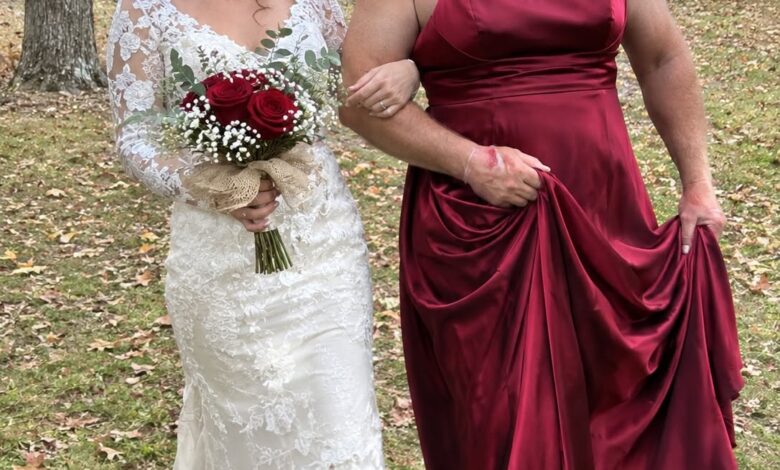
Then he put my hand in Nate’s.
“Take care of her,” he said quietly. “She’s the bravest girl I know. She gets it from her mom.”
Nate nodded. He couldn’t speak.
Daniel turned and walked to the front pew on the left side of the church, the bride’s side. He sat down in the very first seat, on the aisle. Front row.
And for the whole ceremony, every time I glanced over, there he was. A flash of bright red in the front row, where I couldn’t miss it.
The reception went until ten o’clock. There was dancing under the white tent in the church garden, and a barbecue buffet from a smokehouse in Phenix City, and a cake with peach filling that Nate’s mother made from scratch. Daniel danced with me to “Coal Miner’s Daughter,” my mother’s favorite song, in his red dress, while the whole tent clapped along.
Daniel came over and sat down beside me.
He’d changed out of the red dress into jeans and a button-down shirt. He looked tired, and older than I’d ever seen him. He was holding something in his hands.
He cleared his throat.
“Sweetheart,” he said. “I have something for you.”
He held it out. An envelope. Old and slightly crumpled, yellowed at the edges, the flap sealed with a piece of tape that had gone brittle with age. On the front, in faded blue ink, in handwriting I’d know anywhere, the loopy, slanted, hurried handwriting from every lunchbox note of my childhood:
For Mia. On her wedding day.
I couldn’t breathe.
“Where did you…” I started.
“She gave it to me,” Daniel said quietly. “In Kandahar. Two days before she died.”
He looked down at the envelope in my hands.
“She made me promise,” he said. “She said, Danny, if anything happens to me, you give this to my girl on her wedding day. Not before. Not one day before. Promise me. ” He swallowed. “So I promised.”
“Thirteen years?” I whispered. “You’ve had this for thirteen years?”
“I almost gave it to you a hundred times,” he said. “When you graduated high school. When Grandma Pearl died. When you were so sad that night on the back porch.” He shook his head. “But I promised her. Not one day before.”
Then he said something that made my hands start to shake.
“There’s something she kept from you, Mia,” he said. “Your whole life. Something she wanted you to know. But only when you were ready to start your own family.”
My hands were shaking so hard I could barely get the tape loose. Daniel didn’t help. He just sat beside me under the string lights and waited.
Inside the envelope were two things.
The first was a letter. Four pages of thin, lined paper torn from a spiral notebook, folded in thirds, covered in my mother’s loopy handwriting.
The second was a small, square piece of paper, much older than the letter. Soft and creased, like it had been folded and unfolded a thousand times. A scrap of yellow legal pad, with a few words written in pencil in handwriting I didn’t recognize.
I unfolded the letter first.
My darling Mia-bird,
If you’re reading this, it’s your wedding day, and I’m not there.
I’m so sorry, baby. I’m sorry I broke my promise. I wanted to be in the front row in a red dress more than I have ever wanted anything. If you’re reading this, it means I couldn’t keep that promise. But I made Danny promise to give you this, and Danny always keeps his promises.
I need to tell you something now. Something I should have told you a long time ago. I was going to tell you when you turned eighteen. Then I thought maybe when you graduated college. Then I got deployed, and I sat on my bunk in Kandahar thinking, what if I never get the chance?
So here it is.
I didn’t give birth to you, Mia.
The world went very still around me. The string lights. The stacked chairs. The caterers. Nate’s voice laughing somewhere out by the trucks. All of it went quiet, like someone had pressed pause.
I read the line again. I didn’t give birth to you.
Then I kept reading.
Twenty-six years ago, on a cold night in February, I was working a night shift at Fire Station 4 on Victory Drive. I was twenty-four years old. I’d been an EMT for two years.
At 3:40 in the morning, somebody rang the bell at the side door of the station. When I opened it, nobody was there. Just a laundry basket on the step. Inside the basket, wrapped in a pink towel and an old flannel shirt, was a newborn baby girl.
You, Mia. You were maybe three hours old. Your cord was tied off with dental floss. You were cold and hungry and so tiny, and you were crying so loud.
Georgia has a Safe Haven law. A mother who can’t care for her baby can leave it at a fire station or a hospital, no questions asked, and the baby will be safe. Somebody loved you enough to bring you to us.
I picked you up out of that basket, and you stopped crying. You looked right up at me with these big, serious gray eyes. And I swear to you, baby, my whole life changed in that second.
Tucked into the flannel shirt was a note. I’ve kept it all these years. It’s in this envelope. It’s the most precious thing I own, besides you.
I set down the letter. I picked up the small square of yellow legal paper with the trembling handwriting in pencil. I unfolded it carefully.
Please love her. I can’t take care of her. I’m only 16 and I’m so scared. Her name is Mia. Please keep her name. Please tell her I’m sorry.
I couldn’t see anymore. My eyes were too full.
Daniel put his hand on my back. He didn’t say anything.
After a while, I picked up the letter again.
The state took custody of you, the way they’re supposed to. They put you in a foster home while they searched for your birth mother. I couldn’t stop thinking about you. I called the caseworker every day. Every single day for two weeks, until she finally told me, Kate, if you care this much, why don’t you become a foster parent?
So I did. I took the classes. I passed the home study in that little yellow duplex with the Beast rattling in the window. I was twenty-four and single and I made twenty-six thousand dollars a year. Everybody told me I was crazy. Your Grandma Pearl told me I was crazy. Then she met you, and she cried for an hour and went out and bought a crib.
You came home with me when you were five weeks old. Nobody ever came forward. Nobody ever looked for you. When you were fourteen months old, a judge at the Muscogee County Courthouse made me your mother forever.
I kept your name. Mia. Because the girl who left you asked me to. And because it was the only thing she had to give you, and I wanted you to have it.
I never told you because I was afraid. Afraid you’d feel like you didn’t belong. Afraid you’d feel like somebody threw you away. Afraid you’d go looking for her and find a stranger, and feel like a stranger to me.
But here’s what I want you to know, Mia. Read this part twice.
Nobody threw you away. A scared sixteen-year-old girl wrapped you in her own flannel shirt and walked to a fire station in the middle of a February night and rang the bell, because she wanted you to live. She gave you the best thing she had. She gave you a chance.
And then I got to be the one who opened the door.
I didn’t give birth to you, baby. But I chose you. Every single day for twelve years, I chose you. And if I’m gone, I’m still choosing you, wherever I am.
There was one more page. The last one. The handwriting was messier, like she’d written it fast.
Danny’s sitting across from me right now, eating a MRE and complaining about the chili. He knows all of this. I told him last week, on a bad night, and he cried like a baby. Don’t tell him I said that.
I asked him to do something for me, Mia. If anything happens. I asked him to keep looking.
I tried to find her, your first mother. For years. I wanted to tell her that you were safe and loved and smart and stubborn and that you have her gray eyes. I wanted her to know she didn’t have to be sorry. I never found her. But I have a feeling Danny might.
If he does, it’s your choice whether to meet her. Not his. Not mine. Yours. You don’t owe her anything, and you don’t owe me anything. You just get to choose. The way I got to choose you.
And baby, one more thing.
I’m sorry I’m not in the front row. I’m sorry about the red dress. I really was going to wear it. I bought it already. It’s in a garment bag in the back of my closet at the duplex. Bright red. Size 6. I was going to look ridiculous.
Wear it someday, Mia-bird. Not to your own wedding. To someone else’s. Somebody you love. So they’ll spot you right away.
I love you more than all the stars over Kandahar. And there are a LOT of stars over Kandahar.
Mom
I folded the letter. I held it against my chest, along with the square of yellow legal paper. I sat under the string lights in my wedding dress, barefoot, and I cried harder than I’d cried since the day two soldiers knocked on Grandma Pearl’s door.
Daniel put his arms around me and held on.
When I could talk again, I asked him.
“The red dress,” I said. “The one you wore today. Was that…”
Daniel nodded. “It was hers,” he said quietly. “Size 6. I found it when I cleaned out Grandma Pearl’s house. She’d moved your mom’s things into the back bedroom closet after the funeral. The garment bag was still there. The tags were still on it.”
He looked down at his hands.
“I had to let out every single seam to get it on,” he said. “A seamstress in Midtown did it for me. She didn’t ask why.” He almost laughed. “I think she thought I was in a play.”
“And the other thing,” I said. “She asked you to keep looking. For my first mother.”
Daniel was quiet for a long time.
“Mia,” he said finally. “I found her. Four years ago.”
I stared at him.
“When Grandma Pearl died,” he said. “When I cleaned out her house. I found your mom’s file. The Safe Haven paperwork, the foster care records, everything. She’d kept it all in a box in her closet.” He swallowed. “I did one of those DNA tests. I sent in a sample from your hairbrush. I’m sorry. I know that’s a violation of something.”
“Daniel.”
“I know,” he said. “I’m sorry. But your mom asked me to keep looking. And I’d promised her.”
“Her name is Teresa Oduya,” he said. “She’s forty-two. She lives in Macon. She’s a pediatric nurse at Navicent Health. She has two sons, eleven and fourteen. She’s married to a high school chemistry teacher.”
“I didn’t contact her,” Daniel said quickly. “I swear. I found her name, and her address, and I wrote it all down, and I put it in a sealed envelope, and I waited. Because your mom said it had to be your choice. Not mine.”
He reached into his shirt pocket. He took out a second envelope. Newer. White. Sealed. With MIA — WHEN YOU’RE READY written across the front in his blocky engineer’s handwriting.
“It’s here,” he said. “Whenever you want it. Tomorrow. Or next year. Or never.” He put it in my lap, on top of my mother’s letter. “Your call, Mia-bird.”
I didn’t open Daniel’s envelope for six months.
I needed time. I needed to sit with the letter. With I didn’t give birth to you and I chose you and please tell her I’m sorry. I needed to talk to Nate, who held me every night for a month while I cried. I needed to drive out to Fort Benning’s main post cemetery and sit in the grass beside my mother’s white marble headstone, where I’d been coming every Sunday for thirteen years, and tell her I knew.
“You should have told me,” I said to the headstone. “I would have loved you exactly the same.”
The wind moved in the oak trees. A mockingbird sang from a fence post.
“I know you know that now,” I said.
In November, I opened the envelope.
I wrote Teresa Oduya a letter. It took me eleven drafts. I told her my name was Mia. I told her a woman named Kate Reynolds had opened the side door of a fire station on Victory Drive at 3:40 in the morning twenty-six years ago and found me in a laundry basket. I told her about the note in the flannel shirt.
You asked her to tell me you were sorry, I wrote. She did. In a letter she left me before she died. And I want you to know that you don’t have to be sorry. I had a wonderful life. I was loved every single day. You gave me that, by ringing that bell.
I included my phone number. I mailed it on a Tuesday.
She called on Friday night.
I was in the kitchen of Grandma Pearl’s old brick house, making biscuits from Grandma’s recipe card, when my phone rang with a Macon area code. I almost didn’t answer.
There was nothing on the line at first but breathing. Then a woman’s voice, shaking so hard I could barely understand her.
“Is this Mia?”
“Yes,” I said.
There was a long silence. Then she started to cry.
“I’ve been praying for you,” she said, “every single night for twenty-six years.”
We met at a Waffle House off Interstate 75 in Macon, halfway between her house and mine, on a Saturday morning in December.
She was already there when Nate and I walked in, sitting in a booth by the window with a cup of coffee she hadn’t touched. A tall, slender woman in a navy blue cardigan, with dark brown skin and close-cropped graying hair. She stood up when she saw me.
She had my eyes. Big and gray and serious. The eyes my mother said looked up at her from a laundry basket.
We didn’t hug at first. We just stood there in the middle of the Waffle House, looking at each other. Then Teresa put her hand over her mouth.
“Your eyes,” she whispered. “You have my mother’s eyes.”
We talked for four hours. Nate sat at the counter and drank coffee and pretended to watch a college football game on the TV over the grill.
Teresa told me everything. She’d been sixteen and a sophomore at Spencer High School in Columbus. Her parents were strict and religious, and she was terrified. She’d hidden the pregnancy for nine months under baggy sweatshirts. She gave birth alone, at two in the morning, on the bathroom floor of her parents’ house while they slept down the hall. Then she wrapped me in a pink towel and her father’s old flannel shirt, put me in the laundry basket, and walked eleven blocks in the dark to Fire Station 4 on Victory Drive.
“I rang the bell,” she said, “and I hid behind a car across the street. I watched the door open. I watched a woman with a red ponytail pick you up.” She wiped her eyes. “You stopped crying. I saw you stop crying. And I thought, Okay. She’ll be okay now. And I walked home.”
She never told anyone. Not her parents, not her husband, not her sons. She went to nursing school. She became a pediatric nurse because, she said, she wanted to spend her life taking care of babies, since she couldn’t take care of hers.
“Every February,” she said, “on your birthday, I go to a fire station. A different one every year. In Macon, Atlanta, Savannah. And I leave a box of donuts on the step and ring the bell. And I walk away.”
Before we left the Waffle House, I took out my phone. I showed her a photograph.
It was the one Grandma Pearl took when I was eight, at the yellow duplex on the dead-end street, on the Fourth of July. My mother and me on the front steps in matching red, white, and blue T-shirts, eating Popsicles, laughing at something off-camera. Mom’s rust-red ponytail. Her freckles. Her ridiculous, wonderful smile.
Teresa looked at it for a long time.
“That’s her,” she whispered. “The woman with the red ponytail. Who opened the door.”
“That’s her,” I said. “Kate Reynolds. My mom.”
Teresa touched the screen with one finger, very gently, right on my mother’s face.
“Thank you,” she whispered to the photograph. “Thank you for opening the door.”
Daniel got married the following October.
His name is Marcus. He’s a physical therapist at the VA hospital in Tuskegee, where Daniel went for treatment on his leg six years ago. They met in the rehab gym. Marcus told him his gait was terrible and he’d better come back three times a week. Daniel came back five.
They were together six years before Daniel asked. He told me later he’d been afraid. Afraid of being happy. Afraid it wasn’t fair that he got a whole life when my mother didn’t.
“That’s exactly what she’d want you to have,” I told him. “A whole life. She knelt in the dirt for twenty-two minutes so you could have one.”
He proposed the next week.
The wedding was at a little lakeside venue outside of Auburn, Alabama, on a warm Saturday afternoon in October, with the leaves just starting to turn. Eighty guests. Marcus’s huge family from Montgomery. Daniel’s coworkers from the Department of Transportation. A dozen veterans from his old unit, gray-haired now, some of them in wheelchairs, some with prosthetic legs.
Nate and I drove over from Columbus. We sat in the front row on the groom’s side.
I wore my mother’s red dress.
I’d had it altered back to its original size by the same seamstress in Midtown who’d let out every seam for Daniel. Bright fire-engine red. Knee-length. Short sleeves, a full skirt. Size 6. It fit me perfectly. My mother and I were the same size. I never knew that.
When Daniel came down the aisle on Marcus’s arm, he saw me in the front row.
He stopped walking. Right in the middle of the aisle.
He looked at me in my mother’s red dress. Marcus looked at him, confused, then followed his eyes and saw me, and understood. I’d told him the whole story the night before at the rehearsal dinner.
Daniel’s face crumpled. He put his hand over his mouth.
I lifted my hand and waved. Like a crazy woman. Front row.
Daniel laughed. Through his tears, standing in the middle of the aisle at his own wedding, he laughed out loud. The same laugh I used to hear in the background of my mother’s phone calls from Kandahar, crackling over seven thousand miles of satellite.
“Hi, Mia! Your mom is the bossiest woman in Afghanistan!”
“I spotted you right away,” he whispered as he passed me.
“That was the whole point,” I whispered back.
It’s February now. Three years since my wedding. I’m thirty years old.
Last night, on my birthday, Nate and I drove to Fire Station 4 on Victory Drive with a box of donuts.
My mother’s photograph is still on the wall inside, by the side door, in her EMT uniform with her rust-red ponytail. Kathleen Reynolds. EMT. Army Medic. Bronze Star. Gave everything. Captain Haskins retired last year, but the new captain knows the story. Everybody at Station 4 knows the story now.
Teresa drove over from Macon to meet us. She brought her sons. Jordan is fourteen now, and Elijah is seventeen. They’re my half-brothers. They call me Mia, and I call them pests, and Elijah asked me to teach him to make Grandma Pearl’s biscuits.
Daniel and Marcus drove over from Auburn.
The seven of us stood together on the cold sidewalk in the dark at 3:40 in the morning, the hour when my mother opened the door twenty-nine years ago. Teresa held the box of donuts. Her hands were shaking.
“Do you want to ring it?” she asked me. “The bell?”
I looked at the side door of Fire Station 4. A plain steel door with a small window and a white button beside it, under a sign that said SAFE HAVEN — NO QUESTIONS ASKED.
I thought about a sixteen-year-old girl standing on this same step in the dark, holding a laundry basket. I thought about a twenty-four-year-old woman with a rust-red ponytail opening the door. I thought about a young soldier lying in the dirt in Kandahar, listening to Patsy Cline while a medic held his life in her hands. I thought about a man in a red dress walking me down the aisle.
I thought about all the people who’d chosen me. Again and again, every single day.
“No,” I said. “You ring it. You’ve been ringing it every year for twenty-nine years. Tonight, I want to be the one who opens the door.”
Teresa set the box of donuts on the step. She pressed the button.
The bell rang inside the station, loud and clear in the cold February night.
Then I stepped up beside her and pulled open the steel door myself, the way my mother did twenty-nine years ago, and looked down at what was waiting on the step.
A box of donuts. My first mother’s hand in mine. My brothers, my husband, the uncle who wore a red dress to my wedding.
My whole family, every one of them chosen, standing on the step at 3:40 in the morning, waiting for somebody to let them in.