My Husband Disappeared After Our Wedding—Then a Letter Arrived 56 Years Later
The deliveryman had already turned toward his van when I called after him.
“Excuse me. Are you sure these are for me?”
He checked the name on his clipboard and smiled.
“Mary?”
“Yes. That’s me.”
“Then they’re yours, ma’am.”
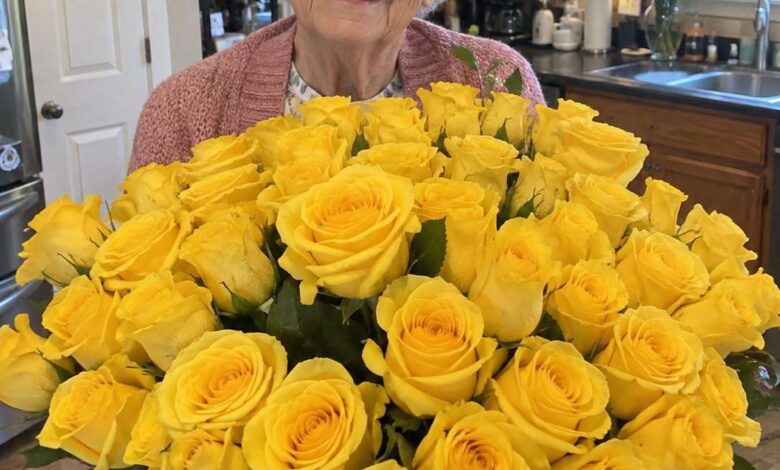
He handed me an enormous bouquet of yellow roses. There were so many that I could barely see over them. Their sweet fragrance filled the cool morning air as I carried them inside.
I placed the flowers on my kitchen table and counted them.
Once.
Then again.
Fifty-six.
My hands became still.
Today would have been my fifty-sixth wedding anniversary.
I had lived alone for many years. Nobody sent me flowers anymore, and I had never been the sort of woman who bought them for herself. Fifty-six roses could not possibly be an accident.
I found the large crystal vase that had been given to me as a wedding present and began arranging the flowers. As I separated the stems, something unusual caught my attention.
It was a small paper rose.
It was badly folded, with uneven petals and a crooked stem held together by an old strip of tape. I almost smiled at how imperfect it was.
Then I turned it over.
Near the bottom was a single faded letter.
J.
James.
My husband.
The man I had lost fifty-six years earlier.
I sat down and held the little paper flower carefully in my hands.
James and I had been married when we were very young. Our wedding was a simple afternoon celebration in my parents’ backyard. There were only a few dozen guests, homemade food, borrowed chairs, and a cake that leaned slightly to one side.
James loved that cake.
He loved everything about that day.
We had only a short time together before he had to leave again. Like many young couples, we spent those days talking about the future.
We imagined a small house, children, a dog, and a porch where we could sit together when we were old.
We thought we had decades ahead of us.
Before James left, he made me a promise.
“Next anniversary,” he said, “I’m going to bring you the biggest bouquet of yellow roses I can find.”
I laughed and told him I had married him for the flowers.
He laughed too.
It was one of the memories I carried with me for the rest of my life.
Soon afterward, James was reported missing while serving overseas. The information I received was limited, and eventually he was officially presumed to have died.
There was no proper goodbye.
There was no grave for me to visit.
There was simply an empty space where my husband had once been.
I never remarried.
People encouraged me to move forward, and eventually I built a quiet life of my own. I worked for many years, bought a small home, tended a garden, and watched nieces, nephews, and younger generations grow up.
But a part of me always remained with James.
I kept his photograph.
I kept my wedding dress.
And I kept the yellow dress I had worn when he left.
I rarely opened the box where it was stored.
That morning, however, something told me to look.
Inside the box was the faded yellow dress, carefully folded after all those years.
As I touched the fabric, I remembered something.
There were three crooked stitches along the side.
James had sewn them himself.
He had never been particularly good at sewing, and his attempt had been so uneven that we had laughed about it together.
I looked again at the paper rose downstairs.
Crooked petals.
Uneven folds.
A stem held together by tape.
It suddenly made sense.
James had always been terrible at delicate things.
The paper rose had been made by him.
But how had it arrived in my bouquet?
Then I noticed a small envelope beneath the ribbon.
My name was written across it.
Mary.
Inside was a short message.
It explained that the sender had something important to tell me and asked me to bring the flowers and the yellow dress to the old train station.
The time was written clearly.
11:00.
I looked at the clock.
I had less than an hour.
My first thought was impossible.
Could James somehow have survived?
My second thought was more cautious.
Who could possibly know about my yellow dress after all these years?
I decided to go.
The old station had changed considerably over the decades. The trains no longer ran there, and the building had become a quiet community landmark.
I arrived carrying the roses and the folded dress.
At exactly eleven, an elderly man stood from a bench near the far wall.
For a moment, I didn’t recognize him.
Then he removed his cap.
“Mary.”
I knew that voice.
“Adrian?”
Adrian had served alongside James. He was one of the last people I remembered connecting to my husband’s story.
He was carrying an old military bag.
James’s name was written across it.
I immediately asked the question I had carried inside me for more than half a century.
“Where is James?”
Adrian looked down.
“He isn’t here, Mary.”
My heart sank.
I held up the letter.
“Then who wrote this?”
“I did,” he said.
I stared at him.
“You made me believe James had sent these flowers.”
“I needed you to come,” he explained. “And I was afraid you wouldn’t if I told you the truth immediately.”
I was hurt and confused.
“You could have called me.”
“I know.”
“Then why didn’t you?”
Adrian looked toward the old tracks.
“Because I have carried something with me for a very long time.”
He opened the military bag.
Inside were several carefully preserved belongings that had once belonged to James.
Then he explained something I had never known.
James had survived the event in which he had disappeared. He and Adrian had spent some time together afterward, separated from their normal unit and eventually unable to return home.
James had remained hopeful for as long as he could.
And during that time, he made the little paper rose.
Adrian told me that James had spoken about me constantly.
He remembered the wedding.
He remembered the yellow dress.
And he remembered the promise he had made about yellow roses.
“He told me that if he couldn’t return home,” Adrian said, “I should make sure you knew that he had never forgotten you.”
I looked down at the little paper rose.
“Why didn’t you tell me?”
Adrian lowered his head.
“He asked me to protect you from the painful details at first. He believed it would be easier for you to think he had simply disappeared. Later, however, he changed his mind.”
I waited.
“What did he say?”
Adrian’s eyes filled with tears.
“He told me to tell you everything. He said you were stronger than he had realized. He wanted you to know that he had thought about you until the very end.”
I closed my eyes.
For decades, I had wondered whether James remembered me.
Now I had my answer.
He had.
Adrian then told me there was something else.
He knew where James had been laid to rest.
For more than fifty years, I had never known where to find him.
Adrian had known for years but had been too ashamed to tell me because he was afraid of reopening an old wound.
“You should have told me,” I said.
“I know.”
For once, there was nothing more to say.
I asked him to take me there.
We drove for several hours.
When we finally arrived, Adrian walked with me through the quiet grounds and showed me the place where James’s name was written.
I stood there for a long time.
After all those years, I finally had somewhere to bring flowers.
I placed the fifty-six yellow roses beside his name.
Then I took the small paper rose from my pocket.
“You were always terrible at crafts,” I whispered with a smile.
I could almost imagine his laugh.
I told him about the life I had built.
I told him about the garden.
The family.
The little house.
The years.
And finally, I told him the thing I had wanted to say for more than half a century.
“I never forgot you.”
The paper rose remained in my hand.
I could not leave it behind.
It was too precious.
On the journey home, Adrian apologized again.
“Do you hate me?” he asked.
I thought about it.
“I am angry with you,” I told him. “You kept something important from me for far too long.”
He nodded.
“But,” I continued, “you finally brought me the truth. And you brought me back to James.”
That was enough for that day.
When I arrived home, it was late.
I placed the crystal vase on the kitchen table.
The fifty-six roses had been left at James’s resting place.
Only the little paper rose remained.
I placed it carefully inside the enormous vase.
Beside it, I put our wedding photograph.
There we were, young and smiling, standing together in my parents’ backyard.
The tiny paper rose looked almost ridiculous inside the enormous vase.
But somehow, it looked perfect.
I touched one of its faded petals.
“You were late,” I whispered. “Fifty-six years late.”
I smiled through my tears.
“But you finally kept your promise.”
And for the first time in many years, the empty space in my heart didn’t feel quite so empty.
The flowers had finally arrived.