After 34 Years of Marriage My Husband Left Me to Keep Our 2 4 Million Lottery Win but He Overlooked One Detail
The Back of the Ticket
At 2:47 on a Friday afternoon in September, my cell phone rang.
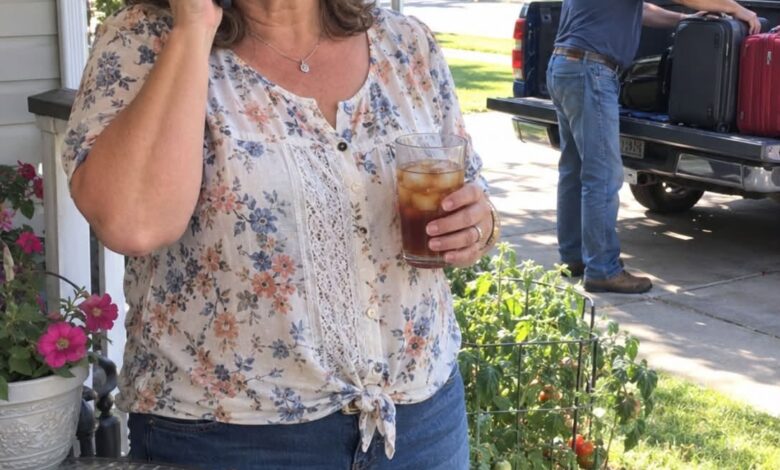
I was sitting on my front porch in Dalton, Georgia. In the white wicker rocker my mother left me. With a glass of iced tea sweating in my hand and my bare feet up on the railing.
I’d just watered the tomatoes. The Cherokee Purples were coming in late this year. Fat and dark and splitting at the tops the way they do when you water them too much after a dry spell.
The phone buzzed on the little table next to me.
A 404 number. Atlanta.
I let it ring twice.
Then I picked it up.
“Is this Patricia Dunn?”
A woman’s voice. Middle-aged. Careful. The voice of someone who’d been trained to say difficult things calmly.
“It is,” I said.
She cleared her throat.
“Mrs. Dunn,” she said. “My name is Linda Holloway. I’m with the Georgia Lottery Claims Center on Centennial Olympic Park Drive. Your husband is here. He’s trying to claim a winning ticket.”
“I thought he might be,” I said.
There was a pause.
A tense one.
I could hear something in the background. Muffled. A man’s voice. Loud. Getting louder.
“Ma’am,” Linda said. “We have a problem with the back of this ticket.”
I took a sip of my iced tea.
“It’s already been signed,” Linda said. “And the signature doesn’t match his ID.”
In the background, I could hear Gary.
Shouting.
That’s my wife’s handwriting! She signs everything! It’s a joint ticket! We’re married! Thirty-four years!
I smiled to myself.
I set my glass down on the table.
“No, Linda,” I said. “I don’t imagine it would.”
Because nineteen years ago, on the very first Friday I ever bought a lottery ticket, I made myself a promise.
And Gary was about to find out exactly what I’d been writing on the back of every single one.
But I need to go back.
To the pineapple magnet.
And to my mother.
My name is Patricia Ann Dunn. Everybody calls me Patty. I’m fifty-eight years old.
I’ve lived in Dalton, Georgia, my whole life. The carpet capital of the world. Ninety percent of the carpet in America is made within sixty-five miles of my front porch. My father worked at Shaw Industries for thirty-one years. My mother worked at Mohawk for twenty-six. Everybody’s daddy worked at a carpet mill.
I married Gary Dunn when I was twenty-four.
He was twenty-seven. A forklift driver at the Shaw plant on Industrial Boulevard. He had a red Chevy pickup and a mustache and he made me laugh at a church fish fry in 1990 by doing an impression of our pastor that was so good the pastor laughed too.
He asked me to marry him six months later. In the parking lot of the Dairy Queen on Walnut Avenue. With a ring from Kmart.
I said yes.
We had three children.
Robby. Born in 1992. He’s thirty-three now. A lineman for Georgia Power. Married. Two little girls.
Tessa. Born in 1995. Thirty now. A nurse at Hamilton Medical Center. Right here in Dalton. Single. A cat named Biscuit.
And Kyle. Born in 1999. Twenty-six. Our baby. He’s in the Army. Stationed at Fort Stewart, down by Savannah.
I raised them.
I want to be honest about that. Gary was there. Gary lived in the house. Gary went to some of the ballgames.
But I raised them.
I packed the lunches. I drove the carpools. I sat up with the fevers. I went to every parent-teacher conference at Westside Elementary and Dalton Middle and Dalton High. I signed every permission slip. I made every Halloween costume. I cried at every graduation.
Gary went to work. Came home. Ate dinner. Watched TV. Went to bed. Went fishing on Saturdays at Carters Lake. Went to the Moose Lodge on Thursday nights.
That was the deal.
I didn’t know it was a deal. I thought it was just how things were.
I worked too.
Part-time. When the kids were small. Full-time once Kyle started kindergarten.
At the front desk of the Walker County Health Department. Twenty-two years. Checking people in. Answering phones. Scheduling immunizations.
I made twenty-eight thousand dollars a year when I retired.
Gary made more. He got promoted. Shift supervisor. Then warehouse manager.
He managed the money.
That was the deal too.
My paycheck went into the joint account. Gary’s paycheck went into the joint account. Gary paid the bills.
Every Sunday night, he gave me cash.
Two hundred dollars.
For groceries. For gas. For whatever the kids needed that week.
If I needed more, I asked.
He usually said no.
Patty, you spent two hundred dollars on groceries last week? What are you feeding these kids? Steak?
Patty, why do you need new shoes? What’s wrong with the old ones?
Patty, the kids don’t need to go to that camp. I didn’t go to camp. I turned out fine.
I learned to stretch it.
I clipped coupons. I bought generic. I made casseroles that could feed five people for three nights. I bought the kids’ clothes at the Goodwill on Thornton Avenue and told them they were vintage.
Two hundred dollars a week.
For thirty-four years.
My mother died on March 14, 2006.
Ovarian cancer. She was seventy-one.
She was sick for fourteen months. I took care of her. In her little brick house on Murray Avenue. Every day after work. Every weekend.
Gary didn’t come.
Not once.
He said hospitals made him uncomfortable. He said sick people made him nervous. He said I was better at that kind of thing.
My sister June came when she could. June is three years younger than me. She lived in Chattanooga then. Forty minutes north. She has a bad heart. Congenital. She’s had two surgeries since she was a baby. She couldn’t do the heavy lifting.
So I did it.
I bathed my mother. I fed her. I changed her sheets. I gave her the morphine when the hospice nurse showed me how.
Three days before she died, she asked me to sit on the bed with her.
She was so small by then. Eighty-one pounds. Her hair was gone. She wore a pink scarf my daughter Tessa knitted in home economics.
She took my hand.
“Patty,” she said. “Can I tell you something?”
“Of course, Mama.”
She looked at me for a long time.
“I’ve watched you,” she said. “Thirty-two years. Since you were born. And for the last fifteen, I’ve watched you with Gary.”
I didn’t say anything.
“You put everybody’s name first,” she said. “The kids. Gary. Me. June. Your boss at the health department. The church. Everybody.”
She squeezed my hand.
“I’ve never once seen you put your own name on anything,” she said.
I didn’t understand.
“What do you mean, Mama?”
“The house is in Gary’s name,” she said. “The truck is in Gary’s name. The bank account says Gary and Patricia Dunn. Gary first. The Christmas cards say The Gary Dunn Family.”
She smiled. A thin, tired smile.
“Even your mailbox,” she said. “DUNN. In Gary’s handwriting. He painted it.”
“It doesn’t matter, Mama.”
“It does,” she said. “It matters.”
She was quiet for a long time.
“I did the same thing,” she said. “With your daddy. Forty-one years. I let him put his name on everything. And when he died, I didn’t know how to write a check. I didn’t know what bank we used. I didn’t know what the mortgage was.”
She looked at me.
“I was sixty-four years old,” she said, “and I had never once in my life signed my own name on something that was just mine.”
“Promise me something,” she said.
“Anything.”
“Find one thing,” she said. “Just one. Something small. Something that’s just yours. And put your name on it.”
She squeezed my hand.
“Every week,” she said. “So you don’t forget you have one.”
She died three days later.
At 4:15 in the morning.
I was holding her hand.
The first Friday after the funeral, I drove to the gas station.
The Highway 41 Gas & Go. On the south side of town. Out past the Walmart. Where 41 meets the interstate.
I’d been going there for gas for ten years. It was owned by an Indian family. The Mehtas. They bought it in 1996. Mr. Arjun Mehta worked the register most days. A thin man with gray hair and gold wire glasses. He always asked about my kids by name.
That Friday, I filled up my car.
I went inside to pay.
I stood at the counter.
And I saw the lottery machine.
I’d never bought a ticket in my life.
My daddy said gambling was for fools. Gary said it was for suckers. My pastor said it was a tax on people who can’t do math.
I stood at the counter.
Mr. Mehta looked at me.
“Mrs. Dunn,” he said. “I am so sorry. About your mother. I saw it in the paper.”
“Thank you, Mr. Mehta.”
“She used to come in,” he said. “On Tuesdays. For a newspaper and a Moon Pie. She always paid in quarters.”
I started crying.
Right there at the counter.
Mr. Mehta came around the counter. He handed me a tissue from a box he kept by the register.
He didn’t say anything.
He just waited.
When I could talk, I said, “Mr. Mehta. How do you play the lottery?”
He blinked.
“The lottery?”
“I’ve never done it,” I said. “I want to try.”
He showed me.
The Fantasy 5. Five numbers. One through forty-two. Two dollars a ticket. Drawings every night. The jackpot rolls over until somebody wins.
He handed me a little slip. A play card. With rows of numbers. And a tiny golf pencil.
“Pick five,” he said.
I stood at the counter and thought about it.
Then I picked.
3. For Robby. Born March 3rd.
11. For Tessa. Born November 11th.
22. For Kyle. Born June 22nd.
16. For my wedding anniversary. June 16th.
14. For my mother. March 14th.
I bubbled them in.
I handed the slip to Mr. Mehta.
He ran it through the machine.
The ticket came out. Pink and white. Shiny.
He handed it to me.
I looked at it.
At the five numbers. My children. My marriage. My mother.
Then I turned it over.
On the back, there was a little box.
Signature. And Name. Address. Phone.
I’d never noticed it before. I’d never held a lottery ticket before.
Mr. Mehta saw me looking at it.
“You should sign it,” he said. “Right away. In Georgia, the ticket belongs to whoever signs the back. If you lose it and somebody finds it, and it’s not signed, they can claim it. If it’s signed, it’s yours.”
It’s yours.
I looked at the little box.
Signature.
Find one thing. Just one. Something small. Something that’s just yours. And put your name on it.
I took a pen off the counter.
A ballpoint. Blue. With HIGHWAY 41 GAS & GO printed on the side.
And I wrote my name.
Not Patty Dunn.
Not Mrs. Gary Dunn.
My whole name. The one my mother gave me.
Patricia Ann Whitmire Dunn.
Whitmire. My maiden name. My mother’s name. My daddy’s name. The name I hadn’t written since my wedding day.
I looked at it.
Then I did one more thing.
Under my signature, in small letters, I wrote:
Week 1. For Mama.
Mr. Mehta was watching.
He didn’t say anything.
He just nodded.
Then I asked him something.
“Mr. Mehta,” I said. “Would you do me a favor?”
“Of course, Mrs. Dunn.”
“Would you initial it?” I said. “Next to my name. With the date. So somebody else knows I signed it. Here. At the counter. The day I bought it.”
He looked at me for a long moment.
He didn’t ask why.
He picked up the pen.
Next to my signature, he wrote:
A.M. — 3/24/06.
“Thank you,” I said.
I put the ticket in my purse.
I went home.
I stuck it on the refrigerator.
Under a magnet.
A pineapple.
Yellow and green. Plastic. Kind of ugly. My mother bought it at a gift shop in Tybee Island in 1987. On the only vacation she and my daddy ever took. It had been on her refrigerator for nineteen years.
I took it from her kitchen the day after the funeral.
The ticket didn’t win.
I didn’t expect it to.
That wasn’t the point.
Every Friday for nineteen years, I bought one ticket.
Same gas station. Same counter. Same Mr. Mehta. Same numbers.
3. 11. 22. 16. 14.
Two dollars out of the weekly grocery budget. Out of Gary’s two hundred.
I’d fill up the car. I’d go inside. Mr. Mehta would have the ticket ready before I got to the counter. He’d memorized the numbers by the second month.
I’d turn it over.
I’d sign the back.
Patricia Ann Whitmire Dunn.
And underneath, every week, the number.
Week 2.
Week 3.
Week 52.
Week 104.
And Mr. Mehta would initial it. With the date.
Every single time.
For nineteen years.
Some weeks, I wrote something else. Under the number.
Not always. Just sometimes. When something happened.
Week 87. Robby graduated.
Week 211. Tessa passed her nursing boards.
Week 340. Kyle enlisted. I’m scared.
Week 412. June’s second heart surgery. She made it.
Week 506. First grandbaby. Lily Rose. 7 lbs 4 oz.
Some weeks, I wrote things I didn’t tell anybody.
Week 133. Gary forgot our anniversary again.
Week 298. Gary said I was getting fat. In front of his brother.
Week 445. Gary went to Biloxi with the Moose Lodge for four days. Didn’t tell me until he was in the truck.
Week 617. Found a receipt in Gary’s jacket. Olive Garden. Chattanooga. Two entrees. I wasn’t there.
I’d stick the ticket under the pineapple.
I’d check the numbers on Saturday morning. With my coffee. In the newspaper. The Daily Citizen-News.
Nothing.
Never anything.
Once, in 2014, three numbers came up. Four dollars. I used it to buy two more tickets. Neither one won.
On Saturday afternoon, I’d take the ticket down from the pineapple.
I’d put it in a shoebox.
In the back of my closet. Behind my winter boots. Where Gary never looked.
Nineteen years.
Nine hundred and eighty-eight tickets.
Every one signed.
Every one numbered.
Every one initialed by Arjun Mehta.
Gary made fun of me.
Every single week.
“Throwing money in the toilet again, Patty?”
He’d say it every Saturday morning. Coming into the kitchen in his bathrobe. Seeing me with the newspaper and my coffee and the ticket.
“It’s two dollars, Gary.”
“Two dollars a week,” he said. “For nineteen years. You know how much that is?”
“About two thousand dollars.”
“Two thousand dollars,” Gary said. “You could’ve bought a new bass boat motor with that.”
He never asked what the numbers were.
He never asked why I picked them.
He never once turned the ticket over.
Nineteen years passed.
We won nothing.
Until the one Saturday I forgot to check.
My sister June went into the hospital on the second Tuesday in September.
Her heart. Again. Congestive heart failure. Her legs swelled up so bad she couldn’t walk. Her lips were blue.
They took her to Erlanger in Chattanooga. The big regional hospital. Forty minutes north.
They said she needed a valve replacement. Her third heart surgery. At fifty-five.
They said her insurance wouldn’t cover all of it. They said there’d be a gap. Forty, fifty thousand dollars, maybe. They said they’d talk to the financial counselor.
June cried when they told her.
She works at the Dollar General on Cleveland Highway. She’s divorced. She rents a trailer. She doesn’t have fifty thousand dollars.
She doesn’t have five.
I drove up every day.
Every single day that week. Tuesday through Sunday. Forty minutes up. Sat with her for six hours. Forty minutes back.
I bought my Friday ticket on the way up. Out of habit. Mr. Mehta had it ready.
I signed it in the car. In the parking lot of the gas station. On my knee.
Patricia Ann Whitmire Dunn.
Week 988. June’s in the hospital again. Third surgery. Please.
Mr. Mehta came out to the car to initial it. He always did when I was in a hurry.
A.M. — 9/12/25.
I stuck it under the pineapple when I got home that night.
At eleven o’clock.
Exhausted.
On Saturday, I left at six in the morning.
I didn’t check the numbers.
I forgot.
For the first time in nineteen years, I forgot.
I forgot on Sunday too.
And Monday. And Tuesday.
June’s surgery was Monday. Eight hours. I sat in the waiting room at Erlanger the whole time. Tessa came and sat with me on her lunch break.
June made it.
She was in the ICU until Tuesday night.
On Wednesday, I finally slept in.
I came downstairs at nine. In my robe. I made coffee.
I looked at the refrigerator.
At the pineapple magnet.
The pineapple magnet was holding nothing.
The ticket was gone.
I looked on the floor. Under the fridge. Behind the trash can. In the junk drawer.
Nothing.
Gary was in the living room. In his recliner. Watching The Price Is Right.
He’d taken the week off. He said he had vacation days to use.
Gary never took vacation days. Not in thirty-four years. Except for fishing.
“Gary,” I said. “Have you seen my lottery ticket? It was on the fridge.”
He didn’t look up from the TV.
“Probably fell behind the fridge,” he said. “It’s two bucks, Patty.”
I looked at him.
At the back of his head. His thinning gray hair. His bathrobe.
He was holding the remote very still.
“Okay,” I said.
That night, Gary was acting way too nice.
He made me tea. Chamomile. With honey. He brought it to me in the living room.
He hadn’t made me tea in thirty-four years.
He sat down on the couch next to me.
“How’s June doing?” he asked.
I stared at him.
Gary hadn’t asked a single question about my sister in ten years.
Not when she had her second surgery. Not when her husband left her. Not when she lost her apartment in Chattanooga and moved into the trailer.
Not once.
“She’s okay,” I said slowly. “She’s out of the ICU. They’re moving her to a regular room tomorrow.”
“That’s good,” Gary said. “That’s real good.”
He patted my knee.
“You’ve been working so hard, Patty,” he said. “Driving up there every day. You should rest.”
He patted my knee.
Gary hadn’t touched my knee since 2015.
I drank the tea.
I didn’t say anything.
On Thursday morning, I saw the numbers.
The Daily Citizen-News. On the kitchen table. Gary had left it there. Folded open to the sports page.
I unfolded it.
I turned to page six. The lottery results. Where they always are.
Fantasy 5 — Friday, September 12:
3 — 11 — 14 — 16 — 22
I read it once.
I read it again.
I read it a third time.
Three. Robby.
Eleven. Tessa.
Fourteen. Mama.
Sixteen. My wedding.
Twenty-two. Kyle.
Underneath, in a little box:
One winning ticket sold at Highway 41 Gas & Go, Dalton. Jackpot: $2,412,000. Currently unclaimed.
I sat down.
Right there. On the kitchen floor. In my robe. With the newspaper in my lap.
My back against the dishwasher.
I sat there for a long time.
Gary came in at nine-fifteen. In his robe. For coffee.
He saw me on the floor.
He saw the newspaper.
He stopped.
“Patty?” he said. “You okay? What are you doing on the floor?”
I looked up at him.
I looked at his face. At his eyes. At the way he was holding his coffee cup. Very still. Very careful.
“My back,” I said. “I dropped a fork. I bent down to get it and my back went out.”
Gary looked at me for a long moment.
“You want me to help you up?”
“No,” I said. “I’ll just sit here a minute.”
He poured his coffee.
He looked at the newspaper in my lap.
He didn’t say anything.
He went back to the living room.
I didn’t say anything either.
I wanted to see exactly what kind of man I’d given thirty-four years of my life to.
I found out on Friday.
I was eating breakfast. At the kitchen table. Scrambled eggs and toast. Same as every morning.
Gary came in.
He was dressed. Jeans. A clean flannel shirt. His good boots.
He was holding a manila envelope.
He set it on the table next to my plate.
“What’s this?” I said.
“Open it,” Gary said.
I opened it.
IN THE SUPERIOR COURT OF WHITFIELD COUNTY, STATE OF GEORGIA
PETITION FOR DIVORCE
GARY WAYNE DUNN, Petitioner, v. PATRICIA ANN DUNN, Respondent.
Divorce papers.
Filed Tuesday.
The day after June’s surgery.
The day after the ticket disappeared from the fridge.
I looked at the date.
Then I looked at Gary.
He sat down across from me.
He picked up a piece of my toast. Off my plate.
He started spreading butter on it.
“I’ve been unhappy a long time,” he said. “I think you know that.”
“Is that right,” I said.
“Thirty-four years, Patty,” he said. He took a bite of my toast. “We grew apart. It happens. The kids are grown. There’s no reason to keep pretending.”
He chewed.
“I’m moving out,” he said. “Today.”
I didn’t say anything.
“Now,” Gary said. He wiped his mouth with a napkin. “I want you to understand something. So you don’t get your hopes up.”
He leaned back…………………………………..CONTINUED ON NEXT PAGE 2 ⬇️