My Grandfather Went to the Bank to Withdraw Money for His Tractor but the Teller Humiliated Him and Called Security
“Earl guaranteed it,” he said. “Personally. Against his farm. Again.”
“That’s why his name is on the deed,” Tom said.
He looked at Ashlyn.
“Ashlyn,” he said quietly. “The man you called security on. The man whose license you held up to the light. The man you told to stick to the ATM.”
Ashlyn was crying now. Silently. Mascara running.
“He paid for the carpet,” Tom said, “that he tracked mud on.”
Nobody said anything for a long time.
Then Ashlyn spoke.
“I’m sorry,” she whispered. “Mr. Doyle. I’m so sorry.”
Grandpa looked at her.
For the first time since we came into the office.
He looked at her for a long time.
“Miss,” he said. “Can I ask you something?”
She nodded.
“When you looked me up,” he said. “On your computer. What did you see?”
Ashlyn swallowed.
“Your account,” she said. “Your balance.”
“And?”
She looked at Tom.
Tom nodded.
“It was—” Ashlyn stopped. “It was a lot, Mr. Doyle. A lot of money.”
“How much?”
She hesitated.
“Two hundred and ninety-one thousand dollars,” she said. “In checking.”
I stared at my grandfather.
“And you still asked me for two forms of ID,” Grandpa said.
“Yes, sir.”
“And held my license up to the light.”
“Yes, sir.”
“And asked me what the money was for.”
“Yes, sir.”
“Why?”
Ashlyn didn’t answer right away.
She looked at her hands. Her perfect pink nails.
“Because I thought you were being scammed,” she said.
Grandpa didn’t move.
“Last month,” Ashlyn said. “I’d only been here three weeks. An older man came in. Eighty-one. A farmer. From out by Wesley. He wanted to withdraw fifteen thousand dollars in cash.”
She swallowed.
“He said it was for his grandson,” she said. “His grandson was in jail in Mexico. He’d gotten a phone call. The grandson needed bail money. Right away. Cash. He had to wire it through a Walmart.”
Tom closed his eyes.
“I gave it to him,” Ashlyn said. “I didn’t ask questions. He had the money. It was his account. He had ID. I gave it to him.”
She was crying hard now.
“It was a scam,” she said. “His grandson was in Des Moines. In college. Fine. He’d never been to Mexico. The man lost fifteen thousand dollars. His whole savings.”
“They trained me,” Ashlyn said. “After that. Tom sent me to a training. In Des Moines. On elder financial abuse. They said older people withdrawing large amounts of cash are the number-one sign. They said to ask questions. To slow it down. To get security if they seem confused or agitated.”
She looked at Grandpa.
“So when you came in,” she said. “Eighty-four. Asking for two thousand in cash. For a tractor part. Which didn’t make any sense to me. I didn’t know tractor parts could cost that much.”
She wiped her face.
“I thought it was happening again,” she said. “I thought somebody was taking advantage of you.”
The office was quiet.
“That’s what you were thinking,” Grandpa said. “When you asked me questions.”
“Yes, sir.”
“When you held my license up to the light.”
“Yes, sir.”
Grandpa nodded slowly.
Then he said something I didn’t expect.
“Then why’d you say people in your situation?”
Ashlyn went very still.
“You didn’t say people your age,” Grandpa said. “You didn’t say people who might be getting scammed.”
He held up his cap.
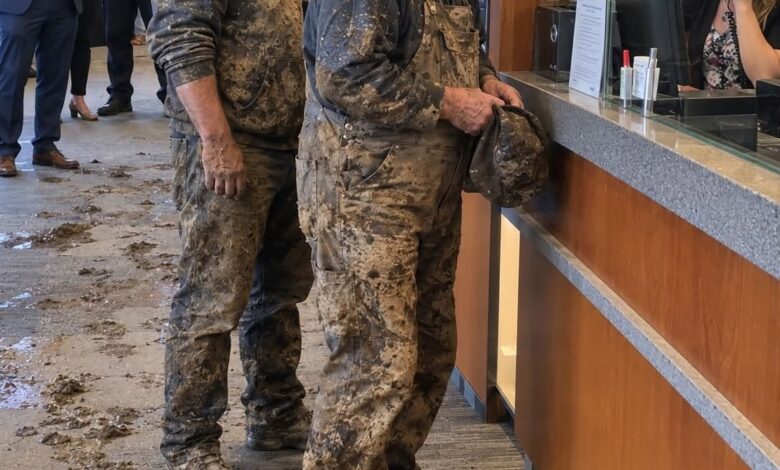
“You looked at my boots,” he said. “And the mud on your carpet. And my overalls. And you said people in your situation.”
He put the cap back in his lap.
“What situation did you mean, miss?”
Ashlyn didn’t answer.
She couldn’t.
“You meant poor,” Grandpa said quietly. “Didn’t you.”
Ashlyn put her face in her hands.
“And when the lady behind me laughed,” Grandpa said, “you smiled at her.”
He looked at her.
“And when you called Tommy,” he said, “you held the phone up so everybody could hear. And you rolled your eyes.”
“You weren’t protecting me, miss,” Grandpa said. “Not by then. Maybe at first. Maybe when you asked for my ID. But not by the end.”
He looked at her.
“By the end,” he said, “you were embarrassed of me.”
Ashlyn was sobbing.
Tom handed her a box of tissues.
“Ashlyn,” Tom said. “I think we need to talk about whether this job is—”
“No,” Grandpa said.
Tom looked at him.
“No, Tommy,” Grandpa said. “Don’t fire her.”
“Earl, she called security on you. She humiliated you in front of the whole lobby.”
“I know what she did,” Grandpa said.
He looked at Ashlyn.
“Miss,” he said. “Where’d you grow up?”
“Naperville,” she said. Through the tissues. “Outside Chicago.”
“Your folks?”
“My dad’s an orthodontist. My mom does real estate.”
“You ever been on a farm?”
She shook her head.
“Before this job,” she said, “I’d never been west of Rockford.”
Grandpa nodded.
“Why’d you come here?” he asked. “To Corwith?”
Ashlyn wiped her eyes.
“My boyfriend,” she said. “He got a job at the ethanol plant in Algona. I followed him. I applied at every bank in the county. This was the only one that called me back.”
She looked at the floor.
“He broke up with me in August,” she said. “I’m still here because I signed a lease.”
Grandpa looked at her for a long time.
“Miss,” he said. “Do you know what’s on my boots?”
Ashlyn looked up.
“Mud,” she said.
“Where from?”
“I don’t know.”
“The north field,” Grandpa said. “Section nineteen. Doyle Township. My great-grandfather broke that sod with a team of mules in 1882.”
He looked down at his boots.
“That mud,” he said, “grew two hundred and four bushels of corn an acre this year. That corn’s going to the elevator in Corwith. And then to the ethanol plant in Algona. Where your boyfriend works.”
He looked at her.
“And then it’s going in somebody’s gas tank,” he said. “Maybe in Naperville.”
“I wear these boots into this bank,” Grandpa said, “because this bank was built on that mud.”
He tapped his boot on Tom’s carpet.
“Every loan this bank ever made,” he said. “Every mortgage. Every car loan. Every dollar in that vault. It came out of the ground. Out of fields like mine. Out of farmers in muddy boots.”
He looked at Ashlyn.
“You see mud on your new carpet,” he said. “And you think it’s dirt.”
He shook his head.
“Miss,” he said. “That’s not dirt.”
“That’s the bank.”
Nobody said anything for a long time.
Then Ashlyn stood up.
She walked out of the office.
I thought she was leaving. Quitting. Going back to Naperville.
She came back two minutes later.
With a bucket. And a brush. And a spray bottle.
From the janitor’s closet.
She got down on her knees.
On the gray carpet. In the lobby.
In her white blouse and her perfect pink nails.
She started scrubbing.
The mud prints. From the front door to window three.
Tom stood up.
“Ashlyn,” he said through the glass. “You don’t have to do that. We have a cleaning service.”
Grandpa put his hand on Tom’s arm.
“Let her,” he said quietly.
We watched through the glass wall.
She scrubbed every print. All fourteen of them.
It took her twenty minutes.
Her nails broke. Three of them. I saw her look at them. Then she kept scrubbing.
When she was done, she came back into the office.
She stood in the doorway. Holding the bucket. Her knees wet. Her blouse stained.
“Mr. Doyle,” she said. “I’m sorry I called it dirt.”
Grandpa looked at her.
“You didn’t call it dirt,” he said. “You thought it.”
“I’m sorry I thought it,” Ashlyn said.
Grandpa stood up.
He put his cap on.
He picked up the envelope with the two thousand dollars.
He put it in the bib pocket of his overalls.
He walked to the door.
He stopped in front of Ashlyn.
“Miss,” he said. “You doing anything Saturday?”
She stared at him.
“Saturday?”
“We’ll have the belt by then,” Grandpa said. “We’ll be back in the north field. Running till dark.”
He looked at her.
“You ever ride in a combine?”
Ashlyn shook her head.
“Seven a.m.,” Grandpa said. “Doyle place. North of town on County Road R-35. White farmhouse. Red barn. Can’t miss it.”
He looked at her shoes. Black heels.
“Wear boots,” he said.
We drove to Algona.
Twenty miles. In the rust-colored Ford with the 2019 calendar on the dash.
Neither of us said anything for the first ten miles.
Then I said, “Grandpa.”
“Mm.”
“Why didn’t you ever tell me? About the bank? About mortgaging the farm? About Valentine’s Day 1986?”
He drove for a while.
He looked at the fields going by. Brown and gold. Half harvested. Combines in the distance. Dust clouds.
“Because it wasn’t about me,” he said.
“It was,” I said. “It was all about you. You saved the bank. You saved the town.”
He shook his head.
“Mrs. Brekke saved the town,” he said. “With four hundred and twelve dollars in quarters. Arne Thorsen saved the town. He had two hundred dollars to his name and he put in a hundred. The Lutheran church took up a collection. Twelve hundred dollars. The Methodist church matched it.”
He looked at me.
“I just went first,” he said.
“Your grandma made me do it,” he said.
I looked at him.
“I didn’t want to,” he said. “Mortgage the farm. I was scared to death. A hundred years. Never a dollar of debt. My daddy would’ve rolled over in his grave.”
He drove for a while.
“Your grandma sat me down at the kitchen table,” he said. “February eleventh. The night before. She’d been to the bank that day. She’d seen the line.”
He swallowed.
“She said, Earl, what’s the farm for?”
“I said, It’s for us. For Mike. For the grandkids someday.”
“She said, If the bank closes, Mike won’t have a town to farm in. There won’t be a co-op. There won’t be a school. There won’t be a church. Everybody’ll sell out and move to Des Moines. What good’s six hundred and forty acres in a ghost town?”
He shook his head.
“She said, The farm isn’t the land, Earl. It’s the people around it.”
He was quiet for a long time.
“We drove to Omaha the next morning,” he said.
We got the belt on Thursday.
Kenny Lindqvist had it overnighted from Moline. He met us at the dealership at seven a.m. He took the two thousand dollars in hundreds and counted it twice.
“Heard you had a little trouble at the bank, Earl,” Kenny said.
Grandpa looked at him.
“Who told you?”
“Linda Feeney,” Kenny said. “The lady who walked out. She told her sister. Her sister told my wife. It’s all over the county.”
He handed Grandpa the belt.
“Linda feels pretty bad,” Kenny said. “Says she didn’t know who you were.”
Grandpa took the belt.
“Didn’t matter who I was,” he said.
We put the belt on Thursday afternoon. It took four hours. Grandpa lay on his back under the feeder house in the dirt. Eighty-four years old. Handing me wrenches.
The combine started on the first try.
Ashlyn came on Saturday.
Seven a.m. Exactly.
In a little white Honda Civic with Illinois plates. She parked by the barn.
She got out.
She was wearing jeans. A flannel shirt. Brand new. The tags still on the sleeve.
And boots.
Brand-new Red Wings. Brown leather. The same kind as Grandpa’s. She’d bought them at the Farm & Fleet in Algona on Friday night. They cost two hundred and thirty dollars. She told me later.
Grandpa was standing by the combine.
He looked at her boots.
“Those’ll need breaking in,” he said.
“I know,” Ashlyn said. “They already hurt.”
“They’ll hurt for about a month,” Grandpa said. “Then they’ll be the most comfortable thing you ever wore.”
He climbed up into the cab.
He looked down at her.
“Well?” he said. “You coming?”
She climbed the ladder.
She sat in the buddy seat. The little fold-down seat next to the driver.
My grandmother used to sit there. Every harvest. For sixty-one years. She’d ride along for an hour every afternoon. Bring him coffee. Watch the corn go in.
Nobody had sat in it since she died.
Grandpa started the combine.
They rode the north field all day.
I drove the grain cart. Every time they filled up, I pulled alongside. The auger swung out. The corn poured into my cart. Gold. Steaming in the cold.
Every time, I could see them through the cab glass.
Grandpa driving. Ashlyn in the buddy seat.
Talking.
At noon, my mom brought lunch to the field. In the cooler. Sandwiches and potato salad and a thermos of coffee.
We ate on the tailgate of the Ford.
Ashlyn ate two sandwiches. She said it was the best sandwich she’d ever had. It was ham on white bread with mustard.
At four o’clock, Grandpa stopped the combine.
In the middle of the field.
He climbed down.
He walked out into the stubble. Where the corn had just been cut.
He knelt down.
He picked up a handful of dirt.
Black. Rich. Wet from the morning frost.
He held it out to Ashlyn.
“Hold out your hands,” he said.
She held them out.
He poured the dirt into her palms.
She looked at it.
Black. Cold. Crumbling between her fingers. Her broken pink nails.
“That’s what a bank is,” Grandpa said.
That was two years ago.
Ashlyn is still at Prairie State Bank.
She’s not at window three anymore.
She’s the head teller now.
She still lives in Corwith. In an apartment above the Rusty Spur. She’s dating a guy named Cody Halverson. Mrs. Halverson’s grandson. He farms eight hundred acres east of town.
She wears her Red Wings to work.
Every day. Under her slacks.
They’re broken in now.
She knows everybody’s name.
Every farmer in Kossuth County. Their wives. Their kids. Their dogs. What they planted. How many bushels they got.
When they come in, she asks.
How’s the beans coming, Arne? Did the hail get you out by Wesley? How’s your knee, Mrs. Brekke?
Old Mrs. Brekke is a hundred and one now. She still comes in every month. To deposit her Social Security check.
Ashlyn walks out to her car. Every time. In her Red Wings. She helps her up the steps.
Tom Callahan changed some things at the bank.
He took down the sign by the coffee machine.
Complimentary for Our Valued Customers.
He put up a new one.
Coffee’s free. Boots welcome. Mud is good luck.
He moved the photograph.
The one from his office. February 14, 1986. Earl and June Doyle in front of the old brick bank. In the snow. Holding a cashier’s check.
He moved it out to the lobby.
Right over the vault door.
Right under the big brass clock.
Underneath it, a new brass plate.
EARL & JUNE DOYLE
February 14, 1986
They mortgaged their farm to save this bank.
They never asked for anything in return.
Come as you are.
And there’s a policy now.
Ashlyn wrote it. Tom signed it. The board approved it unanimously.
My grandfather abstained.
Prairie State Bank — Customer Dignity Policy
No customer shall be asked to justify the purpose of a withdrawal from their own account based on their age, appearance, clothing, or perceived economic status.
Elder financial abuse prevention protocols shall be applied based on behavioral indicators only — confusion, coercion, urgency, third-party pressure — and never on how a customer looks or dresses.
All staff shall complete one full day of agricultural orientation annually, including time spent on a working farm.
No customer shall ever be told to “stick to the ATM.”
The agricultural orientation is at the Doyle place.
Every September.
Grandpa takes every new teller out in the combine.
He puts dirt in their hands.
My grandfather is eighty-six now.
He still farms.
Not all of it. My dad runs most of it now. I’m graduating from Iowa State in May. I’m coming home. To farm with them.
But Grandpa still runs the combine in the north field.
Section nineteen.
Every October.
He still goes to the bank every Tuesday.
In overalls. And a feed-store cap. And muddy boots.
He still takes his cap off when he walks in.
Last Tuesday, I went with him.
We walked through the glass doors. Whoosh.
His boots left prints on the gray carpet.
Mud. Black. Shaped like Red Wing soles.
Ashlyn was at the head teller’s window.
She saw him.
She came around the counter.
She walked right through the mud prints. In her own Red Wings.
She hugged him.
“Morning, Earl,” she said.
“Morning, Ashlyn.”
“How’s the north field?”
“Two-eleven an acre,” he said.
Ashlyn whistled.
“Best year since 2004,” she said.
Grandpa almost smiled.
“You’re learning,” he said.
There was a young man in line behind us.
Twenty-something. New. In a suit. A loan officer, I think. He’d just started.
He was looking at Grandpa’s boots.
At the mud on the carpet.
His nose wrinkled. Just a little.
Ashlyn saw it.
She walked over to him.
She put her hand on his shoulder.
“Derek,” she said. “You see that photo? Over the vault? Under the clock?”
Derek looked up.
At the black-and-white photograph. A man and a woman in front of an old brick bank. In the snow.
“That’s him,” Ashlyn said. “That’s Earl. In 1986.”
Derek looked at the photo.
He looked at Grandpa.
He looked at the mud on the carpet.
“You’re coming to the farm in September,” Ashlyn said. “For orientation. Bring boots.”
On the drive home, I asked Grandpa something.
“Grandpa,” I said. “When the teller called security. When Rick put his hand on his belt. When that lady laughed.”
“Mm.”
“Were you angry?”
He drove for a long time.
Past the elevators. Past the Casey’s. Past the Lutheran church where Grandma’s funeral was.
“No,” he said finally.
“Why not?”
He looked out at the fields.
Brown and gold. Half harvested. Dust clouds rising behind combines in the distance.
“Because I knew who I was,” he said.
He was quiet for a while.
“That girl didn’t know who I was,” he said. “That’s all right. She was new. She’d never seen mud like ours.”
He looked at me.
“But I knew,” he said. “I’ve always known. I’ve worn these boots into that bank for sixty-three years. I don’t need anybody to tell me I belong there.”
“Then why’d you ask for Tom?” I said. “If you didn’t need anybody to tell you?”
He smiled.
Just a little. At the corner of his mouth.
“I didn’t ask for Tom for me,” he said.
I looked at him.
“I asked for Tom,” he said, “so she’d learn.”
He drove for a while.
“Your grandma used to say something,” he said. “When somebody looked down on us. At church. At the store. In Des Moines once. A fancy restaurant. The waiter wouldn’t seat us because I had mud on my boots.”
“What did she say?”
He looked at the 2019 calendar on the dash.
The one she hung there.
The one he won’t take down.
“She said, Earl, you can’t make somebody see you. But you can stand there long enough that they have to look.”
When we got home, Grandpa went inside.
I went to the barn.
When I came in for supper, he was sitting at the kitchen table.
With two coffee cups.
He’d set them out. Like every morning.
One for him. One for her.
But this time, he hadn’t put hers back in the cupboard.
It was still sitting there. Across from him. Full. Steaming.
And next to it, on the oak table, a little pile of black dirt.
From the north field.
Section nineteen.
He looked up at me.
“Your grandma liked to see how the field was doing,” he said.
He touched the dirt with one finger.
“I bring her some,” he said. “Every harvest.”
I sat down at the table.
Across from the empty chair. And the full cup. And the little pile of dirt.
Grandpa looked at it for a long time.
“That’s not dirt, Luke,” he said quietly.
“I know, Grandpa.”
He picked up his coffee.
He raised it a little. Toward the other cup.
Toward her.
“That’s the bank,” he said.