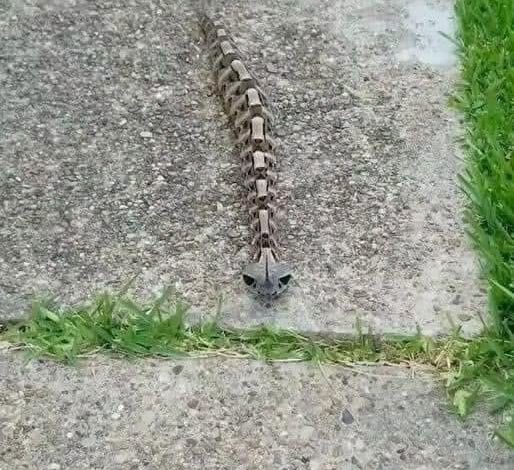
The Leaf-Like Snake Most People Would Never Notice
At first glance, a Gaboon viper can look less like a snake and more like part of the forest floor. Among dry leaves, broken twigs, and shifting shadows, this heavy-bodied African viper can disappear so well that even a careful observer might miss it.
That hidden-in-plain-sight quality is what makes the Gaboon viper one of the most fascinating snakes in sub-Saharan Africa. It is not known for racing after prey or seeking attention. Its survival depends on patience, concealment, and a body pattern that works almost like natural camouflage fabric.
A Snake Built to Vanish
The Gaboon viper lives in parts of sub-Saharan Africa, especially in forested areas and places with plenty of leaf litter. Its colors often include shades of brown, tan, cream, and muted purple-like tones, arranged in complex markings across a broad, heavy body.
Those markings are not just decorative. On a forest floor covered with fallen leaves and patches of light, the pattern breaks up the outline of the snake. This helps it stay hidden from both potential prey and animals that might otherwise disturb it.
The snake’s broad triangular head and thick body make it easy to recognize in a clear photo, but in its natural setting the same features can be surprisingly hard to pick out. For a creature that spends much of its time waiting, that ability to blend in is a major advantage.
Patience Is Its Hunting Strategy
The Gaboon viper typically relies on ambush rather than pursuit. Instead of actively chasing animals over long distances, it can remain still until suitable prey comes close enough.
When the moment is right, the snake can strike with impressive speed. Its diet may include rodents, birds, and other animals of an appropriate size, depending on what is available in its environment.
One of the snake’s best-known features is its exceptionally long fangs. Like other vipers, it uses specialized teeth to deliver venom during a bite. Its venom is medically significant and can cause serious effects, which is why the species deserves caution and respect.
What Readers Should Know
Although the Gaboon viper is venomous, it is not an animal that goes looking for people. Encounters are uncommon because it usually lives in habitats away from heavily populated areas and depends on remaining unnoticed.
The greatest risk comes when someone accidentally gets too close to a concealed snake. For travelers, hikers, field workers, photographers, or anyone spending time in snake habitat, the safest rule is simple: observe from a distance and never try to handle, move, or provoke a wild snake.
If a venomous snakebite occurs, emergency medical care is essential. People should not rely on home remedies or attempt to capture the animal. Quick access to proper healthcare can be critical in any serious snakebite situation.
The Gaboon viper’s reputation often centers on its venom and fangs, but its real story is broader than that. Its camouflage, calm stillness, powerful build, and patient hunting style all work together to help it survive quietly in a demanding environment.
Nature often hides its most remarkable designs in plain sight, and the Gaboon viper is a striking reminder to look more carefully at the world beneath our feet.