My Father In Law Kept Touching My Food Until His Son Caught Him
It was strange. It should have felt like relief. It mostly felt empty.
Jasper came into the kitchen around eleven. He was wearing sweatpants and a Red Sox shirt. He stood at the stove with his hands on his hips, looking at it like it was a car engine.
“Teach me something,” he said.
“What?”
“Cooking. Teach me to make something. I’m thirty-seven years old and I can make toast and scrambled eggs and that’s it.”
I stared at him.
“You’re serious?”
“I’m serious. Teach me Mom’s soup.”
So I did.
I showed him how to cut an onion without crying, mostly. I showed him how to brown the chicken so the skin went crispy, and how to scrape up the brown bits from the bottom of the pot with a wooden spoon. I showed him how to chop the carrots so they were all the same size.
He was terrible at it. Slow and careful and terrible. His carrots were all different shapes. He burned his wrist on the side of the pot and swore.
At one point, he reached toward the pot with his finger, to taste it.
He stopped halfway. Froze.
He looked at me. I looked at him.
And we both burst out laughing. Real laughing. Leaning against the counter, wiping our eyes, laughing.
He got a clean spoon from the drawer.
“Old habits,” he said.
“Apparently they run in the family.”
He tasted it. Considered it.
“Needs more salt,” he said.
I threw a dish towel at him.
We ate that soup together at the table. Both of us sitting down at the same time. Both of us with full bowls.
Halfway through, Jasper put his spoon down.
“This is really good,” he said.
“You made it.”
“No. I mean thank you. For all of it. For all the Sundays. I don’t think I ever said it.”
I looked down at my bowl.
He was right. He never had.
Neither had his father.
“You’re welcome,” I said.
It’s funny how little it takes. Two words. Two words I’d been waiting for months to hear, without even knowing I was waiting.
On Thursday, I ran into one of Henry’s neighbors at the grocery store. Mrs. Okafor, from the apartment across the hall from his. I’d met her once, when we helped him move in.
“How’s Henry doing?” I asked carefully.
She made a face.
“He’s very quiet this week. He usually comes to the bingo in the community room, Tuesday nights. He didn’t come.” She lowered her voice. “He sat in the lobby on Sunday afternoon for a long time. Just sitting. In his jacket. Like he was waiting for somebody to pick him up.”
I felt a twist in my stomach.
I thought about it all the way home. Henry sitting in the lobby of his building in his tan windbreaker, on a Sunday afternoon, with nowhere to go.
I told Jasper that night.
He was quiet for a long time.
“I know it’s hard,” I said. “Do you want to call him?”
He shook his head slowly.
“I want to,” he said. “But he knows where we live. He knows what he has to do.”
He rubbed his face with both hands.
“God, Lis. I hate this.”
“I know.”
“Do you think I’m being cruel?”
I thought about it. I really thought about it, because he deserved an honest answer.
“No,” I said. “I think you’re being kind in a way he’s not used to.”
Then, the following Saturday, Henry called.
It was late in the afternoon. Jasper and I were in the backyard raking leaves. His phone buzzed in his pocket. He pulled it out, looked at the screen, and went completely still.
“It’s him.”
He looked at me. I nodded.
He answered on speakerphone and held the phone between us.
“Hi, Dad.”
There was a long pause on the other end. I could hear a television in the background. A game show. Someone was spinning a wheel.
“Jasper,” Henry said. His voice was rough. Like he hadn’t used it much that week.
“Yeah, Dad.”
Another pause.
“Could I come by tomorrow?”
Jasper looked at me.
I nodded.
“Only if you’re ready to apologize to Lisa,” he said.
There was a long silence.
The game show audience applauded. Someone had won something.
Then Henry answered.
“All right.”
That night I couldn’t sleep.
I lay awake trying to imagine how it would go. In half the versions in my head, Henry showed up and said a quick “sorry” and then went right for the stove. In the other half, he didn’t show up at all.
“What if he doesn’t mean it?” I whispered to Jasper around midnight.
He was awake too. I could tell from his breathing.
“Then he doesn’t come in,” Jasper said. “Simple.”
“It’s not simple. He’s your dad.”
He was quiet for a moment.
“I know he’s my dad,” he said. “But you’re my wife. And I let it be complicated for too long. I’m keeping it simple now.”
Sunday morning, I made soup.
I almost didn’t. I almost made something else. Something neutral. Spaghetti, maybe. Something that didn’t mean anything.
But I stood in front of the open cabinet, looking at Helen’s recipe card, and I thought, no.
This was the right soup.
I made it from scratch. I took my time. Jasper chopped the carrots, and this time they were all almost the same size.
Sunday afternoon, around three o’clock, the doorbell rang.
Henry had never once rung our doorbell. Not since spring. He’d always just walked in. Opened the front door and called out, “It’s me,” and headed straight for the kitchen.
Jasper opened the door.
Henry stood on the front step holding a small brown paper bag.
He looked uncomfortable. He was wearing a button-down shirt I’d never seen before, blue, still with the creases from the package. He’d shaved. He looked like a man going to a job interview.
He came inside slowly.
And for once, he didn’t walk straight toward the kitchen.
He stopped in the front hall.
He waited.
“Lisa,” he said.
I folded my arms.
“Henry.”
He glanced at Jasper. Then back at me.
He took a breath, a real one, the kind you take before you go underwater.
“I owe you an apology.”
I said nothing.
I let the silence sit there. For once, I didn’t rush to fill it. I didn’t say, “Oh, it’s fine,” or “Don’t worry about it,” or “Come in, come in.” I’d spent six months making things easier for him.
I wanted to see what he’d do if I didn’t.
He shifted the paper bag from one hand to the other.
“I shouldn’t have put my fingers in your food,” he said. “Not once. Not any of the times. And I shouldn’t have spoken to you like you had no right to tell me what to do.”
He swallowed.
“This is your home too.”
Jasper stayed quiet. He stood a little behind me, by the coat rack. He didn’t jump in. He didn’t help his father along.
Henry kept going.
“I kept telling myself Helen didn’t mind,” he said. “Because she stopped arguing.”
He looked down at the floor. At the hall rug.
“But after I left here last week, I couldn’t stop thinking about what Jasper said. About the bread.”
His eyes dropped further.
“I went home and I sat in that apartment and I tried to remember. All those dinners. And I could see her. Standing by the stove while I ate. Every single time. I could see her, clear as day. Standing there with a dish towel over her shoulder.”
He shook his head slowly.
“I don’t think I ever once asked her to sit down.”
Jasper looked at him.
Henry rubbed his big rough hands together. I noticed for the first time how swollen his knuckles had gotten.
“I got used to having things my way,” he said. “And when Helen stopped complaining, I decided that meant she was happy.”
He shook his head again.
“Maybe I just didn’t want to hear otherwise.”
Jasper spoke then. Gently.
“She can’t tell us now, Dad.”
“I know.”
Henry looked older suddenly.
Not physically.
Just tired.
“I wish I’d asked her more often whether she’d eaten,” he said.
Nobody answered right away.
I didn’t know what to say. I’d prepared for anger. I’d prepared for a half-hearted mumble. I’d even prepared for him to not show up.
I hadn’t prepared for this.
Then Henry held out the paper bag.
I took it from him. It was light. I opened it and reached inside.
It was a small framed photograph, in a plain wooden frame.
Helen, standing in her kitchen. The old kitchen, in the old house across town, with the green linoleum and the window over the sink.
She was smiling. Not at the camera. At someone off to the side of it. Her head was tilted back a little, like she was laughing at something somebody had just said.
She was wearing the faded yellow apron with the little white daisies.
“I found this yesterday,” Henry said. “In a box. I was looking for something else.”
His voice caught.
“She loved that apron. Wore it till it was almost see-through. I offered to buy her a new one once and she about took my head off.”
Jasper stepped forward and took the photograph from me. He held it carefully, with both hands, like it was made of glass.
For a moment, neither man spoke.
They just stood there in my front hallway, father and son, looking down at the same small picture of the same woman.
I watched Jasper’s thumb move across the glass, right over his mother’s face.
“Who was she laughing at?” he asked quietly.
Henry took a long time to answer.
“Me,” he said. “I’d just dropped a whole tray of dinner rolls on the floor. Fourth of July. Her sister was coming. I was trying to help.” He almost smiled. “Only time I ever tried to help. And I made a mess of it.”
He looked at the photo.
“She laughed so hard she had to sit down.”
Then Henry turned toward me.
“I know saying sorry doesn’t fix everything,” he said.
“No,” I answered. “It doesn’t.”
He nodded. He didn’t argue. He didn’t tell me I was being difficult. He just nodded, like he’d expected that answer and thought it was fair.
“But I’d like to do better,” he said.
I looked at Jasper.
Then at Henry.
At his creased new shirt and his swollen knuckles and his tired eyes.
I thought about Mrs. Okafor, telling me he’d sat in the lobby all Sunday afternoon in his jacket.
I thought about Helen, eating bread in the dark.
I thought about all the things I could say to him. I’d been saving them up for months.
“Then we’ll start with something simple,” I said.
I walked into the kitchen.
A fresh pot of chicken soup was simmering on the stove. Helen’s soup. The whole house smelled like it.
Henry followed me down the hall.
He stopped at the kitchen doorway.
He stopped. Right at the edge, where the hallway carpet met the kitchen tile. He stood there with his hands at his sides, like there was an invisible line on the floor.
“May I come in?” he asked.
I almost smiled.
Six months of Sundays. Six months of him walking right past me to the stove like I was a piece of furniture.
And now: *May I come in?*
“Yes,” I said.
He approached the stove slowly.
He leaned over the pot and breathed in. Closed his eyes for a second.
“Smells good,” he said.
“Thank you.”
He kept his hands at his sides. I could see him keeping them there. I could see the effort it took. His right hand twitched once toward the pot, and he curled it into a fist and put it in his pocket.
Then he asked, “Would you like me to help?”
I’d never heard him ask that. Not in six years. I don’t think Helen ever heard him ask it in forty.
I opened the drawer beside the stove. I took out a clean spoon. A big silver soup spoon, from the set my sister gave us as a wedding present.
I handed it to him.
“You can start,” I said, “by tasting this properly.”
He accepted it.
He looked at the spoon for a second. He turned it over in his hand, the way Jasper had turned over the screwdriver.
Then he dipped it into the pot. One spoonful. He blew on it. He tasted it.
No fingers.
He stood there with the spoon, thinking about it, his eyes on the pot. I waited for “needs more salt.”
It didn’t come.
“It tastes like hers,” he said quietly.
“It’s her recipe.”
He looked up at me, surprised.
I pointed at the open cabinet door. At the index card taped inside.
Henry leaned closer and read it. I watched his lips move as he read. *Taste with a clean spoon. Season at the end, not the beginning. Always make enough for whoever shows up.*
He stood there for a long time.
Then he put the spoon in the sink. Not back in the pot. In the sink.
“She had nice handwriting,” he said. His voice was thick. “I never told her that either.”
He didn’t go to the couch after that.
He stayed in the kitchen. He leaned on the counter, out of the way, and asked Jasper what he’d been up to at work. He asked me how Nora was. He actually remembered I had a sister named Nora. I don’t know how. I’d mentioned her maybe twice.
When the bread came out of the oven, he didn’t reach for it.
When I asked him to get the butter out of the refrigerator, he got it and put it on the table and asked if I needed anything else.
Jasper set the table. Three bowls. Three spoons. Three napkins.
I caught him counting the chairs under his breath.
And when dinner was ready, Henry didn’t reach for the pot.
He waited while I filled the bowls. Jasper’s first. Then Henry’s.
Then mine.
I turned around with my own bowl in my hands.
Henry was standing at the table.
He’d pulled out a chair.
Not for himself.
For me.
He stood behind it with both hands on the back, waiting. The same way Jasper had stood behind a chair a week before, holding on while he remembered his mother eating bread in the dark.
I looked at Henry. He looked at the floor. His ears were going red.
I sat down.
He pushed my chair in, a little clumsily. It bumped the table and my soup sloshed. He muttered, “Sorry, sorry.”
Then he went around to his own chair and sat down.
We all sat down together. At the same time. Three bowls of soup going cold, and none of us eating yet.
Henry looked at his soup.
Then he looked at me.
“Thank you for dinner, Lisa,” he said.
It was a small thing.
Five words. That’s all it was. People say them every day without thinking.
But Jasper reached beneath the table and squeezed my hand. Hard. And I knew he was thinking the same thing I was.
How many dinners had Helen made? Thousands. Tens of thousands. Forty years of Sundays and Mondays and Tuesdays.
And how many times had she heard those five words?
I looked across the room at the photograph. Jasper had put it on the shelf above the kitchen table, next to the cookbooks and the little ceramic rooster my mother gave me.
Helen in her yellow apron. Laughing at a tray of dinner rolls on the floor.
I wished she’d heard those words more often.
That was eight months ago.
I’d love to tell you Henry became a completely different man overnight. He didn’t.
He still talks too loud. He still tells the same three stories from the lumber yard. He still calls me “sweetheart” sometimes, though it sounds different now. It sounds like he’s trying.
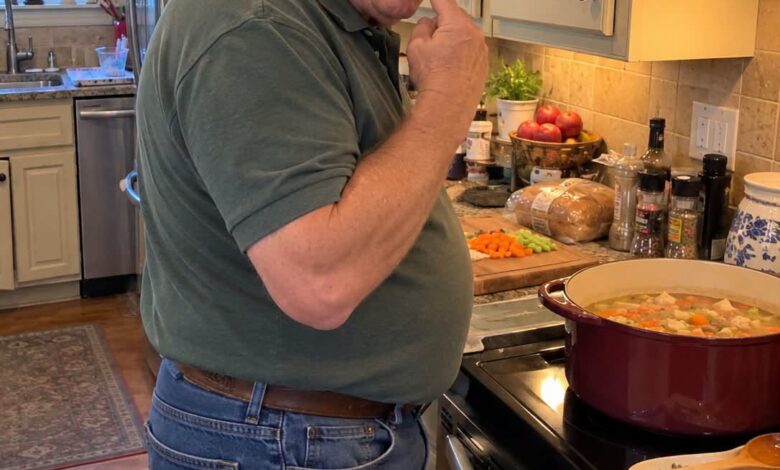
And once, in November, I came back from the pantry and caught him leaning over the gravy with his finger halfway there.
He saw me. He froze.
We stared at each other for a long second.
Then he slowly pulled his hand back, opened the drawer, and took out a spoon.
“Muscle memory,” he said, sheepish.
“Forty years of it,” I said.
“Sixty-four,” he said. “My mother let me do it too.”
That was the first time I ever thought about Henry’s mother. About who stood at her stove while he ate.
Sunday dinners started again. Every week.
But they’re different now.
Henry comes at three. He rings the doorbell. Every time. Even though Jasper has told him a dozen times that he doesn’t have to.
“I like ringing it,” he said once. “Reminds me.”
He brings something every week. Usually bread from the bakery near his building. Once, a store-bought pie that was still frozen in the middle. Once, a bunch of daisies he’d clearly bought at the gas station. He handed them to me without a word and went to wash his hands.
Jasper cooks with me now. Every Sunday. He’s gotten good. Better than good. His carrots are all the same size. He makes a meatloaf that’s better than mine, and that’s not easy for me to admit.
The first time he made it, Henry took a bite and chewed for a long time.
“It’s moist,” Henry said. Then, after a pause, so quiet I almost didn’t hear him: “Your mother’s never was. I used to tell her so.”
He put his fork down.
“I shouldn’t have.”
Jasper didn’t say anything. He just nodded and passed his father the potatoes.
In the spring, Henry asked if I’d teach him to make the soup.
I said yes.
He’s worse at chopping than Jasper was. His knuckles don’t bend the way they used to. He’s slow and stubborn and he argues with every instruction. He thinks I put in too much dill. I think he’s wrong.
But he uses a clean spoon.
Every single time.
And when it’s done, he ladles the first bowl and carries it over to the table and sets it in front of my chair.
Then he goes back for his own.
Last week, after dinner, I found him standing alone in front of the shelf. Looking at the photograph of Helen.
He didn’t hear me come in. He was talking to her. Very softly.
“You’d like it here,” he was saying. “They make me sit down.”
I backed out of the kitchen quietly and let him have the moment.
I think a lot about what Jasper said that day, standing behind that kitchen chair.
*She wasn’t full, Dad. She was making sure we were.*
I think about the bread in the dark. About a ten-year-old boy who saw his mother eating alone and went back to bed and didn’t think anything of it for twenty-seven years.
I don’t think Helen was miserable. I think she loved her family with everything she had. I think she found real joy in feeding them.
But I think somebody should have fed her too.
I think somebody should have pulled out a chair.
We couldn’t give Helen those Sundays back.
None of us could. Not Jasper. Not Henry. Not me.
But we can give them to each other now.
The red toolbox is still in our garage. Henry never took it home. Once, I asked him if he wanted it.
He thought about it.
“Leave it here,” he said. “In case anybody needs reminding.”
So it’s out there, on a shelf next to the Christmas decorations, with the cracked screwdriver inside.
And Helen’s recipe card is still taped inside my cabinet door, above the stove, where all of us can see it.
*Taste with a clean spoon.*
*Always make enough for whoever shows up.*
I used to think that second line was the important one. Now I think they belong together. You make enough for everyone, and then you make sure everyone, including the cook, gets to sit down and eat it.
In my kitchen, nobody has to earn respect by going without.
Not anymore.