My 15 Year Old Son Spent Months Building a Cedar Chest for Grandma but My Sister in Law Threw It Out on Christmas
He stopped in the doorway of Mom’s room. He was still in his coat, with snow on his shoulders and his jumper cables coiled in one hand. His cheeks were red from the cold.
Mom was holding the reindeer sweater over the open chest. She was sitting on the edge of the bed with the sweater in both hands, and the chest open at the foot of the bed with all her other sweaters folded inside, and Rowan kneeling beside it holding the lid up.
Danica was right behind him. She’d followed him down the hall from the kitchen. She stood in the hallway behind him with her arms crossed.
Kyle looked at the chest. Then at his wife.
Nobody said anything for a long time. I could hear the furnace running. I could hear the TV in the living room, Ralphie’s mother on A Christmas Story saying something about the leg lamp.
“Dave said there was a chest by our garbage cans,” Kyle said finally. Quietly. “When I walked back up the street. He said, Kyle, did you mean to throw that out? It looks brand new.” He looked at Danica. “I told him no. I told him Rowan made it for Mom. And then I came up the driveway and it was gone, and there were footprints in the snow.”
Danica didn’t say anything.
“Did you put it out there?” Kyle asked her.
She uncrossed her arms. She crossed them again.
“It doesn’t go with anything, Kyle,” she said. “Look at it. It’s orange. It smells. The whole room smells like a barn now. I spent forty-eight thousand dollars on this room.”
“Mom spent forty-eight thousand dollars on this room,” Kyle said.
Danica’s face went red. She opened her mouth and closed it.
My brother is not a confrontational man. He never has been. He’s an accountant for a paper company in Green Bay, and his whole life he’s been the one who smooths things over, who changes the subject, who says let’s not fight on a holiday. I’d never once in my life heard him speak to his wife that way.
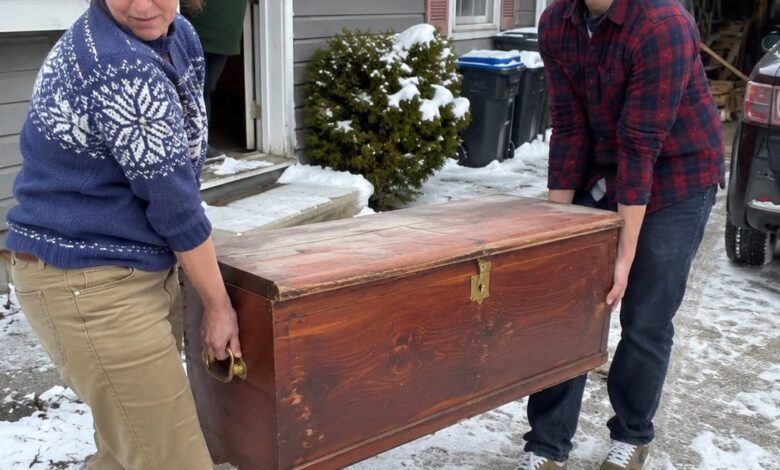
He set his jumper cables down on the hall floor. He walked into Mom’s room. He walked over to the foot of the bed and looked down into the chest, at the folded sweaters, at the underside of the lid. At what Rowan had burned there.
He read it. For Grandma. Love, Rowan. And the little farmhouse with the cedar tree.
He knelt down on the gray rug beside his nephew and put his hand on the lid next to his mother’s hand.
“Grandpa Emil’s closet,” he said softly. “God, Mom. I forgot about that closet.”
Mom looked at him. Her eyes were wet.
“I hid in it,” Kyle said. “Remember? When I was six. The night Grandpa died. I hid in his closet with his coats, and you found me in there in the morning, asleep.”
“I remember,” Mom said.
Kyle stayed there on his knees for a long moment. Then he stood up and turned around and looked at his wife in the doorway.
“Danica,” he said. “Can I talk to you? In the kitchen?”
Chapter Eight: Danica
They were in the kitchen for a long time. Rowan and Mom and I stayed in her room. I could hear their voices through the wall, low at first, then louder, then low again. I couldn’t hear what they said. I didn’t try.
Mom finished putting the reindeer sweater on top of the pile in the chest. Then she smoothed it with her hand. Then she sat there on the edge of the bed looking at it.
“She’s not a bad person, Lainey,” Mom said quietly. “Danica.”
I looked at her.
“She’s scared,” Mom said. “All the time. I’ve lived in this house two years. I see it every day. She cleans when she’s scared. She cleans until her hands are raw. She bought a new set of white towels last month because one of them had a little stain on it.” Mom shook her head. “She’s never once been mean to me. Not really. She brings me tea. She drives me to my doctor’s appointments. She sits with me when Kyle works late. She’s just…” Mom searched for the word. “She’s just never once let me have anything of mine in here.”
“Why didn’t you tell us?” I asked.
Mom looked at the chest. “Because I’m a guest,” she said. “That’s what she calls this room. The guest room. And a guest doesn’t complain.”
Rowan, still kneeling beside the chest, looked up at his grandmother.
“You’re not a guest, Grandma,” he said. “You paid for this room.”
Mom looked at him for a long time. Then she reached out and put her hand on his dark hair.
After a while, the kitchen went quiet. Then I heard footsteps in the hall, and Danica came into the doorway. Alone. Kyle stayed in the kitchen.
She’d been crying. Her mascara was smudged under her eyes. She stood there in the doorway in her white sweater with her hands clasped in front of her, and she didn’t look at me. She looked at the chest.
“Can I come in?” she asked.
Mom nodded.
Danica came in. She walked across the gray rug slowly and stood at the foot of the bed beside the chest. She looked down into it at the folded sweaters and the reindeer on top. Then she looked at Rowan, still kneeling beside it.
“Rowan,” she said. “I’m sorry.”
He didn’t say anything. He looked up at her.
“It’s beautiful,” Danica said. “It is. It’s the most beautiful thing in this house.” Her voice cracked. “And when your grandma opened it and I smelled it, I was eight years old again. In my uncle’s barn. In the winter, with the wood stove going and the walls sweating and that smell. Old cedar boards and hay and animals.” She shut her eyes. “My uncle lined the walls of the room where we slept with old cedar planks he pulled off a corncrib. To keep the mice out. It never got the smell out of anything. I smelled like that barn for six years.”
Rowan didn’t move.
“Every kid in my school knew,” Danica said. “They’d hold their noses when I sat down. They called me Barn Girl. All the way through eighth grade.” She opened her eyes. “And when I smelled that chest, I just panicked. I couldn’t breathe. I wanted it out. I wanted it gone. I didn’t even think. I just got the hand truck.”
She looked at the chest for a long time.
“And then I sat there folding wrapping paper,” she said, “like it was nothing. Because if I act like it’s nothing, maybe it is.” She shook her head. “That’s what I’ve done my whole life. I put things out with the trash and act like they were never there.”
Chapter Nine: What Mom Said
Mom let her talk. She let Danica stand there and say all of it. When she was done, Mom sat for a while on the edge of the bed with her hands in her lap.
Then she said something I’d never heard her say. Not in my whole life.
“Danica,” she said. “Sit down. Next to me.”
Danica hesitated. Then she sat down on the edge of the white bed beside her mother-in-law.
“I lived in a barn too,” Mom said.
Danica turned and stared at her.
“In 1958,” Mom said. “When I was seven. My father’s house burned down in March. The whole farmhouse, in Pulaski. A chimney fire. We lived in the hay barn for a whole summer while he rebuilt it. Me and my mother and my sister Bea and my father. On cots, in the hayloft.” She smiled a little. “I’d forgotten it. I hadn’t thought about it in years. Until you said that.”
“I didn’t know,” Danica whispered.
“Nobody knows,” Mom said. “We didn’t talk about it. You didn’t, back then. It was something you were ashamed of. Poor people lived in barns.” She reached over and took Danica’s hand in hers. “When my father rebuilt the house, the first thing he did was line one closet with cedar. Just one. Because cedar’s what he could afford. And he told me it was the safe place. The place that was ours. That nothing could take from us.”
Danica was crying again.
“That’s why I hid in it, during storms,” Mom said. “That’s why it smells like home to me. To you, it smells like the barn. To me, it smells like getting out of the barn.” She squeezed Danica’s hand. “Same smell. Different ending.”
Nobody said anything. Rowan sat back on his heels on the gray rug, staring at his grandmother.
“Danica,” Mom said. “I want to tell you something, and I want you to hear it. This house is beautiful. You made it beautiful. You came from nothing and you made something perfect, and I’m proud of you. I’ve told Kyle that a hundred times.” She paused. “But I don’t live in a magazine. I live in this room. And I’m seventy-four years old, and I’ve lived in it for two years, and there’s not one thing in it that’s mine.”
She looked at the white walls and the gray rug and the white dresser and the gray lamp.
“I’m not a guest,” she said quietly. “I’d like this to be my room. With my things in it. And I’d like that chest to stay at the foot of my bed. And if it smells like a barn, then that’s all right. It smells like my father too.”
Danica sat there for a long time on the edge of the bed with her mother-in-law’s hand in hers. Then she nodded. She couldn’t speak. She just nodded.
Kyle was standing in the doorway. I don’t know how long he’d been there.
Chapter Ten: The Kitchen Table
We stayed for Christmas dinner. All of us. Ham and scalloped potatoes and green bean casserole and a pan of my mother’s kolaczki, the little Polish cookies with apricot filling that she taught Danica to make the first Christmas after she moved in. Brett came at six, straight from his plow shift, still in his county coveralls, and ate three plates and fell asleep on the white sectional with his boots off. Danica covered him with a blanket. She didn’t say a word about the couch.
After dinner, while Rowan and Danica did the dishes, Kyle and I sat at the kitchen table with coffee.
“I didn’t know,” he said. “About the room. About Mom feeling like a guest. I work twelve-hour days in tax season. I come home and she’s in her room and Danica’s made dinner, and everything looks fine.” He shook his head. “I should’ve seen it.”
“Kyle,” I said. “Can I ask you something? About the forty-eight thousand.”
He looked at me.
“Did anybody write anything down?” I asked. “When she gave you the money?”
He was quiet for a long time. “No,” he said finally. “She just wrote us a check. We put it in our account and paid the contractor.”
I’d been thinking about this for a year. Ever since a woman at my work, in the billing office at Aurora BayCare, told me about her own mother. How her mother gave her brother money to help buy a house, and then three years later needed a nursing home. And how Medicaid, which pays for most nursing homes in Wisconsin once your money runs out, looks back five years at every dollar you gave away. If you gave money to your kids with nothing in writing, they treat it as a gift. And you get penalized. You have to pay out of your own pocket for months before Medicaid will help.
I told Kyle all of it.
“Mom’s seventy-four,” I said. “She’s got a bad hip. She might need a nursing home someday. And if she does, and the state looks at that forty-eight thousand dollar check with nothing in writing, she could be stuck.”
Kyle stared at me. He’s an accountant. I watched him understand it faster than I had.
“We need an elder law attorney,” he said slowly.
“We need an elder law attorney,” I said.
We found one in January. A woman named Patricia Novak in De Pere, who’d been doing elder law for nineteen years. Kyle and Danica and Mom and I sat in her office on a Thursday afternoon, and she explained it to all of us. She said there were ways to fix it. She drew up a written agreement, signed by everybody, that said Mom’s forty-eight thousand dollars was payment for the right to live in that room for the rest of her life. A life lease, she called it. With the value of it figured out by a formula, so it wasn’t a gift. She said it should protect Mom if she ever needed care.
Danica signed it first. She signed her name right under the line that said the room at the end of the hall belonged to Lorraine Brandt for as long as she lived.
Then she turned to Mom. “Lorraine,” she said. “I’m going to make you a sign. For your door.”
Chapter Eleven: Spring
Danica made the sign herself, in February. Out of a piece of cedar.
She called Rowan on a Saturday and asked if he could help her. He was surprised. So was I. She drove over to our house in Ashwaubenon in her white SUV, and she sat at our kitchen table with Rowan and a scrap of cedar he had left over from the chest. He showed her how to sand it. He showed her how to use the wood-burning pen. She was terrible at it. Her hand shook, and her letters came out crooked, and she burned her thumb twice.
But she did it. She sat at our kitchen table for three hours on a Saturday afternoon with my fifteen-year-old son, both of them bent over a little piece of red cedar, and she burned the letters into it herself.
LORRAINE’S ROOM.
Then she sanded it and oiled it, and when she was done, she held it up to her nose and breathed in. She closed her eyes.
“It’s not so bad,” she said quietly. “When it’s yours.”
She hung it on the door of Mom’s room that same day. The white door at the end of the gray hall, in the perfect white-and-gray house in Hobart. A little crooked sign made of red cedar, the only red thing in the whole hall.
Then, over the next two months, Mom’s things started coming back.
Kyle went down to the basement and brought up the box of her photographs. Her wedding picture went on the dresser. A picture of Dad holding baby Rowan went on the nightstand. A picture of Great-Grandpa Emil’s farm in Pulaski went on the wall beside the window. Danica found Mom’s grandmother’s rocking chair at a resale shop in Shawano, where the estate sale company had sold it, and bought it back for sixty dollars. She put it in the corner of Mom’s room by the window, next to the cedar chest.
In March, Danica came to our house again. Alone this time. She had a cardboard box with her.
“Rowan,” she said. “I need help with something.”
Inside the box was a small wooden box. Old and broken, the lid split in half, the hinges rusted. It looked like something a child might keep treasures in.
“My grandma made this for me,” Danica said. “When I was seven. Before we moved into the barn. She died when I was nine.” She looked at Rowan. “It got broken when we moved. I’ve kept it in the back of my closet for thirty years. I never let anybody see it.”
Rowan picked it up and turned it over in his long hands. He looked at the split lid, the rusted hinges, the old dried-out wood.
“It’s cedar,” he said.
Danica nodded slowly. “It’s cedar.”
He fixed it. It took him six weeks after school in Mr. Kowalczyk’s shop. He glued the split lid and clamped it and sanded it and replaced the hinges with little brass ones from the Menards. He oiled it until it glowed. When he gave it back to her, Danica sat in her car in our driveway and opened the lid and breathed in, and she cried so hard Rowan had to go back in the house because he didn’t know what to do.
Chapter Twelve: Next Christmas
We spent the next Christmas at Kyle’s house too.
Snow on every roof in the cul-de-sac. Brett out on his plow, sending pictures of his Santa hat on the dashboard. Rowan sixteen now, taller, driving us there himself with his new license and his hands at ten and two.
When we came in the front door, the house smelled like cedar.
Not a lot. Just a little. It came from the end of the hall, from the room with the crooked sign on the door. But it filled the whole front entry, mixed in with the smell of the ham in the oven and the pine tree in the living room. Sweet and sharp and old, like a closet in a Polish farmhouse in 1958.
Danica met us at the door in a red sweater. A red sweater, not white. I’d never once seen her in red.
She hugged Rowan first. Then me.
“Your grandma’s waiting for you,” she said to Rowan. “She’s been up since six. She won’t tell me why.”
Mom was in her room. Sitting in her grandmother’s rocking chair by the window, in her reindeer sweater from 1979, with the mended elbow. The cedar chest was at the foot of the bed, facing the window, exactly where she told us to put it. Her photographs were on the dresser and the walls. A quilt she’d made in 1985 was folded over the end of the white bed.
It didn’t look like a magazine anymore. It looked like my mother.
“Rowan,” she said, when he came in. “Come here. I’ve got a Christmas present for you. And I need you to do something for me.”
She pointed at the chest. He knelt down beside it and lifted the lid.
Inside, on top of her sweaters, there was a small paper bag from the Menards. Rowan opened it. Inside was a brand-new wood-burning pen, still in the package.
“Your own,” Mom said. “So you don’t have to borrow Mr. Kowalczyk’s anymore.”
Rowan looked at it. Then at her.
“And I want you to use it,” she said. “Right now. On my chest.”
He stared at her. “Grandma, it’s finished.”
“Not quite,” she said. She leaned forward in the rocking chair, slowly, because of her hip, and she put her finger on the underside of the lid. On the words he’d burned there a year before. For Grandma. Love, Rowan. 2025.
“Under that,” she said. “I want you to write something else.”
Danica had come into the doorway behind us. Kyle was behind her.
“Write: Then back to Rowan,” Mom said. “With the year left blank.”
The room was very quiet. Rowan knelt there beside the chest with the wood-burning pen in his hand. He understood. We all did.
“Grandma,” he said. His voice cracked. “I don’t want to.”
“I know, honey,” she said gently. “That’s why I’m asking you now. While I’m here to watch.” She put her hand on his head. “Your great-grandpa built a cedar closet to be the safe place. The place that was ours. And then he died, and it got sold with the farm, and I never got to keep it.” She looked at the chest. “I’m not letting that happen twice. This goes back to you. Someday. And then you put your own grandbaby’s sweaters in it. And you tell them about Emil’s closet, and the barn in Pulaski, and the Christmas your aunt put it out with the garbage and you carried it back in.”
Rowan looked up at Danica in the doorway.
She was crying. But she was smiling too.
“Tell them that part,” Danica said softly. “Please. Tell them I learned.”
So Rowan plugged in the wood-burning pen. He waited for it to heat up, kneeling there at the foot of his grandmother’s bed, while the snow came down outside the window and the ham baked in the oven and the whole house smelled like cedar.
And then, in careful letters, under the words he’d burned a year before, he wrote it.
Then back to Rowan.
He left the year blank.
When he was done, Mom leaned over in her rocking chair and looked at it for a long time. Then she put her hand flat on it, the way she did the first time, and she didn’t say anything at all.
She didn’t have to. She reached into the chest and took out the reindeer sweater from the top of the pile, the one she was wearing a copy of, and handed it to Danica.
“You’re cold,” she said. “You’re always cold in this house. Put this on.”
Danica looked at the sweater in her hands. Red and white and green, with a row of reindeer marching across the chest, knitted by a woman she never met, in 1979. She held it up to her face and breathed in, and it smelled like cedar.
Then she put it on.
Categories:
Stories