A Flight Attendant Moved Me To The Last Row Until The Pilot Came To My Side
Published:
November 15, 2026
Updated:
November 16, 2026
Written by:
Ethan Blake
My daughter Karen bought me a first-class ticket with her airline miles.
I told her it was a waste.
She told me I was seventy-six years old and flying across the country to bury her father, and if I said the word “waste” one more time, she was going to hang up on me.
So I didn’t say it again.
I’m Evelyn. Evelyn Mae Pruitt.
I was married to Walter Pruitt for fifty-three years.
Everybody called him Walt. Except the Navy, which called him Chief. And the boys at Hickory Ridge High School in Chesapeake, Virginia, who called him Mr. P.
He did twenty-two years in the Navy and retired a chief petty officer in 1987. Then he taught wood shop at Hickory Ridge for twenty-one years.
“I’ve spent half my life telling young men what to do,” he said, the day he took the job. “I might as well get paid for it twice.”
We moved out to Mesa, Arizona, in 2009. For my arthritis. The doctor said the dry heat would help my hands, and it did. Some mornings I could open a jar of pickles by myself for the first time in years.
It did nothing for Walt.
He missed the water every single day we lived out there. He’d stand in the backyard in the evening looking out at the brown mountains and the cactus and shake his head.
“Evvie,” he’d say, “this place is a beach somebody forgot to finish.”
But he stayed. For me. Seventeen years, he stayed in a place he didn’t love, because it was good for my hands.
That was Walt.
He died on a Tuesday in October.
In his recliner, in the living room, with the Sunday crossword on his lap and a pencil behind his ear. He did the Sunday crossword all week long. He said it was too good to rush.
His heart. The doctor said he probably didn’t feel a thing.
I was in the kitchen making him a grilled cheese. American cheese on white bread, the way he liked it, cut corner to corner. I called out to ask him if he wanted tomato on it.
He didn’t answer.
And I knew.
You know, after fifty-three years. You know the shape of a silence. You know the difference between a man who didn’t hear you and a man who isn’t there to hear you anymore.
I turned off the burner. I wiped my hands on the dish towel. I stood in the kitchen doorway for a long time before I went in.
He had his eyes closed. His glasses were pushed up on his forehead. The pencil was still behind his ear. Seventeen across was half filled in. A six-letter word for “steadfast.”
He’d gotten as far as L-O-Y-A.
I finished it for him later. In pen. At the kitchen table, at two in the morning, when I couldn’t sleep.
LOYAL.
Walt always said he wanted to go home to Virginia when it was time.
He wanted to be buried at the Albert G. Horton Jr. Memorial Veterans Cemetery in Suffolk. Near his mother and father. With the Navy doing it proper. Taps, rifles, the folded flag. He’d said it so many times over the years that Karen used to roll her eyes.
“Yes, Daddy. We know. The Navy. Proper. You’ve told us forty times.”
“Forty-one now,” Walt would say.
So the funeral home in Mesa flew him ahead. In the cargo hold of a plane to Norfolk. They said it was very common. They said they’d take good care of him.
Karen lives in Virginia Beach. She’s fifty-one. She took care of everything on that end. The church. The cemetery. The Navy honor detail. The reception. The flowers. She called me every evening to go over the list.
All I had to do was get myself on a plane from Phoenix to Norfolk.
All I had to do.
“Mama, are you sure you don’t want me to fly out and get you?” Karen said on the phone, three days before.
“I’m sure, honey. I can get on a plane by myself.”
“You’ve never flown by yourself.”
That stopped me.
She was right. I hadn’t. Not once in seventy-six years. Walt and I flew everywhere together. Every wedding. Every graduation. Every funeral. Every Christmas back to Virginia.
And every single time, for half a century, Walt took the middle seat. So I could have the aisle for my knees.
He never once complained. Not even the time we flew to Seattle for his cousin’s wedding and got stuck between me and a man who ate an entire bag of onion rings and fell asleep on his shoulder.
“It’s all right, Evvie,” he’d said, wiping onion ring grease off his sleeve. “The fellow’s tired.”
“I’ll be fine,” I told Karen.
“I’m upgrading you.”
“You’re what?”
“To first class. With my miles. I’ve got a hundred and twenty thousand miles sitting there doing nothing. You’re sitting up front.”
“Karen, that’s a waste.”
“Mama.”
“It’s a perfectly good waste of a hundred and twenty thousand…”
“Mama. You’re seventy-six years old. You’re flying across the whole country to bury Daddy. If you say the word waste one more time, I’m hanging up this phone.”
I didn’t say it again.
My neighbor, Rosalind, drove me to the Phoenix airport that Thursday morning. She’d lived next door to us for fifteen years. She’d brought over four casseroles in eleven days. I’d frozen three of them.
She walked me all the way to the security line.
“You call me when you land,” she said. “And you call me if anybody gives you trouble.”
“Nobody’s going to give an old woman trouble, Rosalind.”
“You’d be surprised,” she said.
She hugged me. Then she stood there by the rope and watched me go through security, waving every time I looked back, until I turned the corner by the shoe bins and couldn’t see her anymore.
I’d never flown first class in my life.
When they called my row, I stood up and walked down the jetway with the people in suits and the people with expensive luggage, and I felt like I’d snuck into somebody else’s party.
My seat was 3D. On the aisle. Of course on the aisle.
The seat was wide and gray and soft, and it had its own little reading lamp, and there was a blanket folded on it in a plastic bag, and a little pillow. There was more room for my knees than I’d had in any airplane in my whole life.
I sat down and thought, Walt would have loved this.
Then I thought, Walt would have said it was a waste.
I almost laughed.
The flight attendant at the front door was young. Maybe twenty-four. With a high blond ponytail and bright pink lipstick and a name tag that said KAYLA.
She was brisk and cheerful. She had the look of a girl who’d been told her whole life she was very good at her job.
She offered me orange juice before we even pushed back from the gate. In a real glass.
I said yes, because I didn’t know what else to say.
The man in 3C, by the window, got on right after me.
Fifty or so. A navy blue suit, no tie. A silver watch. A haircut that probably cost sixty dollars. A leather laptop bag.
He had his laptop open before he’d even sat all the way down. He nodded at me once. The way you nod at somebody in an elevator. Then he put in a pair of little white earbuds and started typing.
I didn’t mind. I wasn’t looking for conversation.
I had my purse on my lap.
In my purse was Walt’s folding wooden rule.
If you’ve never seen one, it’s a carpenter’s ruler. Six feet long when it’s all opened up. It folds up into a stick about eight inches long, with little brass hinges every six inches, so it fits in a shirt pocket.
Walt carried the same one for forty years.
The wood had gone the color of strong tea from the oil on his hands. The numbers were worn almost smooth in the places where his thumb rested. One of the brass hinges was a little loose and clicked when you folded it.
On the very end, he’d scratched W.P. into the wood with a nail. When he was nineteen years old. On a destroyer called the USS Barry. In 1965. His first ship.
I’d found it in his shirt pocket.
At the funeral home in Mesa, the day after he died, they gave me his things in a brown paper bag. His wallet. His wedding ring. His reading glasses. His watch. And the shirt he’d been wearing, folded up.
I unfolded the shirt. And there in the front pocket was the rule.
He’d been carrying it when he died. Sitting in his recliner. Doing the crossword. With a carpenter’s rule in his pocket. Like he might need to measure something any second.
I hadn’t been able to put it down since.
I slept with it on the nightstand. I carried it in my apron pocket while I made coffee. I held it in my lap when the Navy casualty officer called.
And now it was in my purse. On my lap. In seat 3D.
We took off. Phoenix fell away underneath us. The brown mountains. The cactus. The swimming pools in everybody’s backyards, little blue squares.
A beach somebody forgot to finish.
Somewhere over New Mexico, I took the rule out of my purse.
I just wanted to hold it.
I unfolded one section. Then another. The way Walt used to, when he was measuring something and thinking about something else at the same time. Standing in the garage with the rule half open in his hand, looking at a piece of wood, humming.
I unfolded a third section. The loose hinge clicked.
And I started to cry.
I wasn’t loud. I want to say that. I’ve thought about it a great deal since.
I wasn’t sobbing. I wasn’t carrying on. I was just an old woman in a gray seat with a wooden ruler in her lap and tears running down her face that she couldn’t make stop.
I had a tissue from my purse. I kept pressing it to my eyes.
It had been eleven days.
I’d been strong for eleven days.
I’d been strong on the phone with the funeral home in Mesa, when the young man asked whether I wanted the mahogany or the oak. I’d been strong with the Navy casualty office, spelling out Walt’s service number. I’d been strong with Rosalind and her casseroles. I’d been strong with the neighbors who came by and stood in the doorway and didn’t know what to say.
I’d been strong packing my suitcase. My black dress. My good shoes. And Walt’s dress blues, which Karen wanted for the viewing. I’d laid them out on our bed and pressed them myself. I’d polished the brass buttons with a soft cloth. I’d straightened the ribbons over the left pocket. I’d folded the jacket the way he taught me in 1974, when I was a new Navy wife and didn’t know anything.
And then I’d closed the suitcase and zipped it up. And I hadn’t cried.
I think my body just decided, at thirty-four thousand feet over New Mexico, that it was done being strong.
The man in 3C took out one earbud.
He looked at me.
I saw him look. I tried to stop. I pressed the tissue harder.
I couldn’t stop.
He looked at me for a few more seconds. Then he reached up and pressed the call button over his seat.
Ding.
Kayla came right away.
“Can I help you, sir?”
He leaned toward her. He spoke low. But not low enough. First class is very small.
“Is there any way to move her?” he said. “Or move me? I’ve got a deck I have to finish before we land, and she’s been going for twenty minutes. I paid for this seat so I could get some work done.”
Kayla looked at me.
I looked down at my lap.
At the ruler. At the tissue. At my hands, old and spotted and bent at the knuckles, holding onto a piece of wood that still smelled a little like sawdust if you held it up to your nose.
“I’m so sorry, sir,” Kayla said to him.
Then she crouched down next to my seat. She had a bright, careful smile on her face.
“Ma’am,” she said. “Are you all right? Is there anything I can get you?”
“I’m fine,” I said. “I’m sorry. I’m sorry. I’m flying to my husband’s funeral.”
Something passed over her face.
I think she was sorry. I really do. I’ve thought about it a lot since, and I think somewhere in there, she was sorry.
But I also think she was twenty-four years old. And she had a complaint from a premium passenger in first class. And somebody in a training room somewhere had taught her exactly what to do about complaints from premium passengers.
“You know what,” Kayla said brightly. “We actually have some open space in the back of the plane. It might be a little more private for you back there. You could have a whole row to yourself. Would that be more comfortable?”
I should have said no.
Karen told me later I should have said no. She was furious about it. She said, “Mama, that was your seat. I paid for that seat. You had every right to sit in it.”
She’s right. I know she’s right.
But I was raised in Portsmouth, Virginia, by a mother who believed the very worst thing a woman could ever be was a bother. Don’t make a fuss, Evelyn. Don’t make a scene. Don’t put anybody out.
And I was so tired.
And the man in 3C had already put his earbud back in. He’d turned toward the window. He was typing again. Like the whole matter was settled.
So I said, “All right.”
Kayla carried my purse. I carried the ruler.
We walked down the aisle together. Through the little curtain that separates first class from everybody else. Past row after row of people who looked up from their phones and their books and their little screens. They looked at me. At my face. At the tissue.
And then they looked quickly back down again.
It’s a very long walk on an airplane when everybody has just watched you cry.
Row 32 was the very last row.
The seats didn’t recline, because they backed right up against the wall. The two bathrooms were right behind me. Every few minutes, a door would bang open and shut, and the toilet would make that awful vacuum roar. WHOOSH.
There was a smell of blue chemicals and burnt coffee from the little galley kitchen.
A baby was fussing somewhere around row 28. Not crying. Just fussing. That tired, cranky sound babies make when they’re past being able to sleep.
“There you go,” Kayla said, setting my purse on the middle seat. “Nice and private. I’ll bring you some water.”
She brought me a little plastic cup of water. And a little packet of pretzels.
Then she went back up front. Through the curtain. And didn’t come back.
I sat by the window.
I put the ruler on the tray table. I folded it back up. Section by section. Click. Click. Click. The way Walt did when he was finished measuring something. When he’d made up his mind.
Then I put my forehead against the cold plastic of the window.
Texas went by underneath us. Brown and flat and endless. Roads like pencil lines. Little squares of farms.
And I cried some more.
This time, I didn’t bother with the tissue.
I thought about the middle seat.
Fifty-three years of Walt taking the middle seat.
Fifty-three years of a big man folding himself into the smallest seat on the plane, his knees up against the tray table, his elbows tucked in, so I could have the aisle.
And the very first time I ever flew without him, I ended up in the very last row. By the toilets. Alone.
I don’t know how long I sat there.
An hour, maybe. Long enough that my neck got stiff from leaning on the window. Long enough that the baby in row 28 finally fell asleep.
Then the drink cart came rattling down the aisle.
There was a different flight attendant pushing it. Older than Kayla. Maybe sixty. Short and solid, with gray hair cut very close to her head and a pair of reading glasses hanging on a beaded chain around her neck. Her name tag said DENISE.
She handed somebody in row 30 a ginger ale. She handed somebody in row 31 a coffee.
Then she looked at me.
She looked at me for a long moment.
Then she put the brakes on the drink cart. She came around the side of it. And she sat down in the aisle seat of my row. Right there. In the middle of drink service.
I’m fairly sure that’s against some rule.
“Honey,” she said. “Why are you back here?”
I wiped my face.
“You were in 3D,” Denise said. “I did the count before we pushed back. Pruitt. 3D. I remember.”
“The gentleman needed to work,” I said.
She didn’t say anything for a second.
Her mouth got very thin.
“Kayla told me you’re going to a funeral,” she said.
“My husband’s,” I said. “He’s being buried Saturday. At the veterans cemetery in Suffolk. He was a Navy chief.”
Denise’s face changed.
“My daddy was a Navy chief,” she said quietly. “Thirty years. Norfolk to Rota to Pearl and back to Norfolk. Boatswain’s mate.”
She reached over and put her hand on top of mine. On the armrest.
“What was your husband’s name, honey?”
“Walter Pruitt,” I said. “Walt.”
“Where’d he serve?”
I told her.
Destroyers, mostly. The Barry first, when he was nineteen. Then the Mitscher. Then the Richard E. Byrd. Then the last eight years at the Norfolk Naval Shipyard in Portsmouth, training young sailors in the machine shop.
And then I told her about the shop teaching too. Because once I started talking about Walt, I couldn’t stop. And she let me.
I told her about the twenty-one years at Hickory Ridge.
I told her about the boys who used to come over to our house on Saturdays to use Walt’s table saw in the garage. How I’d come out with lemonade and there’d be six teenage boys standing around the saw with their safety glasses on, all of them quiet as church, watching Walt cut a board.
I told her about the birdhouses. Walt made a birdhouse for every single person on our street in Chesapeake. Every one of them different. He made one shaped like a lighthouse for the widow at the end of the block, because her husband had been a lighthouse keeper in North Carolina.
And I told her about the wheelchair ramp.
One summer, in the nineties, a boy in Walt’s fourth-period class had a father who got paralyzed in a car accident on I-64. A drunk driver. The family didn’t have any money. They couldn’t get the father in and out of the house.
Walt spent that whole summer building them a wheelchair ramp. Out of pressure-treated pine. With a railing and everything. Every weekend from June to August. He’d leave the house at seven in the morning with a cooler and his toolbox and come home at dark.
He told me he was helping a friend with a deck.
He never told anybody. Not me. Not the school. Not the boy.
I only found out a year later, because the boy’s mother sent a card. To our house. Addressed to Mrs. Pruitt. She thought I knew.
Thank you and your husband for the ramp, she wrote. My Jerry goes out on the porch every evening now and watches the sun go down. He says it’s the first thing that’s made him feel like a man again.
I read that card at the kitchen table and cried.
When Walt came home that night, I held it up.
“A deck?” I said.
He looked at the card. He looked at me.
“Well,” he said. “It’s kind of a deck.”
Denise listened to every word.
She didn’t interrupt once. She didn’t look at her watch. She didn’t look at the drink cart.
When I finally ran out of things to say, she sat there for a long moment, holding my hand.
Then she squeezed it. Hard.
And she stood up.
“Don’t you move,” she said.
I thought she meant it the way people say don’t you worry.
I didn’t know she meant it literally.
What I found out later, from Denise herself, was this.
She pushed that drink cart right back up to the front of the plane without serving another single row. She parked it in the forward galley.
And she had a word with Kayla.
She told me it was not a pleasant word.
“I told that girl,” Denise said, a few days later, “that in thirty-four years of flying I’ve moved a lot of people out of a lot of seats. Drunks. Fighters. A man who brought a live chicken on board in 1993. But I have never once moved a grieving widow to the back of the airplane so a man in a suit could finish his PowerPoint. And she was never going to do it again on my watch.”
Then Denise picked up the interphone in the galley. The little phone that calls the cockpit.
She let the captain know there was a passenger on board traveling to a military funeral. Crews like to know that, she told me. Sometimes the captain makes an announcement. Sometimes the airline sends flowers. Sometimes the ground crew in the destination city does a water salute on the runway.
And she mentioned the name.
Pruitt. Walter Pruitt. Navy chief. Chesapeake, Virginia.
The captain was quiet on the line for a long time.
Denise said she thought the phone had cut out.
Then he asked her to spell it.
P-R-U-I-T-T.
Then he asked her to bring him the passenger manifest.
She brought it to the cockpit door. He opened it and took the clipboard from her.
She said he looked at it for a full minute without saying a single word. Just staring at one line.
PRUITT, EVELYN M. Seat 3D. PHX–ORF.
Then he turned to his first officer and said, “Your airplane.”
And the first officer said, “My airplane.”
And the captain unbuckled his seat belt and stood up.
I didn’t know any of that.
I was in row 32 with my forehead against the window. Listening to the bathroom door bang. Watching Texas turn into Louisiana.
What I knew was that the airplane got quieter.
People talk about that. How a whole airplane can go quiet. I didn’t believe it until it happened.
But it did.
It started at the front. Like a wave. I heard the talking stop. Then the next row. Then the next. People were turning around in their seats. Leaning out into the aisle.
Somebody around row 20 said, “Is that the pilot?”
I lifted my head off the window.
I looked up.
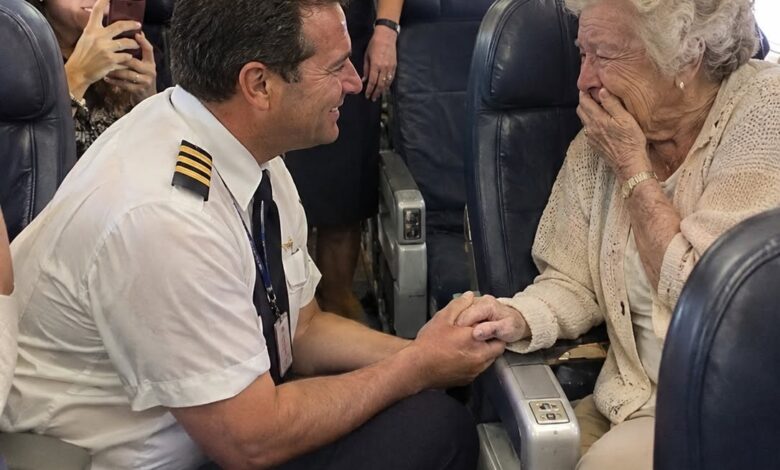
He was tall. Dark-haired, going gray at the sides. A white shirt with four gold stripes on each shoulder. A pair of silver wings pinned over his left pocket. Forty-five or so.
He was walking down the aisle very slowly.
Looking at every single row. Every face. Like a man searching for something he’d dropped.
When he got to row 31, he saw me.
And he stopped.
I didn’t know him. I want to be very clear about that.
I looked up at his face, and nothing came. Not a flicker.
My first thought was that something was wrong with the plane. My second thought was that something had happened to Walt’s body, in the cargo hold of some other plane. My third thought was Karen.
My heart started pounding.
He took off his hat.
I didn’t even know pilots still wore hats. It was black, with a shiny brim and gold leaves on it. He held it against his chest with one hand.
And then, right there in the aisle of that airplane, next to the empty drink cart spot, in front of a hundred and sixty people, the captain got down on one knee beside my seat.
“Mrs. Pruitt,” he said.
Then, softer:
“Evvie?”
Nobody had called me Evvie in eleven days.
Only Walt called me Evvie.
Only Walt. In fifty-three years. My own mother called me Evelyn. My sister called me Ev. Karen calls me Mama. The neighbors call me Mrs. Pruitt.
Only Walt ever called me Evvie.
I stared at this stranger kneeling in the aisle.
“Do I know you?” I said.
“No, ma’am,” he said. “You don’t.”
He swallowed.
“But I ate your lunches for a whole winter.”
He reached out and took my hand.
His hand was warm and steady. He held mine in both of his, very carefully. The way you’d hold a bird you’d found on the ground.
“My name is Marcus Hale,” he said. “Your husband was my shop teacher. At Hickory Ridge. 1997.”
His voice broke.
“He’s the reason I’m alive.”
He told me right there.
On one knee. In the aisle. With the bathroom door banging behind us and the baby in row 28 waking back up and fussing, and the whole back of the airplane leaning in to listen.
When Marcus was sixteen, his stepfather threw him out of the house.
It was January. 1997. There’d been a fight. A bad one. His stepfather had been drinking. Marcus had stood up to him for the first time in his life, because the man had shoved his mother into the kitchen counter. And his stepfather had grabbed him by the collar and thrown him out the front door into the snow.
His mother didn’t stop it.
She just stood in the kitchen doorway and watched.
“She didn’t even look at me,” Marcus said. “She looked at the floor.”
He had a backpack. A jacket that wasn’t warm enough. Eleven dollars in his pocket.
And nowhere to go.
So he went to the only place that had ever felt like his.
The wood shop at Hickory Ridge High School.
He knew the back door by the loading dock didn’t latch right. Everybody in shop class knew. You could jiggle it and it would pop open. Walt had been putting in work orders to fix it for two years.
Marcus walked four miles in the snow to the school that night. He jiggled the back door. It popped open.
He slept on the floor under the big workbench in the back of the shop. On a pile of sawdust, with a canvas drop cloth pulled over him.
It was twenty-two degrees outside. The heat in the school was turned down for the night. He said he could see his breath.
Walt found him at six-thirty the next morning.
Walt always got to school at six-thirty. Every single day for twenty-one years. He liked to have the coffee on and the saws checked and the floor swept before the boys came in at seven-forty.
He came in through that same broken back door. He turned on the lights.
And he saw a pair of sneakers sticking out from under the workbench.
“He didn’t call the principal,” Marcus said. “He didn’t call the police. He didn’t call my mom.”
He shook his head.
“He just crouched down and looked at me under that bench. For a long time. And then he said, Son, that drop cloth’s got linseed oil all over it. You’re going to smell like a cutting board all day.”
I put my free hand over my mouth.
“And then he stood up,” Marcus said, “and he walked out to his truck in the parking lot. And he came back with a sleeping bag.”
I knew that sleeping bag.
It was green. Army surplus. Walt kept it behind the seat of his truck from 1985 until the day we sold the truck. For emergencies, Evvie, he always said. You never know when you’ll get stuck somewhere.
That winter of 1997, the sleeping bag disappeared from the truck. I asked him about it once. In February. He said he’d lent it to somebody.
I’d forgotten all about it.
“He let me stay there until April,” Marcus said.
“He brought a cot in from somewhere. An old Army cot. He set it up in the supply room in the back of the shop, behind the lumber rack, where nobody would see. He ran an extension cord back there for a space heater. He gave me his own key to the back door, so I wouldn’t have to jimmy it anymore. He told the janitor I was his assistant. That I was staying late every night to help him with projects.”
He laughed. It came out wet.
“The janitor’s name was Mr. Gaines. He used to say, Mr. P., that boy works harder than anybody in this building. And Mr. P. would say, He sure does, Ernie.”
“And every single morning,” Marcus said, “he came in with two lunches.”
He was crying now too. A grown man. With four gold stripes on his shoulders. Kneeling in the aisle of his own airplane.
“Two brown paper bags. Every day. Ham and Swiss on rye bread with yellow mustard. An apple. Two oatmeal cookies wrapped in wax paper.”
He took a breath.
“And a note,” he said. “On a napkin. In this tiny little printing. Every single day. Eat the apple first. Do your algebra. Stand up straight, sailor.”
I knew those lunches.
Of course I knew those lunches.
I packed them.
It came back to me all at once. Sitting there in row 32.
January of 1997. A Tuesday morning. Walt came into the kitchen in his work clothes while I was making coffee. He stood by the counter for a minute. Fiddling with the sugar bowl.
“Evvie,” he said. “I’ve been hungrier at work these days. You know. Getting older. Would you mind making me two lunches instead of one?”
I looked at him.
“Two?”
“Just for a while.”
“Walter Pruitt, you’re fifty-one years old. You don’t need two lunches.”
“I’m a growing boy,” he said.
I laughed. I said fine.
And I made two. Every single morning. Ham and Swiss on rye with yellow mustard. An apple. Two oatmeal cookies in wax paper. In two brown paper bags.
January to April.
I thought he was eating both of them.
I used to tease him about it.
“You’re going to have to let out your work pants, Walt,” I’d say, handing him the two bags at the door.
“I’ll have you know,” he’d say, “I’ve got a very high metabolism.”
In March, I started putting in extra cookies. Because I felt sorry for him, working so hard. Four cookies. Two in each bag.
He came home that night and said, “Evvie. Thank you for the extra cookies.”
And I said, “You’re welcome, honey. You must be starving at that school.”
And he said, very quietly, “Somebody is.”
I didn’t understand what he meant……………..READ MORE NEXT PAGE 2