Look Closely: Can You Spot the Man Hidden in the Picture?
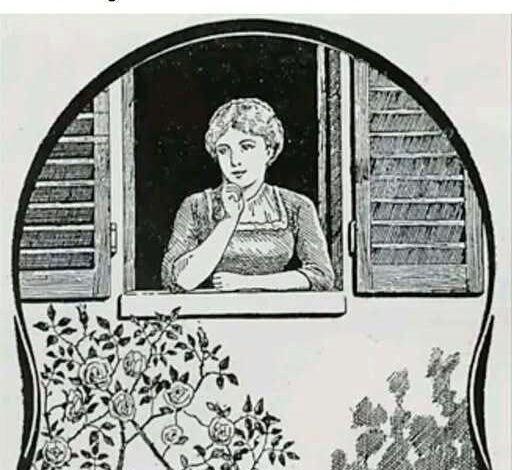
At first glance, this intricate black-and-white illustration appears to tell a simple story. A young woman in an old-fashioned dress stands beside an open window, resting her hand near her chin as she looks toward the garden below. Around her, the artist has created an elaborate collection of flowers, leaves, branches, shadows, and fine decorative lines. However, there is another image carefully concealed within the artwork, creating a fascinating visual puzzle for anyone willing to look closely.
The hidden man is not drawn as an obvious figure somewhere in the garden. Instead, his face is created by combining several existing elements in the illustration. Parts of the window, flowers, leaves, shadows, and surrounding outlines can appear to form different facial features when viewed from another perspective. This means that searching for a conventional person may not work. The key is to examine the illustration as a complete composition rather than focusing only on its most recognizable subject.
The woman naturally attracts most of the attention. Her figure is clear, detailed, and positioned in a prominent area of the picture, so the eye tends to settle on her first. Once attention becomes focused on her, the surrounding details can easily fade into the background. The illusion takes advantage of this natural tendency by placing the secondary image among objects that initially appear unrelated to one another.
One useful way to approach the puzzle is to stop examining every small detail individually. Instead, try looking at the larger shapes created by groups of lines. The outline of a flower might seem ordinary when viewed by itself, while several nearby shapes may begin to resemble part of a face when considered together. The same can happen with shadows and spaces between objects. Sometimes the most important part of an optical illusion is not a single line, but the relationship between many different lines.
Changing your viewing distance can also make a difference. If you normally hold the picture close to your screen, try moving back several feet and looking at the entire illustration. You can also briefly shift your focus away from the picture before looking at it again. These simple changes may help you notice patterns that were difficult to recognize while concentrating on one specific area.
The puzzle demonstrates an interesting feature of visual perception: people often organize complex images according to the objects they recognize first. Once a particular interpretation becomes dominant, other possible shapes may be overlooked. Optical illusions use this effect to create images that can be interpreted in more than one way.
The hidden face may seem difficult to identify at first, but once you notice the intended arrangement, the surrounding details can suddenly appear connected. Lines that previously looked like flower stems, window frames, or decorative patterns may seem to take on a new purpose. This moment of recognition is what gives the puzzle its appeal.
Some versions of this type of puzzle suggest that successfully finding the hidden man reveals something about a person’s age or abilities. Those claims should be viewed simply as part of the puzzle’s presentation rather than as established facts. Finding a hidden image is primarily a visual challenge that depends on how someone examines the arrangement of shapes and details.
That makes the illustration enjoyable without requiring any special explanation. It is simply a creative example of how the same collection of shapes can produce more than one visual interpretation. The image encourages viewers to slow down, examine the details, and consider how perspective can influence what they see.
So, before moving on, take another look at the entire picture. Start with the window, then examine the garden, flowers, leaves, shadows, and spaces between the objects. Rather than searching for a clearly drawn person, look for a larger pattern formed by the artwork itself. The hidden face may already be visible—you simply need to see the illustration in a different way.