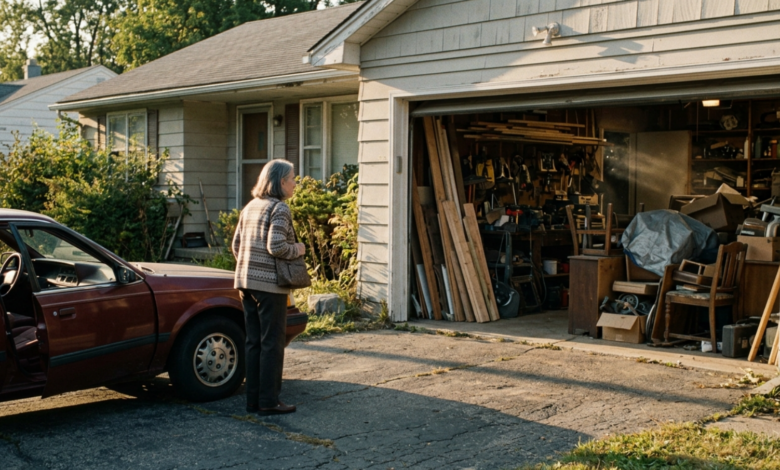
I Thought My Son Was Protecting Me, but What I Found in His Garage Revealed an Unexpected Family Secret
Under the photographs on the garage wall, three words were written in Wendell’s careful handwriting: “For Mama’s comfort.”
I felt a strange tightness in my chest. “Wendell?”
My voice sounded quieter than I intended.
The radio continued playing softly in the background. Somewhere inside the house, a tool made a brief buzzing sound before falling silent.
“Just a minute!” he called.
I had driven nearly forty minutes to reach his home because my son, Zachary, had convinced me that the man I cared about might have an interest in my late husband’s insurance money. I had tried to dismiss the suggestion, but his repeated questions had left me unsettled. I wanted to understand why Wendell had been so reluctant to invite me inside.
When he appeared in the doorway, wearing an old gray shirt and faded jeans, he stopped in surprise.
“Winona? You came all the way out here?”
“I did.”
His eyes moved toward the photographs on the wall. His expression changed, but I saw no obvious sign of dishonesty. Instead, he looked like someone who had been preparing for a difficult conversation.
“Well,” he said quietly, “I suppose you deserve to know what I’ve been working on.”
I crossed my arms, trying to keep my voice steady.
“Then tell me, Wendell. Why have you never invited me inside your house?”
He glanced toward the newly built ramp beside the entrance.
“I wanted to finish something first.”
“Finish what?”
He looked down at his hands. Those were the same hands that had repaired my porch light, carried groceries into my kitchen, and moved a heavy flowerpot when my knees were bothering me.
“I wanted everything to be ready before I showed you.”
“That still doesn’t explain much.”
He nodded, accepting my frustration.
“You’re right. Come inside, Winnie. I’ll show you.”
After a moment of hesitation, I followed him through the doorway.
The house smelled of fresh paint, wood, and coffee. It was modest and comfortable, with familiar furniture, clean curtains, and photographs arranged along the walls. Nothing about the place suggested a hidden relationship or a complicated secret.
Instead, I noticed a wide doorway, a bathroom fitted with grab bars, and newly installed lower kitchen cabinets. The walls were painted a soft, cheerful yellow.
Buttercup yellow.
I stood in the kitchen, looking around without saying a word.
Wendell remained near the doorway.
“My mother spent the last six years of her life using a wheelchair,” he explained. “After my father died, I brought her here because I wanted to look after her. But I didn’t understand how difficult this house was for her.”
He pointed toward the bathroom.
“The doorway was too narrow for her chair. She couldn’t reach things in the kitchen, and the front steps made it difficult for her to go outside without help. I worked all day and sometimes came home too tired to give her the attention she needed.”
He paused before continuing.
“I tried my best, but there were things I wish I had done differently. After she passed away, I promised myself I would make this place more comfortable. I wanted to create a home where someone could move around more easily and feel independent.”
I looked at the yellow walls.
“And this color?”
He smiled faintly.
“My mother always wanted a yellow kitchen. I found these photographs in an old box. I never finished painting the room while she was alive, so I decided to do it now.”
I touched the wall gently.
“And the ramp outside?”
He looked at me.
“You once told me that your knees sometimes made the steps at your back porch difficult. I remembered. I thought that if you ever wanted to visit, you shouldn’t have to worry about getting inside.”
I stared at him.
“You’ve been making these changes with me in mind?”
“Partly,” he answered. “But I needed to do this for myself, too. I wanted to turn some difficult memories into something useful.”
For the first time since my husband, Dwight, had passed away, I felt a little hope returning to my life. It was a feeling I hadn’t expected, and I wasn’t sure what to do with it.
Then I noticed several folded papers on the kitchen counter. A lumberyard receipt showed a total of $18,400.
“Wendell, what is all this?”
He gathered the papers.
“Just expenses from the work.”
“That is a considerable amount of money.”
He gave a small laugh.
“More than I originally expected.”
“Have you borrowed money?”
“No. I sold my fishing boat, used some savings, and took on extra repair jobs around town.”
I thought about the evenings when he had seemed unusually tired.
“You’ve been working very hard.”
“Perhaps a little too hard,” he admitted.
I wanted to tell him that he didn’t need to exhaust himself trying to fulfill a promise to his mother or impress a woman he had known for only a few months. But I understood the feeling of holding on to something unfinished. For two years, I had kept Dwight’s recliner beside the window, unable to imagine moving it. Wendell had been trying to make peace with his own memories.
Neither of us had completely figured out how to move forward.
I sat at the kitchen table.
“Have you eaten today?”
He blinked in surprise.
“What?”
“You heard me. Have you eaten?”
He smiled.
“I had coffee.”
“Then you need a proper meal. Do you have eggs?”
“Yes, ma’am.”
“Good. Make some. I’ve driven a long way, and I would rather not leave knowing you’ve been working all day without eating.”
He laughed, and the tension in the room eased.
As he moved around the kitchen, I noticed a handwritten list on the refrigerator.
Things to finish before Christmas:
Complete the ramp.
Install the bathroom rails.
Finish the kitchen.
Repair the back door.
Ask Winnie to dinner.
I read the last item twice before smiling to myself.
For the first time in a long while, someone had written my name beside something to look forward to.
The Banking Alert
I returned home that afternoon feeling lighter than I had in months. I had promised Wendell that I wouldn’t reveal the surprise renovations before Christmas, and I intended to keep my word.
There was one complication I hadn’t considered: my son had helped me set up banking notifications on my phone.
Zach had suggested the arrangement after hearing about a neighbor who had lost money through a scam. At the time, I thought he was simply being careful. I hadn’t realized how much information the arrangement would give him about my financial activity.
That evening, while preparing supper, I received his call.
“Mama, where were you today?”
“Hello to you, too, Zach.”
“I stopped by your house, and you weren’t home.”
“I had some errands.”
“What kind of errands?”
I put down the spoon I was holding.
“Since when do I need to give you a schedule?”
There was a pause.
“You went to see Wendell, didn’t you?”
I looked at the phone.
“How did you know where I went? Have you installed something on my phone?”
“No. I just know you, Mama.”
I wasn’t convinced.
“Zachary, I’m ending this conversation now. We can speak another time.”
“Wait. Did he ask you for money?”
“No.”
“Did he ask to see your bank statements?”
“No, Zach. Good night.”
I ended the call, feeling unsettled.
For years, I had interpreted my son’s concern as a sign of affection. After his father died, I understood why Zach might have worried about losing me, too. But I was beginning to realize that concern could become overbearing when it left no room for trust.
The next morning, I contacted my bank to review the permissions on my account. A representative explained that Zach had viewing access and that some notifications were being sent to his email address.
“Would you like to change those settings?” she asked.
I hesitated.
He was my son. I had carried him when he was a baby, stayed beside him through childhood illnesses, and helped him through difficult years. I had even contributed toward equipment for his auto repair business when he needed support.
Still, I had a right to manage my own finances privately.
“Yes,” I finally said. “I would like to change them.”
By lunchtime, my account access was private again.
I didn’t feel victorious. I felt sad that a simple boundary had become necessary.
Later that day, my daughter, Megan, called.
“Mama, what’s going on?”
“What has your brother told you?”
“He says you’ve been visiting Wendell without telling us. He thinks this man might be encouraging you to keep things from the family.”
I took a slow breath.
“Megan, have you met Wendell?”
“No.”
“Have you ever had a conversation with him?”
“Not really, but Zach says—”
“Then I want you to understand something. You can worry about me. You can ask questions. But you cannot decide who I am allowed to spend time with simply because you’re uncomfortable with my choices.”
She grew quiet.
“We’re just trying to protect you.”
“I know, sweetheart. I appreciate that you care. But protecting someone should not mean taking away their independence.”
After a moment, she said, “Zach thinks Dad would never have wanted you to date again.”
My throat tightened.
Dwight and I had shared thirty-nine years of marriage. He had been my partner, my closest friend, and the person with whom I had built a home. Nothing could change what he meant to me.
“Your father loved me, and I loved him,” I said. “That will always be part of my life. But loving him doesn’t mean I must spend every remaining year alone.”
“I didn’t mean it that way.”
“I know. I love you, Megan. I just need you to understand that I am still your mother, and I am also a person with a future.”
When the call ended, I sat quietly for a while. It was difficult to discover that the children you had raised could still see you as someone who needed to be directed, even after you had spent decades making decisions for yourself.
I hoped they would eventually understand.
A Difficult Sunday Dinner
The following Sunday, Wendell came to my house for supper. He brought a pecan pie from a local bakery and apologized because he had forgotten to buy whipped cream.
I laughed so hard that I nearly dropped the serving spoon.
It felt good to enjoy an ordinary evening without explaining or defending myself.
Then Zach arrived unexpectedly with his wife, Jordyn.
His eyes immediately went to Wendell.
“So, this is the man everyone’s talking about.”
Wendell stood politely.
“Good evening, Zach.”
“Let’s not pretend we know each other.”
“Zach,” I said, “please speak respectfully in my home.”
He looked surprised, then turned toward Wendell.
“I hear you’ve been working on a project at your house. What exactly are you building?”
Wendell set down his fork.
“I’m renovating my home.”
“And why haven’t you invited my mother over before?”
“I wanted to finish the work first.”
Zach gave a skeptical look.
“My mother has savings and insurance money from my father. She’s sixty-four years old, and I want to make sure nobody takes advantage of her.”
Wendell listened without interrupting.
“You have every right to care about your mother,” he said. “But you should also give her the chance to make her own decisions.”
“Then explain why you’ve been keeping your house a secret.”
“I wasn’t trying to hide anything. I was preparing a surprise.”
The room became quiet.
I knew Zach was worried, but the way he was speaking had turned a family dinner into an uncomfortable confrontation.
“Zachary, sit down,” I said.
He remained standing.
“I’m trying to protect you, Mama.”
“I understand that. But I can protect myself, too. If you have a reasonable question, ask it respectfully. Don’t accuse someone without evidence.”
He looked at me with frustration.
“If you choose him over your family, don’t expect us to keep coming around.”
Jordyn quietly said his name, but he didn’t respond.
I looked at my son and remembered the little boy who used to come to my room during thunderstorms. I remembered the teenager who had once needed comfort after a difficult day and the young man who had worked hard to establish his business.
I loved him. That hadn’t changed.
But I realized that he had begun treating my affection as though it gave him authority over my life.
I stood up.
“You are welcome in this home, Zachary. You may disagree with my choices, and you may tell me when you’re worried. But you cannot threaten to withhold your family from me because I refuse to do what you want.”
His expression changed.
“If you leave tonight, that will be your decision. I hope you’ll reconsider, but I won’t allow this conversation to continue this way.”
For a moment, nobody spoke.
Then Zach picked up his jacket. Jordyn looked at me with sadness.
“I’m sorry, Winona,” she said.
I nodded.
“I know, sweetheart.”
They left, and the house became quiet again.
Wendell sat beside me.
“I’m sorry this has become so difficult.”
“You have nothing to apologize for.”
He reached across the table and took my hand. I let him hold it.
For the first time since Dwight’s funeral, I didn’t feel that wanting companionship was something I needed to justify.
The Letter From the Attorney
The next morning, a letter arrived from an attorney’s office in Dallas. It contained a copy of a document concerning a request for financial authority.
My name appeared on the paperwork beside Zachary’s.
I read the document carefully. It appeared that my son had explored the possibility of obtaining broader authority to assist with my financial affairs. The document did not establish that he had received such authority, but I wanted to understand why the matter had been raised without my knowledge.
I contacted the attorney who had helped Dwight and me prepare our wills.
His name was Mr. Harlan, and he had known our family for years.
When I arrived at his office, he greeted me warmly and invited me to sit down.
“What can I help you with, Winona?”
I placed the letter on his desk.
“Can you explain what this means?”
He reviewed the paperwork.
“This appears to concern an inquiry about financial authority,” he explained. “It does not, by itself, establish that your son has obtained any legal power over your affairs. We need to examine the details and determine exactly what was requested.”
“Does this mean someone believes I cannot manage my own money?”
“Not necessarily. Families sometimes explore ways to help relatives with financial matters. But the legal requirements depend on the arrangement involved, and you should understand any proposal before agreeing to it.”
I looked at him.
“I worked for thirty-four years in an emergency room. I’ve managed a household, handled insurance paperwork, paid bills, and made difficult decisions. I can still manage my own affairs.”
“I have no reason to assume otherwise,” he replied.
“Then why does my son behave as though I cannot make a decision without him?”
Mr. Harlan took a moment before answering.
“Disagreement does not automatically mean someone lacks the ability to make decisions. Let’s review your current arrangements, confirm that your accounts are secure, and make sure your wishes are properly documented.”
His calm response helped me think more clearly.
I also asked him to review the beneficiary designations and estate documents Dwight and I had prepared. I wasn’t doing it to punish my children. I simply wanted to ensure that my plans reflected my wishes.
Our house was paid off, and our savings were sufficient for my needs. Dwight’s insurance policy had been intended to help me maintain financial stability, cover future expenses, and enjoy my retirement without depending on someone else.
It wasn’t a fund that my children could manage according to their own preferences.
The distinction mattered.
I left the office feeling more confident. I didn’t need to make dramatic changes or argue with anyone. I needed clear information, appropriate safeguards, and the freedom to decide what happened next.
That afternoon, I drove to Wendell’s house.
He was outside sanding a piece of wood when I arrived.
“You look serious,” he said.
“I’ve had a complicated morning.”
I told him about the letter and the conversation with the attorney. He listened without interrupting.
When I finished, he put down his tools.
“Winnie, I don’t want to come between you and your children.”
“You haven’t.”
“I know what family disagreements can do. My sister and I struggled for months after our mother passed away. We argued about decisions, responsibilities, and who had done more. We forgot that we were both trying to cope with losing someone we loved.”
“What happened between you?”
“We stopped speaking for a while. Years later, I realized how much I missed the ordinary things. A conversation over coffee. A Sunday dinner. The chance to tell her I was sorry.”
He looked toward the yard.
“I don’t want you to lose the opportunity to make things right with Zach.”
I felt tears gathering in my eyes.
“I don’t want to lose my son, either. But I can’t keep him close by allowing him to make every decision for me.”
“No,” Wendell said gently. “You can love someone and still say no.”
Those words stayed with me.
Over the following weeks, I began making small but important changes. I reviewed my bank statements, updated my account security, and discussed my estate plans with my attorney. I also made an appointment with my doctor to talk about my knees and possible physical therapy.
I returned to the grief group I had attended after Dwight’s death. I had originally gone because I struggled with the emptiness he left behind. Now I understood that grief wasn’t something I had to finish before I could begin living again.
Moving forward didn’t mean forgetting the people we had lost.
Sometimes it meant learning how to carry their memories while making room for new experiences.
Wendell and I continued seeing each other. We visited a diner in town, walked through a garden center, and sat on his porch drinking coffee while the evening light settled over the yard.
He never asked about my insurance or savings. He never requested money for his renovations.
When I offered to contribute toward the cost of the ramp, he shook his head.
“No, ma’am.”
“Wendell, I’m not offering charity.”
“I know.”
“Then let me help in some way.”
He considered the idea.
“If you’d like to help, you can choose the flowers for the front of the house.”
“Flowers?”
“Your choice.”
I smiled.
“That sounds much more reasonable.”
The following Saturday, we bought yellow roses and purple coneflowers. I chose the plants, and he carried them. We found a comfortable arrangement without either of us having to insist on doing everything.
For the first time in years, I felt as though I was building something rather than simply preserving what remained.
An Apology at the Kitchen Table
One Friday afternoon, Zach appeared at my front door alone.
“Mama, can we talk?”
“Of course.”
He sat at the kitchen table and looked toward Dwight’s old chair.
“I miss Dad,” he said.
The words brought tears to my eyes.
“So do I, sweetheart.”
He rubbed his hands together.
“After he died, I thought I had to take care of everything. The house, the accounts, you, Megan. I kept telling myself that if I stayed in control, nothing bad could happen.”
I sat across from him.
“Nobody expected you to take care of everything alone.”
“I know. But when you started seeing Wendell, I became afraid that you might give away what Dad had worked so hard to leave you.”
“Did I ever tell you I planned to do that?”
“No.”
“Did Wendell ever ask me for money?”
“No.”
He lowered his eyes.
“I let my worries get the better of me.”
I wanted to reach across the table and comfort him immediately. That instinct had been part of me since the day he was born.
But I needed him to understand that his actions had consequences.
“Zach, I love you. But you hurt me. You made me feel as though I had to defend my right to enjoy my own life.”
His eyes filled with tears.
“I’m sorry, Mama.”
I believed he meant it. Still, an apology was only the beginning of rebuilding trust.
“There is something else we need to discuss,” I said. “The paperwork concerning my finances.”
He shifted in his chair.
“I wasn’t trying to take your money.”
“Then what were you trying to do?”
“I thought it might be easier if I handled more of the bills. I thought I was helping.”
“Without asking me?”
He looked down.
“I made a mistake.”
“Yes, you did.”
I reached across the table and held his hand.
“You are my son. I want you in my life. I want you at Sunday supper, and I want my grandchildren to visit whenever they can. But I will not surrender control of my finances or my future to prove that I love you.”
He nodded slowly.
“I understand.”
I hoped he did.
Before he left, he asked one final question.
“Do you really love Wendell?”
I thought about the man who had remembered the color of his mother’s kitchen, who had spent his savings making his home more comfortable, and who had listened when I needed someone to hear me.
“Yes,” I said. “I do.”
Zach looked toward the window.
“I don’t know if I’m ready to spend time with him yet.”
“That is your choice. You don’t have to rush.”
“But I’m going to try.”
I hugged him at the door. For the first time in months, I felt that we were beginning to understand each other again.
We still had work to do, but at least we had started talking honestly.
A Call About My House
I thought the most difficult part of the situation was behind us. Then, a few days later, a real estate agent called.
“Mrs. Winona, I’m contacting you to confirm whether you authorized an inquiry about selling your property in Seagoville.”
I gripped the phone.
“I’m sorry. What did you say?”
The agent explained that someone had contacted him to discuss the property’s possible value. He had not listed the house or begun advertising it. He simply wanted to confirm whether I had requested the information.
I had not.
After thanking him, I ended the call and sat quietly.
Dwight and I had bought that house when Zach was still in elementary school. We had celebrated birthdays there, watched our children grow, and spent countless weekends tending the yard. It was the place where we had built our family life together.
I wasn’t ready to leave.
I called Zach.
“Mama?”
“Did you contact a real estate agent about selling my house?”
There was a pause.
“I was looking into some options.”
“Options for whom?”
“For you. The house is large, and there are repairs to consider. I thought you might be more comfortable somewhere smaller.”
“Did you ask me whether I wanted to move?”
“I was going to talk to you about it.”
“After contacting an agent?”
He sighed.
“Nothing was signed.”
“That isn’t the point, Zach.”
He explained that he believed a smaller home might be easier for me to maintain. I understood the practical concern, but he had once again made inquiries about my future without speaking to me first.
“I appreciate that you’re thinking about my comfort,” I told him. “But I am not planning to sell my house.”
“You don’t have to decide right now.”
“I have decided.”
He sounded frustrated.
“Mama, you’re letting your emotions make this difficult.”
I took a slow breath.
“I am capable of deciding where I want to live. I will speak with my attorney about ensuring that nobody can act on my behalf without the proper authority. This is not about punishing you. It is about respecting my decisions.”
He began to respond, but I gently ended the conversation.
Afterward, I walked to Dwight’s recliner and sat down.
For two years, I had left it beside the window because moving it seemed like another way of saying goodbye. Now I looked around the familiar room and understood something important.
I didn’t have to leave my home to prove that I was moving forward. I could keep the memories and still make new ones.
I looked out at the yard Dwight had spent so many weekends tending.
“I’m not ready to leave yet,” I whispered.
The house remained quiet, but I no longer felt as though I needed permission to stay.
A Christmas Invitation
That afternoon, I visited Wendell. He was installing the final section of railing beside the ramp when he noticed my expression.
“What happened?”
I told him about the real estate agent and my conversation with Zach. He listened carefully, then invited me inside.
We sat at the kitchen table while he prepared coffee.
“You don’t need me to tell you what to do,” he said.
“Good, because I don’t want anyone making decisions for me.”
He smiled.
“Then I’ll just listen.”
I explained that I was tired of feeling as though everyone around me had begun treating my future like a family project. I knew my children cared about me, but I wanted them to recognize that caring for someone also meant listening to them.
Wendell nodded.
“When my mother was alive, I sometimes made decisions for her because I thought I knew what was best. I told myself I was protecting her. Sometimes I was helping, but other times I was making things easier for myself.”
He looked down at his hands.
“I don’t want to repeat that mistake with you.”
“You haven’t,” I assured him.
“But if I ever start doing it, tell me.”
“I will.”
He took a breath and looked toward the yellow kitchen wall.
“Winnie, there’s something I’ve wanted to ask you.”
My heart gave an unexpected little jump.
“What is it?”
“Would you like to come here for Christmas dinner?”
I looked at him, and he quickly continued.
“Not because I need someone to fill the house. Not because I expect you to replace anyone. I just thought it might be nice to share the day with someone who understands why this kitchen matters to me.”
I looked around the room. The ramp outside, the photographs of his mother, and the list on the refrigerator all reminded me of the care he had put into making his home more welcoming.
Then I thought about my own house, with Dwight’s recliner beside the window and the Christmas decorations stored in the hallway closet.
For two years, I had believed that keeping everything unchanged was a way of keeping my husband close. Perhaps I had been asking too much of the furniture and not enough of myself.
Dwight would always be part of my story. But my life was still unfolding.
“I’d love to come,” I said.
Wendell smiled.
“Then it’s settled.”
We planned a simple meal of turkey, mashed potatoes, green beans, and pie. I promised to bring the dressing, and he promised to pay attention to the cooking time.
It was an ordinary conversation, but it made the future feel a little brighter.
There was still the question of my family. Zach needed time to understand that his concern did not give him the right to control my choices, and I needed time to rebuild the trust between us.
I also knew that forgiveness would not erase every disagreement overnight.
But I was ready to take things one step at a time.
I had learned that love and independence could exist together. I could care deeply about my children without handing them the responsibility for every decision I made. I could honor my late husband without giving up the possibility of companionship. And I could welcome someone new into my life without forgetting the people who had shaped it.
As I drove home that evening, I thought about the yellow kitchen, the flowers we had chosen, and the handwritten list on Wendell’s refrigerator.
For the first time in a long while, I wasn’t simply looking back at the life I had lost.
I was beginning to look forward to the life I still had.
And that felt like a good place to begin.