I Married My First Love to Fulfill Her Dying Wish but After She Passed Away Her Son Revealed a Secret She Had Kept From Me
I looked back down.
I wrote you a letter. Six pages. I told you everything. I told you I was scared and I loved you and I didn’t know what to do. I gave it to my father to mail, because I didn’t have a stamp. That’s the truth. I didn’t have a stamp.
He read it. And he burned it in the fireplace in front of me.
He said a deacon’s daughter was not going to marry a delivery driver’s son who’d be in school for seven more years. He said I’d ruin your life and mine. He said you’d have to quit Wheaton and drive a truck like your father. He said if I contacted you, he’d go to your scholarship committee and tell them what you’d done.
I was eighteen, Tommy. I believed him.
Walter Pierce was a mechanic who’d fixed my father’s Cadillac. He was ten years older than me and he went to our church, and he’d been sweet on me for a year. My father went to him. I don’t know exactly what he said. I know that two weeks later, Walter came to our house and sat with me on the porch swing, the same one you used to sit on, and asked me if I was in trouble. I told him the truth. All of it.
He said he’d marry me anyway. He said he’d raise the baby as his own and never tell a soul. He said, Maggie, you don’t have to love me. Just let me take care of you.
So I called you. I told you I was marrying Walter. I hung up before you could hear me cry.
Daniel was born on the eleventh of June, 1982, in Tulsa.
He’s yours, Tommy. He’s your son.
The paper was shaking in my hands. I couldn’t see the words anymore. I put the letter down on my knee and pressed my hand over my eyes.
Daniel didn’t move beside me.
After a while, I picked the letter back up.
Walter knew. He always knew. He loved Daniel like his own blood. He taught him to fish and to fix a carburetor and to tell the truth, and he was the best father I’ve ever seen. But six years ago, when he was dying, he made me promise him something. He said, Maggie, that boy has a right to know who his father is. And that man has a right to know he has a son. He said, I raised him, but I didn’t make him. Don’t let me take that to my grave.
I told Daniel after Walter’s funeral. He was thirty-eight. He didn’t speak to me for four months.
And I didn’t tell you. For six more years, I didn’t tell you. I kept meaning to. I kept being afraid. That you’d hate me. That you’d think I’d stolen your son from you. That you’d be right.
Then the cancer came. And I knew I was out of time.
Tommy, I asked you to marry me because I wanted Daniel to see it. Just once. His mother and his father, standing together. I wanted him to see the man I’ve loved my whole life, in his only suit, putting a ring on my finger. I wanted to give him that, even if I couldn’t give him the rest. It was selfish. I know it was. But I’d never once in my life asked for anything for myself. I asked for this.
And I wanted to be your wife. Even for a week. I wanted to know what it would have been like.
It was everything, Tommy. It was everything I imagined on the steps of the Shrine Mosque.
The truth is the only thing that ever really sets anybody free. You told me that when you were eighteen. I’m finally listening.
I’m sorry. I’m so sorry. I love you. I always did.
Be good to our boy.
Your wife, Maggie
P.S. The shoebox on the windowsill is yours. Daniel has it. Don’t let him throw it away. He’ll want to.
I sat on the steps of Grace Community Methodist Church in my funeral suit, the same charcoal gray JCPenney suit I got married in five weeks earlier, and I held my dead wife’s letter in my lap, and I looked at the man beside me.
At his dark hair going gray at the temples. At his wire-rimmed glasses, like mine. At his hands, big and square, with long fingers. Like my father’s.
I’d met him three weeks earlier, and he’d looked at me like he was trying to memorize me. Now I understood why.
“You knew,” I said. My voice didn’t sound like my own. “The whole time. In the hospital.”
Daniel took his hands away from his face. His eyes were red.
“For six years,” he said. “Since Dad’s funeral. Walter’s funeral.” He laughed, a broken sound. “I don’t even know what to call him now. He was my dad. He’s still my dad.”
“He is,” I said. “He’ll always be your dad.”
Daniel looked at me.
“I looked you up,” he said. “After Mom told me. Six years ago. I found your church website. There’s a picture of you on it. In a robe, at a baptism, holding a baby. I looked at it every night for a month.” He swallowed. “I drove up here twice. To Springfield. I sat in the parking lot of this church on a Sunday morning and watched people go in. I watched you shake their hands at the door after. I couldn’t make myself go in.”
“Why not?”
“Because I was angry,” Daniel said. “At Mom, mostly. For lying to me my whole life. At Walter, a little, for going along with it. And at you.” He looked at me. “Because I thought, what kind of man doesn’t notice his girlfriend disappeared? What kind of man doesn’t drive home from Illinois and find out why?”
I didn’t answer. I couldn’t. Because I’d asked myself that same question for forty-five years.
“I didn’t know,” I said finally. “Daniel, I swear before God, I didn’t know. She called me two days before Thanksgiving and said she was marrying someone else. I thought she’d stopped loving me. I thought I wasn’t good enough.” My voice broke. “I sat on the floor of my dormitory hallway until two in the morning. And then I went to class the next day. And the next. I told myself it was God’s will.”
Daniel was quiet for a long time.
“Mom told me that,” he said. “In the hospital. On the second day you came. After you left, she cried for an hour. She said, He didn’t know, Danny. He never knew. Don’t you dare blame him.”
We sat there on the church steps. The wind came up and blew a few dead leaves across the parking lot.
“There’s something else,” Daniel said. “Something I need to say. Before you hear it from somebody else.”
I waited.
“When Mom told me she was going to marry you,” he said slowly, “I was angry. Really angry. I told her it was crazy. I told her you were a stranger. And I said…” He stopped. He looked ashamed. “I said maybe you were after her money. Walter left her the house in Tulsa and his life insurance and his retirement. About six hundred thousand dollars, altogether. I looked it up. In Missouri, a spouse can claim a share of the estate, even if the will says something different. It’s called an elective share.” He wiped his face with his hand. “I said to her, Mom, you’re about to make some preacher you knew in high school a rich man.”
“What did she say?”
“She laughed at me,” Daniel said. “She said, Danny, that man bought me a ring at a flea market for eight dollars. Does that sound like a man who wants my money?” He shook his head. “And then she said, If he does try, let him. He’s owed forty-four years of child support. I’ll consider it a down payment.”
I laughed. I couldn’t help it. It came out of me like a sob.
That was Margaret. That was exactly Margaret.
I went to see a lawyer that week. A man named Harold Bishop, a member of my congregation for thirty years, who’d practiced estate law in Springfield since 1982. I sat in his office on Walnut Street, two blocks from the house where Margaret grew up, and told him everything.
He listened without interrupting, the way good lawyers do. When I was done, he took off his reading glasses and rubbed his eyes.
“Tom,” he said. “Margaret’s will was signed in Tulsa four years ago. Before your marriage. It leaves everything to Daniel. But under Missouri law, a surviving spouse who wasn’t provided for in the will can choose to take an elective share instead. For a spouse with no shared children, that can be up to half the estate.” He looked at me over the desk. “You were married. It was legal. Shirley from the Recorder’s office filed the license. If you wanted to, you could claim it.”
“I don’t want it,” I said.
“I know you don’t,” Harold said. “But Daniel doesn’t know that for certain. And it’s going to sit between you two like a stone until he does.”
He explained that I could sign a document called a disclaimer, giving up any claim to Margaret’s estate, permanently. It had to be in writing, signed and notarized, and filed with the probate court within nine months. Once it was filed, it could never be taken back.
“Draw it up,” I said.
He did. I signed it in his office on a Thursday afternoon, with his secretary as the notary. Harold filed it with the Greene County Probate Court the next morning and mailed a certified copy to Daniel in Tulsa.
I added a letter to the envelope. One page. I told Daniel I’d signed it so he’d never have to wonder. I told him the only things of his mother’s I wanted were the ring with the pink heart, if he’d let me have it back from the funeral home, and the shoebox on the windowsill.
He called me the night he got it.
“You didn’t have to do that,” he said.
“Yes, I did,” I said.
He was quiet on the phone for a long time. Then he said, “The ring. She asked to be buried with it. I’m sorry. I should have asked you first.”
I closed my eyes. “No,” I said. “No. That’s right. That’s where it belongs.”
“But the shoebox,” Daniel said. “I still have the shoebox. I haven’t opened it. She told me not to.” He paused. “Can I bring it up this weekend? Will you open it with me?”
He came on Saturday afternoon. He brought Jenna, his wife, and the children, Lily and Sam. They’d driven up from Tulsa that morning, three hours. They sat in the parsonage living room beside my church, a small, plain room with a couch from 1994 and a bookshelf full of theology, and Jenna made the kids sit on the floor and not touch anything.
Daniel set the battered Florsheim shoebox on my coffee table. He took off the rubber bands. He looked at me.
“Together,” I said.
He lifted the lid.
It was full of letters. Dozens of them. Old envelopes, yellowed, with three-cent stamps and five-cent stamps and twenty-cent stamps. Every one of them addressed in my handwriting, from Wheaton, Illinois. To Miss Margaret Ellison, 1412 Walnut Street, Springfield, Missouri.
All of them unopened.
Underneath them, at the bottom of the box, there was a peach-colored silk flower, crushed flat and brown at the edges. The corsage I gave her on prom night in 1981. And a photograph, faded and curled at the corners, of two seventeen-year-olds on the steps of the Shrine Mosque. A skinny boy in a powder blue tuxedo with ruffles, and a red-haired girl in a peach dress with puffy sleeves, laughing so hard her eyes were closed.
And one more thing. A little card, newer than everything else, in Margaret’s shaky hospital handwriting.
Tommy. These are the letters you wrote me in October and November of 1981. My father kept them from me. He hid them in his desk. I found them after he died in 1999. I’ve read every one a hundred times. I’m giving them back to you so you can show your son what kind of man his father was at nineteen. Read him the one from November 14th. M.
Daniel found it in the pile. November 14, 1981. My handwriting, young and earnest and a little clumsy.
He read it out loud, sitting on my couch, with his wife and his children listening.
Dear Maggie, I don’t know why you won’t write back. Your mother says you’re busy. Maybe you’ve met someone else. If you have, I understand. I’ll try to understand. But I want you to know that whatever happens, whoever you end up with, wherever you go, I’m going to spend my life trying to be the kind of man you’d be proud to have known. I’ll be that man whether you’re watching or not. Because you made me want to be. Love always, Tommy.
Daniel stopped reading. He set the letter down on the coffee table. He took off his glasses and pressed his hands against his eyes.
On the floor, ten-year-old Lily looked up at me.
“Are you my grandpa?” she asked.
Jenna said, “Lily!”
But I knelt down on the floor, slowly, because my knees aren’t what they were, so I was eye to eye with that little girl. She had red hair. Margaret’s hair. In a braid down her back.
“I think I might be,” I said. “If you’ll have me.”
Daniel took a DNA test in April. Not because he doubted it, he said. Because Walter had always told him a good engineer checks his math.
We both spat into little plastic tubes at my kitchen table and mailed them off, and six weeks later the results came back in an email we opened together on a phone call, him in Tulsa and me in Springfield. Parent and child. Ninety-nine point nine nine percent.
Neither of us said anything for a long time on the phone.
“Well,” Daniel said finally. “Walter always said I had somebody else’s ears.”
The first Sunday in May, the Calloway family came to church.
That’s what I’ve started calling them. The Calloway family. Daniel Pierce and Jenna Pierce and Lily and Sam Pierce. They keep the Pierce name. They always will, and they should. Walter Pierce earned it. But in my heart, and on the little card I keep in my Bible, they’re the Calloway family too.
They drove up from Tulsa that morning. Three hours. They walked into Grace Community Methodist at ten fifty-five and sat in the third pew on the left, Lily in a blue dress with her red braid, Sam in a clip-on tie he kept tugging at. I was standing at the pulpit going over my notes when they came in. I looked up and saw them, and I had to look back down at my notes for a long time.
My sermon that morning was on the Prodigal Son. I’d written it weeks before. But I didn’t preach the one I’d written.
I stood at the pulpit of the church where I’d served for twenty-six years and looked out at ninety faces, and at four in particular, and I told them about a girl in a peach dress and a boy in a blue tuxedo. I told them about a letter that got burned in a fireplace, and a mechanic who sat on a porch swing and said, You don’t have to love me, just let me take care of you. I told them about a son who grew up not knowing, and a father who grew old not knowing, and a woman who carried the truth for forty-five years because she was afraid.
“We usually tell the Prodigal Son as a story about the one who left,” I said. “But I’ve been thinking it’s also a story about the one who waited. The father, standing at the end of the road every day, looking for his son. Not knowing if he’d ever come home.”
I looked at the third pew.
“Sometimes we don’t know we’re the one waiting,” I said. “Sometimes we’re standing at the end of the road for forty-five years, and we don’t even know who we’re waiting for. Until one day, God sends him walking up the road toward us. With his wife. And two grandchildren in their Sunday clothes.”
Nobody in that church made a sound. Old Mrs. Hendricks in the front row had her handkerchief out. Harold Bishop, the lawyer, was looking at the floor.
In the third pew, Daniel had his arm around his wife. He was crying. He didn’t hide it this time.
After the service, I stood at the door shaking hands the way I always do. The Calloway family came last. Jenna hugged me. Sam shook my hand very seriously and said, “Good sermon, sir,” which his mother had clearly told him to say in the car.
Lily hugged me around the waist and wouldn’t let go.
And Daniel stood in front of me on the church steps, the same steps where he’d handed me Margaret’s envelope seven weeks before. He held out his hand. I shook it. Then he pulled me into a hug, a hard one, the kind men give when they don’t know what else to do with their arms.
“Thanks, Dad,” he said into my shoulder. Very quietly. So quietly I almost didn’t hear it.
He let go before I could say anything. He walked his family to their car without looking back. I think he couldn’t.
I stood on the steps of my church and watched them drive away. Then I went inside and sat in the last pew of the empty sanctuary for a long time.
On the second Saturday of May, Daniel and I drove out to Greenlawn Cemetery together.
It was forty-five years to the night since the prom at the Shrine Mosque. Daniel didn’t know that until I told him in the car. He went quiet for a while, and then he asked me to tell him about it. So I did. The peach dress. The blue tuxedo with the ruffles. The corsage. Her father waiting on the porch with the flashlight. The promise on the steps.
We stood together at her grave under the big oak tree as the sun went down. The headstone had been set the week before. Daniel had chosen the words himself. I hadn’t seen it yet.
Margaret Ellison Pierce Calloway 1963 – 2026 Beloved Mother, Grandmother, and Wife “The truth will set you free.”
I stood there and read it three times.
“I hope that’s all right,” Daniel said beside me. “The last name. And the verse. I asked Jenna, and she said you’d want it.”
“It’s perfect,” I said. My voice didn’t work right. “It’s exactly right.”
Daniel reached into his jacket pocket. He took out something small and held it out to me in his open palm.
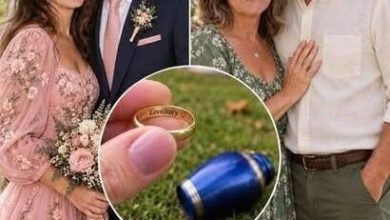
It was a ring. A little silver band with a tiny pink enamel heart.
I stared at it.
“I thought she was buried with it,” I said.
“She was,” Daniel said. “This is a different one.” He almost smiled. “I drove out to that flea market on 66 last weekend. The old man with the jewelry case at the back was still there. I told him who I was. He remembered you. He said a preacher in a gray suit came in at closing time and spent forty minutes picking out an eight-dollar ring, and almost cried when he paid for it.” Daniel looked down at the ring in his hand. “He had one more. Same kind. Pink heart. He said he’d been saving it. He said he figured somebody would come back for it.”
He held it out.
“I want Lily to have it,” he said. “When she’s older. When she goes to prom. I want her to know where it came from. Her grandmother, and her grandfather, and a promise somebody kept forty-five years late.”
I took the ring from him. I held it in my palm and looked at that ridiculous little pink heart catching the last of the evening light, the way its twin caught the afternoon sun through a hospital window when its wearer laughed so hard the nurses came running.
“You keep it,” I said, and pressed it back into his hand. “Until she’s ready. You give it to her, Daniel. Not me.”
“Why not you?”
“Because you’re her father,” I said. “That’s your job. Walter taught you how to do it.” I closed his fingers around the ring. “And because I want to be standing right next to you when you do.”
We stood there at her grave until it was dark. Two men, side by side, a father and a son who’d met for the first time at a dying woman’s bedside. We didn’t say much. We didn’t have to.
At some point, Daniel reached into his other pocket and took out a folded piece of paper. He unfolded it and held it so I could read it in the light from his phone.
It was my letter. November 14, 1981. I’m going to spend my life trying to be the kind of man you’d be proud to have known. I’ll be that man whether you’re watching or not.
“She kept it on her nightstand in Tulsa,” Daniel said. “For twenty-seven years. After she found them. This one, by itself. I used to see it every time I visited and never knew what it was.” He folded it carefully and put it back in his pocket. “I’m going to keep it on mine.”
Then he looked at me.
“She was watching, you know,” he said. “The whole time. Every sermon you posted online. Every picture on that church website. She knew exactly what kind of man you turned out to be.” He swallowed. “She just couldn’t tell you she was proud. Because then she’d have had to tell you everything.”
I looked at the headstone in the dark. The truth will set you free.
“She told me,” I said. “At the end. That’s what the wedding was, Daniel. That was her telling me.”
We drove home through the dark Ozark hills with the windows down and the smell of honeysuckle coming in. Daniel was staying at the parsonage that night, on the couch from 1994. In the morning, he’d drive back to Tulsa, to his wife and his children and his life.
And in two weeks, he said, he’d bring them back. For Sunday dinner. And the Sunday after that. As often as I’d have them.
I told him I’d have them every Sunday for the rest of my life.
Forty-five years ago, on the steps of the Shrine Mosque, I made a promise to a girl in a peach dress. I kept it in a hospital room in my only suit, with a ring from a flea market, forty-five years late.
I thought that was the end of the story. It turns out it was the beginning. Because some promises don’t end when you keep them. They just keep growing, quietly, the way a family grows, the way the truth does, once somebody is finally brave enough to let it out into the light.