After His Funeral They Took My Room Until The Convoy Arrived
“You need to tell me what else you lied about,” he said.
Then he backed out of the driveway, very carefully, around the military vehicles, and drove away down the street.
Harper stood there at the end of the driveway, watching the Audi turn the corner.
Mrs. Patterson’s little white dog barked twice.
My father pointed at me from the porch.
“You’ve destroyed your sister’s marriage,” he said.
“I told the truth about my house.”
“You embarrassed her husband.”
“He embarrassed himself.”
Harper turned around and came back up the driveway toward me. Her face was red. Her eyes were wet.
“You couldn’t let me have one thing ,” she said.
I looked past her at the house.
The house David had rebuilt between deployments, one weekend at a time. The cabinets. The drywall. The desk under the window. I looked at the frost on the lawn. I looked at the cardboard box strapped into the back of the lead vehicle.
“You tried to take my bedroom,” I said, “before the flowers from my husband’s funeral had even wilted.”
“You always get treated like you’re special!” Harper said.
The bitterness in her voice was older than that morning.
I knew that. I’d heard it before.
It was there when David and I missed her birthday because we were deployed. It was there when we missed her first wedding. It was there when we came home and couldn’t explain where we’d been, and the whole family sat around the Thanksgiving table and decided that our silence meant our jobs were boring and unimportant. Or worse. That we thought we were too good to talk to them.
Harper had taken all that old resentment and turned it into a story. A story where I was weak, and dependent, and lucky that anybody put up with me in my own house.
“I didn’t ask you to admire my work,” I said. “I expected you to respect my grief.”
She laughed. A sharp, ugly laugh.
“Your grief has controlled this house for seven months.”
“No,” I said. “Your impatience has.”
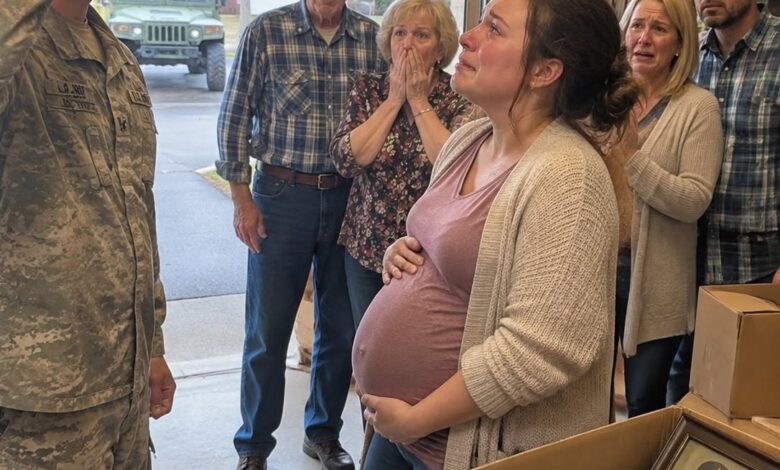
The baby shifted inside me. Then a dull cramp tightened across my lower back. It wrapped around me like a belt being pulled tight.
I put one hand on the side of the lead vehicle to steady myself.
Ortiz noticed immediately.
“Major,” he said quietly. “We need to move.”
I nodded.
My mother came down the driveway fast, her slippers slapping on the concrete.
“You can’t leave like this,” she said.
“The convoy has orders, Mom.”
“I mean with us angry .”
“You were already angry,” I said, “when you thought I was powerless.”
Her eyes filled with tears.
But I couldn’t treat tears as proof that somebody was sorry anymore. I’d seen too many of them in seven months. Tears when I didn’t want to go to my father’s poker night. Tears when I asked her to put the kitchen cabinets back the way they were. Tears had always been the thing that made me give in.
“Please come inside,” she said. “Please. I’ll make your father apologize.”
“I don’t need you to make him say words he doesn’t mean.”
“We’re your family , Maya.”
“Then you should have acted like it,” I said, “before the uniform showed up.”
I climbed into the back seat of the lead vehicle.
It smelled like cold vinyl and coffee. Someone had laid a folded gray blanket across the seat for me. I didn’t know who. Nobody mentioned it.
Ortiz handed me the seat belt and waited while I buckled it. He watched to make sure I fastened it low, under my stomach, not across it.
My mother stood beside the open door with her robe pulled tight.
“Where are they taking you?” she said.
“I can’t tell you.”
“When are you coming back?”
“I can’t tell you that either.”
Her face tightened. She’d heard me say that exact sentence a hundred times over twelve years. I can’t tell you. And every time, she’d heard it as I won’t tell you.
She was hearing it now, finally, the way it was meant.
Right before Ortiz closed the door, my father called out from the porch.
“You think those people care about you more than we do?”
I looked at the soldier holding my door. At the folded gray blanket across my knees that someone had put there without being asked. At the cardboard box in the back, strapped down so David’s photographs wouldn’t slide around during the drive.
“I think they understand the difference,” I said, “between duty and ownership.”
The door shut.
As the convoy pulled away, I watched the mailbox go past the window. The one David had painted dark green, with our house number in white.
I felt it then. The first clean break. Between the life David and I had built and protected, and the version of that life my family had decided to take over.
I didn’t feel like I’d won anything.
I just felt exhausted.
The drive took almost two hours. I don’t know where we went. I didn’t ask, and nobody said. I fell asleep against the window somewhere along the way, and when I woke up, Ortiz was gently saying, “Ma’am. We’re here.”
The temporary quarters were a plain apartment on the third floor of a building I’d never seen before. A small kitchen. A gray couch. A bedroom with a double bed. A table by a window that looked out on a parking lot and some bare trees.
The young soldier with the shaved head carried in my cardboard box and set it down on the table. Then he set the gray field case next to it.
“Is there anything else you need, ma’am?” Ortiz asked.
“No,” I said. “Thank you, Sergeant.”
He hesitated at the door.
“Ma’am,” he said. “I served with Captain Cole in 2017. Briefly. Six weeks.” He paused. “He talked about you the whole time. Drove us all crazy.”
I didn’t say anything. I couldn’t.
Ortiz nodded once and closed the door behind him.
I went into the kitchen to get a glass of water.
I opened the refrigerator.
Someone had stocked it. Bottled water. A carton of eggs. A bowl of fruit. Apples, bananas, oranges. Saltine crackers on the counter.
And a box of ginger tea. The exact kind I’d been drinking every morning for months because it was the only thing that helped my nausea.
I don’t know how they knew. Someone must have checked. Someone must have asked.
Those ordinary things almost broke me more than the funeral had.
Because David used to do that.
Every single time I came home from a deployment, the refrigerator would be full. Even if he’d only gotten home a few hours before me himself. Even if he was exhausted. He’d go to the grocery store and fill it with the things I liked. Eggs. Fruit. Whatever I could keep down.
He never made speeches about taking care of me. He never said, “Look what I did for you.”
He just checked my tires. He filled my gas tank. He washed my favorite coffee mug and left it upside down on a dish towel by the coffeemaker. He made sure there was food I could eat.
I sat down on the kitchen floor of that strange apartment, with my back against the refrigerator, in David’s old T-shirt stretched over my stomach.
And I cried.
Not the way I’d cried at the funeral, quietly, in my dress uniform, with everyone watching. Not the way I’d cried for seven months, at three in the morning, into my pillow so my parents wouldn’t hear.
I cried loud. Ugly. Until I couldn’t breathe. Until my throat hurt. Until the baby started kicking, like she was asking me what was wrong.
I cried until I could breathe again without fighting it.
Nobody told me I was ruining Thanksgiving.
I slept for eleven hours.
When I woke up, my phone was full of messages.
Harper said I’d humiliated her in front of Julian. She said I’d done it on purpose. She said I’d planned the whole thing.
My father wrote that I’d become arrogant and ungrateful. That the Army had changed me. That he didn’t recognize his own daughter.
My mother sent seven messages. They all said the same thing, in slightly different words. Please call us. Please. We can fix this privately. Just call.
I read them all.
Then I answered just once, to all of them.
I will communicate about the house in writing. I am not discussing my orders. I need space to grieve and protect my pregnancy.
My father replied in less than a minute.
After everything we did for you?
I turned my phone face down on the table.
During the next week, their stories kept changing.
First, my father said the garage was warmer than I remembered. He said he’d checked the thermometer. He said it was fifty-five degrees in there, easy.
Then Harper said she’d only meant for me to stay in the garage for a few hours. While Julian held one client meeting. Then I could have had my room back.
Then my father said he’d thought the black bracelet I always wore on my wrist, the memorial bracelet with David’s name and rank engraved on it, was just a sentimental thing. He hadn’t known it meant anything.
Then my mother said everyone had just been so tired after the funeral. That holidays put so much pressure on families. That they’d all been careless, and nobody had meant anything by it.
None of those explanations answered the real question.
Why had four grown adults looked at a pregnant widow standing in a freezing kitchen the morning after her husband’s funeral, and decided that her bedroom mattered less than Julian’s convenience?
The answer came from Harper.
She didn’t mean to give it to me.
She called from my mother’s phone, after I stopped answering hers. I picked up because I thought it was my mother.
“Julian moved into a hotel,” Harper said. No hello. “He says he can’t trust me.”
“I’m sorry you’re hurting,” I said.
“No, you’re not.”
“I’m sorry you’re hurting,” I said again. “I’m not sorry I corrected the lie.”
“You could have just agreed and sorted it out later!”
“That’s what you expected.”
“Because you always give in eventually!” she said.
Her words sat there between us on the phone.
That was the plan.
That was the whole thing. There’d never been a misunderstanding. Not about the temperature in the garage. Not about my pregnancy. Not about who owned the house.
Harper had told Julian the room was his because she was sure I’d give it up rather than start a fight after David’s funeral.
And my parents had backed her up because me giving in had become part of how the house worked. Every time I stayed quiet to keep the peace, they took it as permission for the next thing. The cabinets. The recliner. The poker nights. The room.
The garage.
“You didn’t think I agreed,” I said slowly. “You thought I could be forced to agree.”
Harper started crying.
“Do you know what it’s like being your sister?” she said. “You disappear for months. You never explain anything. You come back and you can’t talk about where you were. And then military vehicles show up in the driveway like you’re some important person in a movie.”
“I’m not in a movie, Harper.”
“You made us look insignificant ,” she said.
“I was trying to stay alive,” I said. “And keep other people safe.”
She went quiet.
For years, my family had decided that my secrecy meant I was rejecting them. Because that explanation protected their pride.
It was easier for them to believe that David and I thought we were too important to talk to them, than to accept that some parts of our lives just couldn’t be shared. With anyone. Not because we didn’t love them. Because we weren’t allowed.
But resentment didn’t explain the garage.
It only explained why they felt like they had the right to punish me when I was too tired to fight back.
“I can’t fix your marriage,” I told her. “I can’t make Julian trust you. And I won’t tell him your lie was harmless. Because it wasn’t.”
“So that’s it?” Harper said.
“For now,” I said. “Yes.”
I hung up before she could turn my boundary into another argument.
The legal process for the house went forward. Quietly. No drama.
I talked to a lawyer on base, a JAG officer named Captain Liu who was very calm and very good. She helped me write everything properly. I sent my parents formal written notice. I made sure nobody could use the house for Julian’s business. I gave my parents the full amount of time the law required to find somewhere else to live. More than that, actually. I gave them sixty days instead of thirty.
My father fought me every step of the way. Through text messages. Long, angry text messages, sent late at night.
But he never once gave me a real reason why he had the right to stay after I’d taken back my permission. He couldn’t. There wasn’t one.
He just wanted to argue about gratitude. After everything we did for you. After we dropped our whole lives for you.
Gratitude was easy to argue about. Because you could stretch gratitude to cover almost anything.
So I didn’t argue about it. Every time, I just brought it back to the practical things. Dates. Access. Belongings. Which day the movers were coming.
My mother stopped repeating his accusations after about two weeks.
She started asking different questions instead. Practical ones.
Which of the dishes are yours, and which did we bring?
Should the old dresser in the guest room stay?
Where did David keep the spare garage door opener?
I answered every single one. Without bringing up the bigger hurt. Without making it about anything else.
The blue plates are mine. The white ones with the flowers are yours.
The dresser stays. It was David’s grandmother’s.
The spare opener is in the junk drawer by the back door, under the takeout menus.
Then, three days before they were supposed to leave, my mother texted me.
Could I see you? Just me. Alone. I won’t stay long.
I thought about it for a whole day.
Then I said yes.
We met at the house in the middle of a Tuesday afternoon.
The convoy was long gone. The frost had melted. The driveway looked painfully ordinary. Just a driveway. Just a house. Mrs. Patterson was walking her little white dog across the street, and she waved at me, a little uncertainly.
I let myself in with my key.
My mother was standing in the front hallway, next to a row of taped-up moving boxes. She was wearing jeans and an old green sweater, not her pink robe. Her hair wasn’t done. She looked older than I’d ever seen her.
She was holding the spare house key in her palm.
“I knew the house was yours,” she said.
“I know,” I said.
“I knew David paid for it. Every month. I knew your father’s name was never on anything. Not the deed. Not the mortgage. Nothing.”
I waited.
She looked toward the door to the garage.
“When Harper said Julian needed your room,” she said, “I knew it was wrong. I knew it right away. I also knew your father wanted to prove that we still had some authority over you.”
“Why?” I said.
She was quiet for a long time.
“Because the funeral made him feel shut out,” she said finally. “There were all those officers there. All those people in uniform who knew things about David that we didn’t. There were parts of the service we didn’t understand. When they did the rifles, and the bugle, and they folded the flag and gave it to you. Your father didn’t know what any of it meant. That colonel came up and said you were one of the best officers he’d ever commanded , and your father didn’t even know you were an officer.”
She swallowed.
“He hated feeling like a guest in David’s life,” she said.
“So he treated me like a guest in my own home,” I said.
“Yes,” my mother said.
It was the first answer anyone had given me without trying to make the cruelty sound like an accident.
My mother closed her fingers around the key.
“I went along with it,” she said. Her voice was shaking. “Because I liked believing you needed us. If you needed us, then I didn’t have to admit how much we were taking from you.”
The truth was uglier than a misunderstanding.
But it finally made that Thanksgiving morning make sense.
They hadn’t sent me to the garage because they thought it was warm enough out there.
They’d done it because they needed me to stay the weakest person in the house. The grieving widow. The pregnant daughter who couldn’t take care of herself. The one who needed them.
And when the convoy showed up, and the soldier saluted me in the driveway, it terrified them. Because it showed them something they’d been working very hard not to see.
“I’m not asking you to forgive me today,” my mother said.
“Good,” I said.
She nodded once.
“Your father wants me to keep this key,” she said. “In case you change your mind.”
“And what do you want?” I said.
My mother looked down at her closed hand for a long moment.
Then she opened it. She took my hand, turned it palm up, and placed the key in it.
“I want to stop pretending,” she said, “that your boundaries are attacks on me.”
The key was cold against my skin.
It didn’t fix what she’d done. I knew that. She knew that.
I didn’t invite her to stay. I didn’t hug her. I didn’t tell her it was okay.
But giving that key back, with no conditions, no strings, no If you’ll just call your father , was the first choice she’d made in seven months that actually cost her something.
I closed my hand around it.
“Thank you,” I said.
She nodded. Then she went back to taping boxes.
My father left two days later.
He loaded the last of the boxes into his car himself. He didn’t speak to me. He didn’t call. He didn’t text. He just drove away.
My mother texted me from the road. We’re on our way home. The spare garage opener is back in the junk drawer.
Harper moved her things out of the small guest room the same week. She sent me one short message.
I won’t contact you again unless you contact me first.
I read it a few times. Then I wrote back.
Okay.
I accepted that boundary. It seemed fair. It was the first one she’d ever offered me.
Julian never used the house as an office. I never asked Harper what happened between them after that. I heard from my mother, much later, that they were trying counseling. That he’d moved back in, eventually. That it was hard.
I didn’t ask for more details.
Their marriage was theirs to fix.
The house was still mine.
But I didn’t move back right away.
Too much of that kitchen still belonged to the morning my father called my grief an inconvenience. Too much of that garage still felt like the place my family had tried to put me when they thought I had nowhere else to go.
I stayed in the secure apartment through December and January. My orders changed twice. My medical team checked on me every week. The threat assessment slowly came back down. Ortiz stopped by once in early January, just to see how I was. He brought me a bag of the ginger tea.
“Supply run,” he said, like it was nothing.
My daughter was born on a snowy night in late January.
Seven pounds, one ounce. A full head of dark hair, just like David’s. She came out screaming and mad about it, red-faced and furious, and the nurse laughed and said, “She’s got opinions already.”
“She gets that from her father,” I said.
They put her on my chest, and she stopped screaming. She opened her eyes and looked up at me, cross-eyed and serious.
I named her Avery.
That was David’s middle name. David Avery Cole.
My mother met her only after she agreed to the rules I set.
I wrote them down, so they’d be clear.
No surprise visits.
No questions about my work.
No criticism of how I grieve.
No contact through Harper or my father. Only through me.
She read them. She didn’t argue. Not about a single one.
She just wrote back, I understand. Thank you for letting me meet her.
The first time she visited, Avery was two weeks old.
My mother knocked on the door of my apartment. She didn’t use a key. She didn’t have one.
She came in carrying two bags of groceries. She set them down on the kitchen counter. Then she stopped.
She didn’t open my cabinets. She didn’t put anything away. She didn’t rearrange my refrigerator. She just left the bags sitting there on the counter.
Then she turned around and looked at me.
“Where would you like me to sit?” she asked.
It was a small question.
Such a small question.
But I noticed it.
I pointed at the armchair by the window. She sat down. I put Avery in her arms.
My mother looked down at her granddaughter for a long time without saying anything. Her eyes were wet. She touched Avery’s tiny fist with one fingertip, very gently, the way you’d touch a bird.
“Hello, Avery,” she whispered. “I’m your grandma. I’ve got a lot to learn.”
That cardboard box from the garage stayed with me through every move.
From the house to the secure apartment. From the secure apartment, in March, back to the house, after I’d repainted the kitchen and moved David’s recliner back up from the basement and taken down every one of Julian’s command hooks from the bedroom wall.
The bottom of the box had gotten soft from sitting on the freezing concrete that Thanksgiving morning. So when Avery came home, I reinforced it with packing tape, three layers, and put it on the floor beside her crib.
Inside, I kept David’s old Army T-shirt. The one I’d worn that morning in the driveway. The photographs from our deployments. His black memorial bracelet, with his name and rank engraved on it. And the soft yellow blanket with the little gray elephants that he’d bought the day after we found out about her.
The box had once held the things my family ordered out of my bedroom. The things they’d decided were in the way.
Now it held the pieces of David’s life that I would give our daughter someday, when she was old enough to understand them.
One evening in April, my mother was visiting. It was her fourth or fifth visit. She’d started coming every other Sunday, for two hours, the way we’d agreed.
I went into the kitchen to warm up a bottle. When I came back, she wasn’t in the living room.
I found her in Avery’s room.
She was kneeling on the floor beside the cardboard box. Avery was asleep in the crib above her.
My mother had a package in her hands. Clear plastic sleeves. Archival sleeves, the kind museums use, to keep old photographs from fading or getting damaged.
She hadn’t opened the box.
She was just kneeling there next to it, holding the package of sleeves in both hands, waiting.
When she heard me in the doorway, she looked up.
“I saw these at the craft store,” she said quietly. “I thought of David’s pictures. They won’t last forever in a cardboard box. Not without protection.”
She held the package a little tighter.
“May I help you protect these?” she asked.
I stood in the doorway with Avery’s bottle in my hand and thought about it.
I thought about Thanksgiving morning. My boxes stacked by the garage door. My mother pointing with her celery knife. Just put your things beside Julian’s car. But don’t block it.
I thought about the key, cold in my palm.
I thought about Where would you like me to sit?
I thought about the fact that she’d asked. That she hadn’t just opened the box. That she’d knelt there and waited for me.
Then I set the bottle down on the dresser.
I sat down on the floor beside my mother.
I lifted the lid of the box myself.
And I took out the first photograph. David and me in the desert, years ago, sunburned and squinting, his arm around my shoulders, both of us laughing at something one of the guys had said off camera.
I looked at it for a moment.
Then I handed it to her.