My Mom Never Got to See Me Get Married but When Her Army Friend Appeared at My Wedding She Revealed a Promise From Years Ago
For the first twelve years of my life, it was just my mother and me.
We lived in a small yellow duplex on a dead-end street in Columbus, Georgia, twenty minutes from the main gate of Fort Benning. There was a chain-link fence around the yard, a peach tree that never gave a single edible peach, and a window air conditioner in the living room that rattled like a freight train every summer night. My mother called it the Beast. She talked to it. Come on, Beast, one more night, she’d say, slapping the side of it with her palm, and somehow it always worked.
I never knew my father. When I was little and asked about him, my mother would sit down on the edge of my bed and say the same thing every time. It’s just us, Mia-bird. You and me against the world. Then she’d tuck the quilt under my chin and tickle me until I forgot what I’d asked.
My mother’s name was Kathleen Reynolds, and everybody called her Kate. She was five-foot-four, with freckles across her nose and a rust-red ponytail she wore so tight it pulled her eyebrows up. She worked days as an EMT for the Columbus Fire Department and served in the Army Reserve as a combat medic one weekend a month and two weeks every summer. She could put in an IV in the back of a moving ambulance, splint a broken leg in four minutes, and make a box of macaroni and cheese taste like a restaurant meal with nothing but black pepper and a slice of American cheese melted on top.
She sang constantly. Off-key, mostly Patsy Cline and Reba, while she cooked, while she drove, while she brushed my hair before school. She laughed loudly. She cried at commercials. She never once in my whole childhood let me feel like we were missing anything.
When I was twelve, her Reserve unit was activated for deployment to Afghanistan.
She told me at the kitchen table on a Sunday night in January, with two bowls of chocolate ice cream between us. I remember that the Beast wasn’t running because it was winter, and the kitchen was so quiet I could hear the clock on the stove.
“Twelve months, Mia-bird,” she said. “That’s all. I’ll be home next January. You’ll stay with Grandma Pearl.”
I stared at my ice cream. “What if something happens to you?”
She reached across the table and took my hand. “I’m a medic,” she said. “I’m the one who makes sure nothing happens to anybody. That’s my whole job.”
She left me with her mother, my Grandma Pearl, in a little brick ranch house on the other side of Columbus with a carport and a porch swing and a kitchen that always smelled like biscuits.
Grandma Pearl was sixty-eight that year. A retired school cafeteria manager with silver hair she set in pink foam curlers every Saturday night and a voice that could stop a food fight across a gymnasium. She’d raised my mother alone too, after my grandfather died in a mill accident when Mom was six. She believed in grace before every meal, homework before television, and a switch from the forsythia bush for back talk, though she never once used it on me.
She took me to school. She packed my lunches. She sat with me at the kitchen table every night while I did my math homework, and she never once let me see her worry.
My mother called whenever she had even a minute of free time. Sometimes the calls came at strange hours, three in the morning or in the middle of a school day, and Grandma Pearl would come wake me up or call the front office. The connection was always terrible, full of static and delays and echoes, so we’d talk over each other and laugh about it.
I missed her so much it felt like a stomachache that never went away.
Whenever I cried to her on the phone, and I cried a lot that first year, she’d make a joke. It was always the same one.
“Don’t worry, sweetheart,” she’d say, her voice crackling over seven thousand miles of satellite. “I’ll be home before you know it. I’ve got to be there for your wedding, after all. I’m going to wear a bright red dress, so you’ll spot me right away. In the front row. Waving like a crazy woman.”
“Mom,” I’d say, sniffling, “I’m twelve. I’m not getting married.”
“Not yet,” she’d say. “But someday. And I’ll be there. Red dress. Front row. You can’t miss me.”
She talked about Daniel all the time.
Specialist Daniel Mercado was twenty-four, twelve years younger than my mother, a combat engineer from San Antonio assigned to the same forward operating base in Kandahar Province. They met in the chow hall the first week, she told me, when he dropped an entire tray of spaghetti on her boots and then tried to clean it off with a napkin while apologizing in two languages.
“He’s like the little brother I never had,” she said on the phone. “He makes me laugh every single day, Mia. Even on the bad days. Especially on the bad days.”
There were a lot of bad days. She never told me about them directly. But I could hear it in her voice sometimes, a flatness, a tiredness that hadn’t been there before she left. On those calls, if I listened carefully, I’d hear a man’s voice in the background, cracking jokes, doing impressions of their sergeant, singing terrible karaoke. And I’d hear my mother start to laugh.
“That’s Daniel,” she’d say. “Ignore him. He’s an idiot.”
“Hi, Mia!” he’d shout in the background. “Your mom is the bossiest woman in Afghanistan!”
“He’s not wrong,” my mother would say. And then she’d laugh again, really laugh, and I’d feel better.
In August of her deployment, their convoy hit a roadside bomb outside Arghandab.
Daniel was in the second vehicle. The blast tore through the floor and shattered his left leg and opened a wound in his side that the Army surgeons later said should have killed him in under four minutes. My mother was in the fourth vehicle. She ran forward through the smoke while they were still taking fire. She knelt in the dirt beside him, packed the wound with her bare hands, and held pressure for twenty-two minutes until the medevac helicopter arrived.
She got a Bronze Star for it. She never mentioned the medal to me. I found out when the citation came in the mail to Grandma Pearl’s house.
After that, she said, she and Daniel were inseparable.
She was supposed to come home in January. Then her unit was extended. Three more months, until April.
On March 9th, a Thursday, two soldiers in dress uniforms knocked on Grandma Pearl’s front door.
I was thirteen by then. I was sitting at the kitchen table doing my pre-algebra homework. I looked up when I heard the knock and saw Grandma Pearl walking down the hallway to answer it, wiping her hands on a dish towel. Through the window in the front door, I saw the green uniforms.
Grandma Pearl stopped in the middle of the hallway. The dish towel fell out of her hands onto the floor.
She knew before she opened the door. So did I.
My mother died on March 7th in Kandahar Province, during an attack on a medical evacuation convoy she was riding with. She’d been treating a wounded Afghan police officer in the back of an armored ambulance when it came under fire. The officer survived. My mother didn’t.
She was thirty-seven years old.
My whole world fell apart. There’s no other way to describe it. One day I had a mother who sang Patsy Cline off-key and talked to the air conditioner and promised to wear a red dress to my wedding. The next day I had a folded American flag, a Bronze Star I’d never seen her wear, and a gold star pin they gave Grandma Pearl at the funeral at Fort Benning’s main post chapel.
All I had left was my grandmother. And she was seventy years old and heartbroken, sitting at her kitchen table every night holding her daughter’s last letter, reading it over and over until the paper went soft.
Three weeks after the funeral, there was another knock on Grandma Pearl’s door. It was a Saturday morning in April, and I almost didn’t answer, because every knock still made my stomach turn over.
A man was standing on the porch. Twenty-five, maybe, with short black hair and dark eyes and a jaw that needed shaving. He was leaning on a cane, and his left leg was in a big black brace from his hip to his ankle. He was holding a bouquet of grocery store daisies in one hand and a shoebox under his other arm.
He looked at me for a long time without saying anything.
“You’re Mia,” he said finally. His voice cracked. “You look just like her.”
“Daniel?” I said.
He nodded. He’d been in the hospital at Walter Reed in Maryland for seven months, he told us, learning to walk again. He’d only been released two weeks before. He’d gotten on a Greyhound bus in Washington, D.C., and ridden it seventeen hours to Columbus, Georgia, with his leg in a brace, because he’d promised my mother something.
“What did you promise her?” Grandma Pearl asked. She’d come up behind me in the doorway with her hand on my shoulder.
Daniel looked at her. Then at me.
“That if anything happened to her,” he said, “I’d look after her girls.”
Grandma Pearl looked at him for a long moment. At the cane and the brace and the grocery store daisies.
Then she stepped aside and held the door open.
“Come in, son,” she said. “I’ll make biscuits.”
After that, Daniel became family.
He got medically retired from the Army that summer. He couldn’t go back to combat engineering with his leg the way it was. So he enrolled at Columbus State University on the GI Bill to study civil engineering, and he rented a tiny apartment ten minutes from Grandma Pearl’s house. And he started coming over.
At first it was Sunday dinners. Grandma Pearl would make pot roast or fried chicken, and Daniel would show up at five-thirty with a store-bought pie and his cane, and we’d sit around her little kitchen table. He’d tell stories about my mother in Afghanistan. Funny ones. The time she organized a pie-eating contest on the base on Thanksgiving with MRE apple turnovers. The time she out-arm-wrestled a two-hundred-pound sergeant from Alabama. The time she sang “Coal Miner’s Daughter” over the loudspeaker on the Fourth of July and the whole base sang along.
I laughed for the first time since the funeral at one of those Sunday dinners. Grandma Pearl cried when she heard it.
Then he started coming over more.
He fixed my bike, a rusted pink Huffy with a bent front wheel that my mother had been meaning to get to for a year. He spent a whole Saturday afternoon on it in Grandma Pearl’s carport with a borrowed wrench, swearing in Spanish under his breath. When he was done, he made me ride it up and down the driveway five times while he leaned on his cane and cheered like I’d won the Tour de France.
He made pancakes on Saturday mornings. Terrible ones. Too thick, burned on the outside, raw in the middle. Grandma Pearl tried to teach him. He never learned. I ate them every single time.
He came to my school performances. My eighth-grade choir concert, where I had a four-line solo in “Silent Night” and forgot two of the lines. My ninth-grade production of Our Town , where I played Emily, and he sat in the front row and cried so loudly during the cemetery scene that people turned around to look at him.
Grandma Pearl could always count on Daniel. When her kitchen pipe burst at two in the morning in the middle of January, he was there in fifteen minutes with a toolbox. When I was failing geometry in tenth grade, he sat with me at the kitchen table three nights a week with a protractor and a lot of patience. When Grandma Pearl had her gallbladder out, he drove her to every appointment and slept on her couch for a week.
He was always there for us. He became, without either of us ever saying it out loud, almost like a father to me.
I never called him that. I called him Uncle Daniel. But we both knew.
There were things Daniel didn’t talk about. I learned them slowly, over years.
He didn’t talk about March 7th. He wasn’t there; he was at Walter Reed by then, with his leg in pieces. But he’d been her friend, her little brother, the one she’d saved. And he’d survived, and she hadn’t.
Once, when I was fifteen, I found him sitting on Grandma Pearl’s back porch at midnight, alone, after a Sunday dinner. He had a can of Coke in his hand and he was staring at the peach tree in the backyard, the one that never gave a single good peach, which Grandma Pearl had dug up from our old duplex and replanted after Mom died.
I sat down beside him on the step.
“Uncle Daniel,” I said. “Do you think about her?”
“Every day,” he said. He didn’t look at me.
“Do you think it should’ve been you?” I asked. I don’t know why I asked it. I think I’d been wondering for a long time.
He was quiet for so long I thought he wasn’t going to answer.
“Yeah,” he said finally. “I think about that every day too.”
He set his Coke can down on the step.
“She knelt in the dirt in the middle of a firefight,” he said, “and kept her hands inside my side for twenty-two minutes. She was singing. Did you know that? She was singing Patsy Cline the whole time. ‘Walkin’ After Midnight.’ So I’d have something to listen to instead of the gunfire.”
He wiped his eyes with the back of his hand.
“She saved my life,” he said. “And I couldn’t save hers. I wasn’t even there.”
I didn’t know what to say. So I just leaned my head against his shoulder, the way I used to lean against my mother’s, and we sat there on the back porch until Grandma Pearl came out in her bathrobe and curlers and told us both to get to bed.
I grew up. That’s the strange thing about grief. You think it will stop the world. It doesn’t. It just moves in with you and becomes part of the furniture.
I graduated from high school in Columbus. Daniel and Grandma Pearl sat in the bleachers at the stadium and screamed my name so loud the principal paused before handing me my diploma. I went to the University of Georgia in Athens on a scholarship for children of fallen soldiers. I studied nursing. Of course I did.
Daniel finished his engineering degree and got a job with the Georgia Department of Transportation, designing bridges. He drove up to Athens every few weeks to take me to dinner and lecture me about studying. He brought Grandma Pearl along whenever her hip would let her.
Grandma Pearl died when I was twenty-two, in the spring of my senior year of college. A stroke, in her sleep, in her own bed in the little brick ranch house with the carport. She was seventy-nine.
Daniel was the one who found her. He’d come by on a Saturday morning to fix a leaky faucet and she hadn’t answered the door. He called me in Athens at nine-fifteen. I could hear him crying before he said a word.
He handled everything. The funeral, the church, the headstone. He cleaned out her house when I couldn’t bear to. He found her old recipe box and gave it to me, with her biscuit recipe on a stained index card at the front, in her round school-cafeteria handwriting. He found my mother’s Bronze Star in her dresser drawer, wrapped in tissue paper, and the folded flag from the funeral in her cedar chest, and the gold star pin.
And he found something else, which he didn’t tell me about.
Not for four years.
I met Nate Alvarez in my second year working as an ER nurse at Piedmont Columbus Regional Hospital.
He was a firefighter with the Columbus Fire Department. The same department my mother worked for as an EMT, nineteen years earlier. He came into the emergency room one night in October with a cut on his forearm from a broken window at a house fire, and he sat on the gurney making jokes while I stitched him up. He asked me out three times before I said yes.
On our fourth date, he told me he’d heard about my mother. Kate Reynolds. The old-timers at the fire station still talked about her, he said. There was a photograph of her on the wall in the station on Victory Drive, in her EMT uniform, with her rust-red ponytail pulled tight. Under it, a little brass plaque: Kathleen Reynolds. EMT. Army Medic. Bronze Star. Gave everything.
I’d never known it was there. I cried in the middle of a Mexican restaurant on Macon Road, and Nate held my hand across the table and didn’t say anything.
He proposed two years later, on the back porch of Grandma Pearl’s old brick ranch house, under the peach tree. I’d inherited the house when she died. I couldn’t bear to sell it. Nate had helped me paint it and replace the carport roof.
He knelt down in the grass beneath that peach tree that had never given a single good peach and held out a ring.
I said yes before he finished the question.
The first person I called was Daniel.
He was quiet on the phone for a long time. Then I heard him blow his nose.
“Your mom would be so happy,” he said, and his voice cracked. “She’d be over the moon, Mia-bird.”
He was the only person left in the world who called me that.
The wedding was in May, at a little white Methodist church on the outskirts of Columbus, with a garden reception afterward under a big white tent in the church’s backyard. A hundred and twenty guests. Nate’s huge, loud family from Phenix City. My friends from the hospital. Half the Columbus Fire Department in their dress uniforms.
I got ready in the bride’s room at the back of the church. A small, stuffy room with a full-length mirror and a pink velvet loveseat and a box of tissues on every flat surface. My best friend and maid of honor, Jasmine, was doing my makeup. My bridesmaids were laughing and taking pictures.
At one forty-five, fifteen minutes before the ceremony, they all went out to take their places, and for a minute I was alone in front of the mirror.
I looked at myself.
The dress was simple. Ivory satin, fitted through the waist, flowing at the bottom. I’d found it at a consignment shop in Atlanta for three hundred dollars. My hair was pinned up, with a few curls falling loose around my face. Rust-red, like my mother’s, though I’d always pretended it was more brown than red.
I was wearing my mother’s earrings. Small gold hoops. She wore them every day of my childhood. The Army sent them back in a plastic bag with her other personal effects.
I looked at myself in that mirror and burst into tears.
Because she wasn’t there. She was supposed to be there. She’d promised. I’ll be there for your wedding, in a bright red dress, so you’ll spot me right away. Front row. Waving like a crazy woman.
I wanted her to walk through that door. I wanted it more than I’d ever wanted anything in my whole life. I wanted to see her rust-red ponytail and her freckles and her ridiculous, wonderful, off-key smile. I wanted her to see me like this.
I stood alone in that stuffy little room and cried so hard I had to sit down on the pink velvet loveseat.
Someone knocked on the door.
“Mia?” It was Jasmine. “Mia, honey, are you okay? It’s almost time. And, um…” She hesitated. “Daniel’s here. He wants to see you before you go out.”
I wiped my face. I tried to fix my makeup in the mirror. It didn’t work.
“Okay,” I said. “Let him in.”
The door opened.
Daniel was standing in the doorway.
He was forty years old now. A little gray at the temples. A little heavier than he used to be. He still walked with a slight limp from the leg the surgeons at Walter Reed had rebuilt with titanium rods and screws.
And he was wearing a red dress.
For a moment, I couldn’t speak.
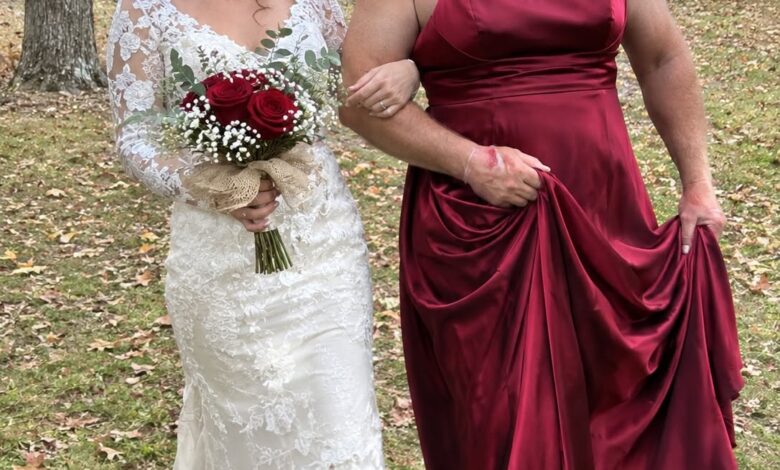
It was a bright, bold, fire-engine red. Knee-length, with short sleeves and a full skirt, the kind of dress a woman might wear to a summer wedding in Georgia. It didn’t fit him well. It was tight across the shoulders and too short in the torso. He was wearing it over a white undershirt, with his own black dress shoes and dark socks. He’d shaved carefully. He was holding a small bouquet of daisies. Grocery store daisies. Just like the ones he brought to Grandma Pearl’s doorstep, thirteen years earlier.
“Uncle Daniel,” I whispered. “What are you wearing?”
He smiled. But his eyes were full of tears.
“Do you remember,” he said, “how your mom always said she’d wear a red dress to your wedding? So you’d spot her right away?”
I put my hand over my mouth.
“I can’t bring her back, Mia-bird,” he said. His voice was shaking. “God knows I’d give anything. But I wanted you to know that she’s here with you today. She promised she’d be in the front row in a red dress.” He looked down at himself and laughed through his tears. “So I figured somebody’d better keep her promise.”
I burst into tears.
I got up off the pink velvet loveseat in my ivory satin wedding dress and threw my arms around a forty-year-old disabled combat veteran in a fire-engine-red dress, and I sobbed into his shoulder. He held me. He held me the way he held me on the back porch at fifteen, and at Grandma Pearl’s funeral, and on a hundred other nights when I needed somebody.
For a moment, standing there in that stuffy little room at the back of the church, it felt as if my mother were there with us. I swear I could smell her. Ivory soap and gun oil and the strawberry lip balm she always wore.
“Daniel,” I said into his shoulder. “Will you walk me down the aisle?”
He pulled back. He looked at me.
“In this?” he said.
“Especially in that,” I said.
The organ started playing at two o’clock. Pachelbel’s Canon.
The doors at the back of the little white church opened, and the hundred and twenty guests stood up and turned around to watch the bride come down the aisle.
And they saw me, in my ivory dress and my mother’s gold hoop earrings, on the arm of a forty-year-old man with a limp and a gray-streaked buzz cut, wearing a fire-engine-red dress and carrying a bouquet of grocery store daisies.
Nobody laughed.
Nobody whispered.
I’d been afraid they might. Nate’s cousins from Phenix City. My coworkers from the hospital. The firefighters in their dress blues. I’d been afraid somebody would snicker, or take a picture to post online, or say something cruel.
Nobody did. They all understood why he was doing it. Somehow, without anybody explaining, every single person in that church understood.
Halfway down the aisle, I saw an old man in a Columbus Fire Department dress uniform in the third row stand up a little straighter and put his hand over his heart. He was seventy, maybe, with a white mustache. I found out later his name was Captain Earl Haskins. He’d been my mother’s supervisor at the fire station on Victory Drive for nine years. He’d been the one who hung her photograph on the wall.
Then the firefighter beside him put his hand over his heart. Then the one beside him. Then the whole row of firefighters in dress uniforms, every one of them standing at attention with their hands on their hearts as Daniel and I walked past.
Nate was waiting at the altar in his own dress uniform. He’d seen Daniel come in. He had tears running down his face before we were halfway there.
When we reached the front of the church, Daniel stopped. He turned to me. He lifted my veil, very carefully, with his big, scarred hands. He kissed me on the forehead…………….READ MORE NEXT PAGE 2