After His Funeral They Took My Room Until The Convoy Arrived
The soldier held the salute long enough for everyone in the driveway to understand that it wasn’t for show.
“Major,” he said, with his eyes fixed on me. “The convoy is secure. We are ready to move on your order.”
Behind him, three dark vehicles sat at the curb with their engines running. Frost was still on the lawn. Somewhere down the street, a dog was barking at the whole thing.
Julian’s Audi keys stopped spinning around his finger.
My father stepped out onto the porch with the newspaper still pressed against his chest. My mother and my sister, Harper, stood behind him in the open doorway, my mother in her pink robe, Harper in a cream sweater with her coffee mug in both hands.
None of them said a word.
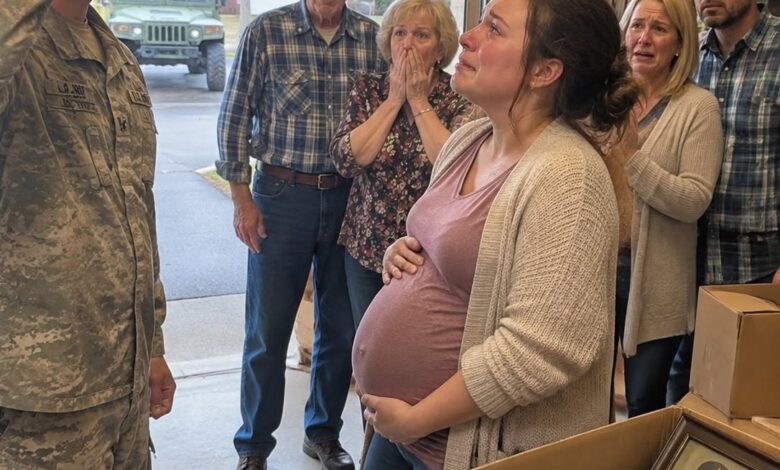
I returned the salute. Then I lowered my hand and rested it on the curve of my stomach, because the baby had started kicking the second the vehicles pulled up.
“At ease,” I said. “I need one secured case from the upstairs bedroom and the cardboard box beside the garage door. Nothing else.”
“Yes, ma’am.”
He turned and signaled to another member of the team. A younger soldier with a shaved head walked toward the house.
Then he stopped at the bottom of the porch steps. He didn’t take another step.
“Permission to enter, ma’am?” he asked.
That question mattered more than anyone in my family understood.
For seven months, they had walked through David’s house like my permission didn’t matter. They had moved the furniture. They had filled the closets. They had invited their friends over for card games and argued over who got which room, and not once had any of them asked the person whose name was on the deed.
Now a uniformed stranger, a twenty-two-year-old kid I’d never met, was showing me more respect at my own front door than my own family had shown me the morning after I buried my husband.
“Permission granted,” I said. “Straight upstairs. First door on the left.”
To understand how I ended up standing in my own driveway on Thanksgiving morning, eight months pregnant, in my husband’s old Army T-shirt, with my whole family staring at me like they’d never seen me before, I have to go back.
Not very far. Just about three hours.
And then a little further than that.
My name is Maya Cole. I’m thirty-four years old.
I’ve been in the United States Army for twelve years.
My family thought I worked in an office.
That’s not entirely their fault. That’s what I told them. When I was commissioned, I was given a short, simple explanation I was allowed to share about my job. I work in Department of Defense administration. That was it. That was all I could say. So I said it at every Christmas dinner and every birthday party for twelve years, and after a while, my family stopped asking questions.
They decided I pushed paper somewhere in a beige building. They decided my job was boring. They decided that when I disappeared for four or five months at a time, it was because I was “on assignment,” and that probably meant sitting at a different desk in a different beige building.
I let them believe it. I had to.
I met David at an officer training course in Virginia, eleven years ago.
He sat next to me on the first day, and he was eating an apple so loudly that I finally turned to him and said, “Are you planning on finishing that before the lecture, or should I take notes for both of us?”
He looked at me. He took another very loud bite.
“You can take notes for both of us,” he said with his mouth full.
I hated him for about two weeks.
Then I didn’t.
We got married four years later, at a courthouse in North Carolina, on a Tuesday, because that was the only day we were both stateside at the same time. My parents drove down. Harper didn’t come. She said she had a work thing. My mother cried through the whole ceremony, which took nine minutes.
David did the same kind of work I did. We couldn’t talk about it with anyone else, but we could talk about it with each other, late at night, in whispers, in whatever little apartment we were living in that year. That was one of the things that made us fit. We never had to explain.
Five years ago, we bought a house. Our first real house. A two-story place in a quiet neighborhood with a big maple tree and a two-car garage and a kitchen that hadn’t been updated since 1985.
David fixed it up himself. Every time he was home between deployments, he’d work on it. He replaced the kitchen cabinets. He patched the drywall in the upstairs hallway where some previous owner had obviously punched a hole. He built a desk into the corner of our bedroom under the big window, out of oak, because he said I needed a place to sit and think where the light was good.
He paid every single mortgage payment. Every month, on the first, automatically, from his account. He was funny about it.
“My one job,” he used to say. “Keep the roof over your head.”
In March, I found out I was pregnant.
We’d been trying for two years. We’d almost stopped hoping.
I took the test in the upstairs bathroom at five in the morning, and I didn’t even wait for the full three minutes. I just sat on the edge of the tub and watched the second line show up, slowly, like a photograph developing.
I walked into the bedroom holding it. David was still asleep, flat on his back, one arm over his eyes.
I sat down on the bed next to him and held the test in front of his face.
He opened one eye. He looked at it.
He opened the other eye.
He sat straight up so fast he hit his head on the reading lamp.
The next day, he went out and bought a baby blanket. Soft yellow cotton, with little gray elephants on it. He brought it home in a paper bag and laid it out on our bed and just looked at it.
“It’s too early to buy stuff,” I told him. “It’s bad luck.”
“It’s a blanket, Maya,” he said. “Blankets can’t be bad luck.”
He folded it very carefully and put it in the top drawer of the dresser.
Three weeks later, he left on his last deployment.
In April, two officers in dress uniforms knocked on my front door.
I knew before I opened it. Everyone in our world knows. Two officers in dress uniforms on your front porch on a weekday morning only means one thing.
They said David had been killed during an operation overseas. They said they were very sorry. They said that, because of the nature of the operation, his remains hadn’t been recovered yet. They said they would do everything they could.
I thanked them. I closed the door. I sat down on the floor of the front hallway with my back against the wall.
I was nine weeks pregnant.
That night, I called my parents.
They lived three hours away, in the house I grew up in. My father, Gary, was a retired insurance adjuster. My mother, Diane, had been a church secretary for thirty years. They were the kind of people who had the same thing for dinner every Tuesday and went to bed at ten o’clock and never, ever talked about anything uncomfortable at the table.
My mother answered. I told her.
She was quiet for a second. Then she said, “Oh, Maya. Oh, honey. We’re coming. We’ll be there tomorrow.”
They came the next afternoon with two suitcases and a casserole.
And they never left.
At first, I was grateful.
I really was. I couldn’t do anything. I couldn’t eat. I couldn’t sleep. I’d wake up at three in the morning and reach for David’s side of the bed, and it would be cold, and I’d remember all over again.
My mother made meals. My father mowed the lawn. They answered the phone when people called. They sat with me.
After about two weeks, I said, “You can stay as long as you want. Really. I’d like you here.”
My father nodded. My mother hugged me.
That was the invitation. That was all I ever said.
It was open-ended. I didn’t think it needed to be anything else. They were my parents.
But slowly, over seven months, things changed.
It happened so gradually that I didn’t really notice until it was too late.
First, they moved into the bigger guest room instead of the small one. Then my mother rearranged the kitchen cabinets. “It makes more sense this way, honey.” Then my father moved David’s recliner out of the living room and into the basement, because he said his back needed the couch.
Then my father’s poker friends started coming over on Thursday nights. Three or four men I’d never met, in my dining room, eating chips and laughing loudly until eleven o’clock. My father never asked me. He just told me.
“The fellas are coming over tonight. You don’t mind.”
It wasn’t a question.
And then my parents started calling it their house.
Not on purpose, maybe. Just little things. My mother on the phone with her sister: “You should come visit us at the house sometime.” My father telling the neighbor: “We’re thinking about putting in a new fence.”
We.
I’d hear it from upstairs, lying in bed with my hand on my stomach, and I’d tell myself it didn’t matter. They were helping. They were grieving too. They loved David.
I was so tired. Everything was so heavy. It was easier not to fight about little things.
So I didn’t.
I’d learn later that every time I stayed quiet, they took it as permission for the next thing.
In early November, I got the call.
They’d recovered David’s remains.
He came home on a military transport plane on a gray Tuesday morning. I stood on the tarmac in my dress uniform, with my parents behind me in their church clothes, while six soldiers carried his flag-draped casket down the ramp.
My mother whispered, “Why are you wearing that?”
“Because I’m in the Army, Mom.”
“I know, but… you work in an office. Do office people wear those?”
I didn’t answer her.
The funeral was the day before Thanksgiving. At a national cemetery an hour away.
There were officers there my parents had never met. Men and women in uniform who came up to me afterward and hugged me and said things like, “He saved my life in ‘19,” and “There’s no one I’d rather have had beside me,” and “We’ll never forget what he did.”
My father stood off to the side in his gray suit, watching all of this.
At one point, a colonel I’d served under came over and shook his hand.
“Your son-in-law was one of the finest soldiers I ever served with,” the colonel said. “And your daughter is one of the best officers I’ve ever commanded. You should be very proud of both of them.”
My father nodded and said, “Thank you.”
But I saw his face. He was confused. He didn’t understand what the colonel meant. Commanded? Officer? He looked at me across the cemetery like he was trying to work out a puzzle.
And I could see that he didn’t like the feeling.
Later, I’d understand that this was where it started. That day. At the cemetery. My father standing at the edge of a crowd of people who knew things about David, and about me, that he didn’t know.
He hated feeling like a guest.
Harper and her husband, Julian, came to the funeral too.
Harper is three years younger than me. She’s beautiful in a careful, polished way. She works in real estate. She’s always had a sharp edge, even when we were kids. When we were little, she used to tell people I was adopted, just to see my face.
Julian was her second husband. They’d been married about a year. He ran some kind of financial consulting business. He drove a black Audi, wore a lot of expensive quarter-zip sweaters, and called everybody “boss.” I’d met him exactly three times.
They’d recently sold their condo in the city. They were “between places,” Harper said, while they looked for a house in my area. Julian was opening a satellite office nearby and needed to be closer to some new clients.
“Mom said we could crash at your place for a couple of weeks,” Harper told me after the funeral. “Just until our new place closes. That’s okay, right?”
Mom said.
I was standing at my husband’s grave. I’d just been handed a folded flag. My hands were still shaking.
“Fine,” I said.
They moved into the small guest room that night. The one my parents had moved out of.
Julian brought in four suitcases, a monitor, a desk chair, and a printer.
Which brings me back to Thanksgiving morning.
The morning after the funeral.
I came downstairs at seven-thirty in my sweatpants and David’s old Army T-shirt. It was the only thing I owned that still fit over my stomach. It was soft from about a thousand washes, and it still smelled a little like him, if I pressed my face into the collar.
I hadn’t slept. My back hurt. The baby had been kicking all night.
The kitchen smelled like coffee and onions. My mother was already chopping celery for the stuffing. My father was at the kitchen table with the newspaper. Harper was leaning against the counter with her mug.
Julian was sitting in David’s chair at the head of the table, scrolling on his phone, spinning his car keys around one finger.
Nobody said good morning.
I poured myself a glass of water. I could feel them all looking at me.
“Maya,” Harper said. “We need to talk about the room.”
“What room?”
“Your room,” she said. “The big bedroom. Julian needs an office. He has client calls starting Monday, and he can’t do them from the guest room. It’s tiny, and the Wi-Fi’s terrible in there. Your room has that desk. And the light’s better.”
I turned around and looked at her.
“David built that desk,” I said.
“I know. That’s why it’s perfect.” She smiled. “It’s just sitting there. You don’t even use it.”
“Where am I supposed to sleep?” I said.
There was a little pause.
My mother didn’t look up from her celery.
“Well,” she said, “your father set up the camping cot in the garage. Just for now. Until Harper and Julian’s place closes.”
I stared at her.
“The garage.”
“It’s insulated,” my father said, without lowering the newspaper. “Mostly. There’s the space heater.”
“It’s twenty-eight degrees outside,” I said. “I’m eight months pregnant.”
“It’s temporary, Maya,” Harper said. “Don’t be so dramatic. It’s a couple of weeks.”
That’s when I noticed the boxes.
Three cardboard boxes, stacked by the door to the garage. I recognized my handwriting on the side of one of them. M – SWEATERS.
They’d already packed my things.
While I was sleeping. Or while I was lying awake upstairs, listening to the baby kick, they’d gone into my bedroom closet and taken my clothes off the hangers and put them in boxes.
“You packed my stuff,” I said.
“Just the basics,” my mother said. “So you wouldn’t have to. You’ve been through so much, honey. We wanted to help.”
Then she pointed with her knife toward the garage door.
“Just put your things beside Julian’s car,” she said. “But don’t block it. He has to get out early tomorrow.”
Julian laughed.
He didn’t even look up from his phone. He just laughed. A short, easy laugh, like my mother had made a cute joke.
“Yeah, don’t scratch the Audi,” he said. “That’s my baby.”
He spun his keys around his finger.
I stood there in my kitchen. In my husband’s T-shirt. With my glass of water.
I looked at my mother, chopping celery. I looked at my father, behind his newspaper. I looked at Harper, leaning against the counter David installed, holding a mug from a set David’s mother gave us for our wedding.
I thought about the cemetery. The folded flag. The colonel shaking my father’s hand.
I thought about how tired I was. How much my back hurt. How I hadn’t slept in four days.
I thought about how much easier it would be to just say yes. To pick up the boxes and carry them into the garage and lie down on the cot and pull the blankets over my head and not have to fight with anyone about anything. Not today. Not the day after I buried David.
“Okay,” I said.
Harper smiled.
“See?” she said to Julian. “I told you she’d be fine with it.”
I picked up the first box. M – SWEATERS.
I carried it through the door into the garage.
It was freezing in there. I could see my breath. Julian’s black Audi was parked on the left side, gleaming. My car was on the right. Someone had unfolded the old green camping cot along the back wall, between the lawnmower and David’s workbench. There was a pillow on it. One thin blanket. A little space heater sat next to it, not plugged in.
I set the box down beside the Audi. Carefully. Not blocking it.
I went back in and got the second box, and then the third.
The third box was smaller. It was the one I’d packed myself, months ago, and kept on the floor of my closet. Two of my uniforms, folded. My medical file from the OB. A stack of photographs of David and me from different deployments. And the yellow blanket with the gray elephants on it.
I put that one down next to the garage door, on the cold concrete.
Then I sat down on the camping cot in the freezing garage with my hands on my stomach.
And that’s when my phone rang.
It was a number I knew. A secure line.
I answered it.
“Major Cole,” a man’s voice said. “This is Colonel Reese. Are you somewhere you can talk?”
I looked around the garage.
“Yes, sir.”
He didn’t explain much. He couldn’t, on the phone. He told me the risk assessment had changed overnight. He told me some of the information connected to David’s final mission was no longer being treated as contained. He told me that people who might want that information might also know who I was. And where I lived.
“Your pregnancy has raised your priority, Major,” he said. “We’re not taking any chances. I’m sending a team. We’re moving you to protected temporary housing until we have a better picture. They’ll also secure the materials you have at your residence.”
“How long until they get here?”
“About an hour.”
I looked at the camping cot. At the space heater that wasn’t plugged in. At my breath fogging in the air.
“Sir,” I said. “I’ll be ready.”
I didn’t tell my family.
I went back inside the house. I walked past the kitchen, where my mother was now stuffing the turkey and Harper was laughing at something on Julian’s phone. Nobody looked up.
I went upstairs to my bedroom.
They’d already started setting it up as Julian’s office. His monitor was on David’s desk. His printer was on my nightstand. My side of the bed had been stripped down to the mattress.
I opened the bottom drawer of David’s desk with the key I kept on a chain around my neck. I took out the compact gray field case that held our secured materials. I checked the seal. It hadn’t been touched.
I set it on the bare mattress.
Then I sat down next to it and waited.
I’d been sitting there about forty minutes when I heard the engines.
Then I heard my father’s voice downstairs, very loud.
“What in the world…?”
I went down the stairs and out the front door.
And that’s how I ended up in the driveway, on Thanksgiving morning, while a soldier held a salute in front of my whole family.
The young soldier with the shaved head went upstairs.
Harper pushed past my mother in the doorway and came out onto the porch.
“What is this?” she demanded. “Some kind of performance?”
The soldier in front of me, the team leader, didn’t even look at her. His name tape said ORTIZ. He was a sergeant first class, maybe forty, with gray in his eyebrows and a face like a closed door.
He hadn’t come to scare my family. He hadn’t come to settle a fight about bedrooms or make anyone apologize. His orders were narrow. Find me. Make sure I was okay. Secure the classified materials. Get me to protected housing.
The convoy was there because of the risk.
The humiliation happening in that driveway belonged entirely to my family.
My father finally found his voice.
“You’re a major ?”
“I am.”
“In the Army?”
“Yes.”
He looked from me to the three dark vehicles at the curb. Then back at me. At David’s old T-shirt stretched tight over my stomach. At my sweatpants and my bare ankles and my sneakers with no socks.
“But you said you worked in an office,” he said.
“I said my work involved Department of Defense administration,” I said. “That was the cover I was authorized to give you.”
Harper crossed her arms.
“So you lied to us,” she said. “For twelve years.”
“I protected classified work for twelve years.”
“That’s the same thing.”
“No, Harper,” I said. “It isn’t.”
Julian was still standing by the Audi with his keys in his hand. He’d come out onto the driveway when the convoy pulled up, to make sure nobody blocked his car.
He looked at Harper.
“You told me she’d already left the service,” he said.
Harper’s head snapped around toward him.
“I said she was basically done.”
“You said she’d agreed to let me use the room,” Julian said. “Last week. On the phone. Before we even drove down. You said she’d already said yes.”
That sentence landed harder than his laugh had in the kitchen.
Harper hadn’t just assumed I’d give up my bedroom after the funeral.
She’d promised it to him. A week before. Before David was even in the ground. Before anybody had asked me anything.
I looked at my sister.
She wouldn’t look at me.
My mother came down the porch steps, pulling her pink robe tighter around her.
“We can talk about all of this inside,” she said. She was using her church voice. Soft and reasonable. “The neighbors don’t need to see military trucks sitting in the driveway on Thanksgiving.”
Across the street, Mrs. Patterson was standing on her porch in her bathrobe, holding her little white dog.
“The vehicles aren’t here for the neighbors, Mom,” I said.
My father’s embarrassment turned into anger. I watched it happen. His face went red, starting at his neck.
“You brought armed men to your family’s home,” he said. “On Thanksgiving .”
“This is my home,” I said.
His mouth went tight.
“We’ve lived here for seven months.”
“Because I invited you to stay,” I said. “After David was reported dead.”
“You needed us.”
“I needed my parents,” I said. “That’s not what I got.”
The young soldier came back out the front door carrying the gray field case.
He walked down the steps and set it on the ground beside me. He crouched down and checked the seal without opening it. He looked up at Ortiz and nodded once.
Then he went to the side of the garage, opened the side door, and came back out carrying the small cardboard box from beside the garage door. The one with my uniforms and my medical file and David’s photographs and the yellow blanket.
He carried it with both arms, carefully, like it was something breakable.
Harper watched him. She looked confused. Like she couldn’t understand why anyone would handle that box with care. She’d ordered it into the garage that morning. To her, it was just stuff I needed to get out of the way.
The soldier put it in the back of the lead vehicle and strapped it down.
Ortiz turned to me.
“Major,” he said, “are all occupants authorized to remain at this location after your departure?”
It was a routine security question. He had to ask it. He needed to know who’d be in the house, so he could put it in his report.
It wasn’t an offer to throw anybody out.
But every single face in that doorway changed.
I looked at my mother first.
She’d known David paid the mortgage. She’d watched him replace the kitchen cabinets, two summers ago, sweating in the July heat. She’d brought him lemonade. She’d stood in that same kitchen this morning and told me to put my things beside Julian’s car.
Then I looked at my father. He’d treated my grief like bad manners for seven months. Like it was something that made the house uncomfortable. Like it was something I should be able to put away when company came over.
Then I looked at Harper.
She was standing in the doorway at the bottom of the stairs. Right below the bedroom she’d promised to her husband.
“They’re authorized to remain temporarily,” I said. “I’ll provide written notice about future access today.”
My father took one step forward on the porch.
“You’re throwing your parents out ?”
“I’m ending an arrangement that you abused.”
“On Thanksgiving ?”
“You ordered your pregnant daughter into a freezing garage on Thanksgiving morning,” I said.
“That was temporary!”
“So is your permission to live here.”
My mother pressed both her hands together, like she was praying.
“Please,” she said. “Please, Maya. Lower your voice.”
“I’m not raising it,” I said.
And I wasn’t.
That was what scared them most. I could see it.
They’d expected grief to make me fall apart. Scream. Cry. Beg. They wanted me to break down in the driveway so they could point at it and say, See? She’s not okay. She’s not thinking straight. She needs us to make the decisions.
Instead, I took out my phone.
I’d been writing the message in my head since the moment Ortiz saluted.
I typed it out standing in the driveway with my free hand on my stomach.
It went to my parents, Harper, and Julian.
It said that no room in the house could be turned into a business office. That no personal property could be removed, packed, or moved. That nobody had permission to say they owned the house, or to act like they did.
It said I was withdrawing my parents’ open-ended permission to live there, and that I would follow the normal legal process for their departure, with proper written notice and a reasonable amount of time.
I didn’t make up a deadline in the driveway. I didn’t ask the soldiers to throw anybody out. It wasn’t their job, and it wasn’t how I wanted to do it.
I just made a record.
Something nobody could rewrite later.
I pressed send.
Four phones went off within seconds of each other.
Julian read his first.
Then he looked up at Harper.
“You told me your parents owned this place,” he said.
Harper lowered her voice.
“They practically do.”
“No,” I said. “They don’t.”
Julian turned to my father on the porch.
“Is your name on the deed?” he asked.
My father didn’t answer.
“Is Harper’s?”
Again, no answer.
Julian looked at the Audi. Then back at the house. Then at the soldiers. Then at me.
For the first time that morning, he didn’t look like a rich guy picking out his new office. He looked like a man who’d just realized his wife had walked him into the middle of a family fight built on a lie.
That didn’t make him innocent.
He’d been sitting in that kitchen when they told a pregnant widow to go sleep in a garage. He’d laughed when my mother told me not to block his car. He’d made a joke about his Audi.
But it changed the shape of things.
Harper had promised him something she didn’t have. She’d been so sure I’d never stand up to her in front of him.
“I’m leaving,” Julian said.
Harper stared at him.
“What?”
“I’m not moving my business into a house you don’t own.”
“You were excited about it ten minutes ago!”
“I was told it had been offered.”
“You heard her say okay !” Harper said. “In the kitchen! You were right there!”
“I heard her say it,” Julian said, “after you told her to sleep in a garage.”
He didn’t apologize to me.
He just walked to the Audi, opened the door, and tossed his travel coffee mug into the cup holder. He started the engine.
Harper ran down the driveway and slapped the passenger window with the flat of her hand.
“Julian! Don’t you dare leave me here!”
He rolled the window down a few inches……………..READ MORE NEXT PAGE 2