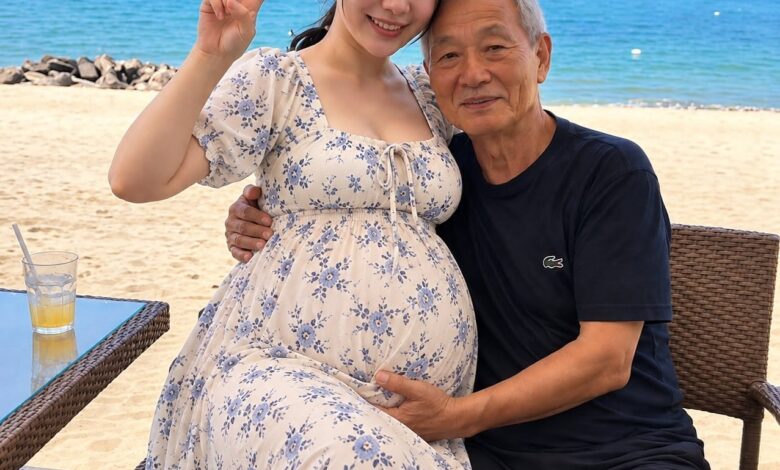
A Young Woman Found Happiness After Marrying a 70 Year Old Man
When 26-year-old Yuki announced that she was marrying a 70-year-old man named Kenji, the people closest to her reacted as though she had just revealed the most unbelievable secret of her life.
Her best friend stared at her across the kitchen table, waiting for a smile that would reveal the whole thing was a joke. Another friend laughed nervously, then stopped when she realized Yuki was completely serious. Even her relatives struggled to understand how a young woman with her entire future ahead of her could decide to marry someone old enough to be her grandfather.
“Wait a minute,” one friend finally said. “You’re twenty-six. He’s seventy. Please tell me there’s something about this man that you haven’t told us.”
Yuki lowered her eyes to her cup of tea.
“He makes me feel safe,” she answered.
For several seconds, nobody said anything.
Then another friend leaned forward and asked the question everyone else had apparently been too polite to say aloud.
“Girl, is he rich-rich?”
The room erupted in awkward laughter, but Yuki didn’t laugh. She had expected questions about money, inheritance, loneliness, and whether she had lost her mind. What she hadn’t expected was how quickly people she had known for years would dismiss her feelings simply because the man she loved did not fit their expectations.
Kenji was not a wealthy businessman, a famous celebrity, or a powerful politician. He was a retired physics professor with silver hair, a slightly crooked smile, and a peculiar sense of humor that could make an ordinary conversation feel like an adventure.
He owned a modest home, kept too many books, and had a habit of explaining everyday problems as though they were complicated scientific experiments. He could spend ten minutes discussing why a pancake turned out unevenly, only to conclude that the universe had personally decided to test his patience.
But Yuki had not fallen in love with his house, his possessions, or the number of years he had lived.
She had fallen in love with the way she felt when she was around him.
And that feeling had begun on a quiet beach in Okinawa, at a time when she had almost forgotten what it meant to feel comfortable in her own skin.
Chapter One: The Young Woman Who Had Become Tired of Pretending
Before Kenji entered her life, Yuki had become very good at pretending that everything was fine.
At twenty-six, she had a job, a small apartment, a collection of clothes she rarely wore, and enough photographs on social media to convince strangers that she was enjoying her youth.
Her pictures showed cafés, sunsets, weekend trips, and carefully arranged meals. She smiled in almost every photograph. Sometimes she even believed the smile herself.
But when the day ended and she returned to her apartment, the silence seemed to grow larger with every passing hour.
She had spent years trying to build the life she thought she was supposed to want. She worked hard, maintained friendships, went on dates, and told herself that happiness would eventually arrive if she kept moving in the right direction.
Instead, she found herself exhausted.
Her relationships had followed a familiar pattern. At first, someone would show interest. They would exchange messages late into the night, make plans for the weekend, and talk about the future as though it were a place they could visit together.
Then the promises would become vague.
A message would go unanswered. A planned dinner would be postponed. Someone who had insisted that Yuki was special would suddenly become too busy to make time for her.
She learned not to ask too many questions. She learned to pretend she didn’t care. She learned to leave first emotionally, even when the other person had already walked away.
The hardest part was not any single disappointment. It was the slow realization that she had begun expecting disappointment before anything had even happened.
Whenever a new person treated her kindly, she searched for the reason. Whenever someone complimented her, she wondered what they wanted. Whenever a relationship began to feel promising, she prepared herself for the moment it would fall apart.
She was not looking for a perfect man. In fact, she had grown suspicious of people who seemed perfect.
She wanted someone who could sit beside her without demanding that she entertain him. Someone who could listen without turning every conversation into a competition. Someone who could disagree without making her feel small.
Most of all, she wanted to stop feeling as though love were an examination she had to pass.
That was why, when she finally took a short trip to Okinawa, she made a decision that surprised even her.
She would not spend the vacation trying to meet anyone.
She would not check dating apps while waiting for her coffee. She would not photograph every meal to prove she was enjoying herself. She would not answer messages from people who appeared only when they were bored.
For a few days, she would simply exist.
She imagined walking along the beach, reading a book, eating local food, and returning home with a clearer mind.
She had no idea that the most unexpected conversation of her life was waiting just a few steps away from the water.
Chapter Two: The Stranger With the Lemonade
The afternoon Yuki met Kenji was warm and breezy.
The beach was not crowded. A few families were gathered near the shoreline, children ran between patches of sunlight, and the gentle sound of waves blended with distant conversations.
Yuki had found a quiet place beneath a tree. She sat on a towel with her shoes beside her, staring at the water while trying not to think about the problems she had brought with her.
Her phone buzzed.
It was a message from a friend asking whether she had met anyone interesting yet.
Yuki looked at the screen, sighed, and turned the phone facedown.
“An excellent decision,” a voice said nearby.
She looked up.
An older man stood several feet away, holding a bottle of lemonade. He had silver hair, a slightly sunburned nose, and the relaxed expression of someone who had stopped trying to impress strangers decades earlier.
“Sorry?” Yuki asked.
He pointed toward her phone.
“Turning that thing over. One of humanity’s greatest achievements. We invented a device that allows everyone to contact us at any moment, then spend our lives trying to escape it.”
Yuki stared at him for a second before laughing.
The man seemed pleased with himself.
“I’m Kenji,” he said. “Retired professor, occasional gardener, and a man who has recently discovered that retirement does not automatically make tomatoes cooperate.”
“Yuki,” she replied.
He nodded toward the empty space a short distance away.
“Would you mind if I sat there? I promise not to lecture you about physics unless you specifically request it.”
“Are you a physics professor?”
“Retired. Which means I can tell people I’m an expert and blame the university if I’m wrong.”
She laughed again, more naturally this time.
Kenji sat down, leaving enough distance between them to make it clear that he was not trying to intrude. He opened his lemonade and offered her the second bottle he had brought.
At first, their conversation stayed light. They talked about the weather, the beach, and the small restaurants nearby. Kenji made fun of his own terrible sense of direction, explaining that he could once calculate the trajectory of a moving object but still occasionally become lost on the way to a supermarket.
Then, without either of them quite realizing how it happened, the conversation became more personal.
Kenji asked whether Yuki had come to Okinawa for work or for pleasure.
“A little of both,” she answered.
“That’s a very diplomatic answer.”
“I’m trying to relax.”
“Then I recommend avoiding diplomacy. It requires too much energy.”
She smiled, but the expression faded when he asked whether she was enjoying her trip.
Yuki considered giving him the usual answer. She could have said that everything was wonderful and that she was having the time of her life.
Instead, she looked at the water.
“I’m still trying to remember how to enjoy things without feeling guilty about it.”
Kenji did not immediately respond.
He did not tell her to be positive. He did not explain that other people had it worse. He did not turn her sadness into an opportunity to describe his own accomplishments.
He simply waited.
That silence made it easier for her to continue.
She spoke about the disappointments she had experienced, the pressure she felt to have her life figured out, and the strange loneliness of being surrounded by people while feeling that nobody really knew her.
When she finished, she felt embarrassed.
“Sorry,” she said. “I don’t usually tell strangers all of that.”
“Good,” Kenji replied.
Yuki blinked.
“Good?”
“It means you have standards. Imagine if you told every stranger your entire life story. We’d never finish buying groceries.”
She laughed despite herself.
Then his expression softened.
“I’ve lived long enough to know that most people spend an extraordinary amount of time pretending,” he said. “They pretend to be happy, pretend to be successful, pretend not to be frightened. You don’t have to do that with me.”
He paused before adding, “And you don’t have to explain your sadness to earn the right to feel it.”
Something about those words stayed with Yuki.
They were not a promise that he would fix her life. They were not a declaration that he understood everything she had experienced.
They were simply permission to stop pretending for a moment.
For the first time in weeks, Yuki felt that she could breathe without preparing herself for the next disappointment.
They stayed on the beach until the afternoon light began to soften.
Before leaving, Kenji gave her the name of a small restaurant where he claimed the pancakes were better than the ones served in most expensive hotels.
“That’s a very serious claim,” Yuki said.
“I was a scientist. I believe in evidence.”
“And if the pancakes are terrible?”
“Then we will have discovered something important about the limitations of human knowledge.”
She left smiling.
She told herself she had simply met a charming old man.
But later that evening, when she sat alone in her hotel room, she realized she was thinking about him.
Not because he was mysterious or handsome in a conventional way.
Because she had spent an entire afternoon with someone who had not made her feel that she needed to be more interesting, more attractive, more successful, or less complicated.
For once, she had been allowed to be herself.
Chapter Three: The Friendship Nobody Expected
Yuki returned to the beach the following afternoon.
She told herself she wanted to enjoy the scenery. She also told herself that there was no particular reason she had chosen the same stretch of sand where she had met Kenji.
She was not entirely convinced by her own explanation.
He was there.
This time, he had brought a small notebook and a book whose pages were marked with handwritten notes. When he saw her approaching, he raised his lemonade in greeting.
“I was beginning to suspect the ocean had frightened you away,” he said.
“I’m not that easy to frighten.”
“Excellent. The restaurant I recommended serves a dessert that would challenge your courage.”
They spent the afternoon walking along the shore, stopping occasionally to watch the waves or discuss whatever caught their attention.
Kenji told her stories about teaching physics to university students. Some had been brilliant. Others had fallen asleep during lectures despite sitting in the front row.
“One student once asked whether gravity could be considered a personal opinion,” he said.
“What did you tell him?”
“That if gravity were a personal opinion, I would have voted against it after the third time I dropped my glasses.”
Yuki laughed so hard that she had to stop walking.
But the moments she remembered most were not the jokes.
They were the small things.
Kenji noticed when she became quiet and did not demand an explanation. He remembered that she preferred her drinks less sweet. When she mentioned wanting to visit a local market, he offered directions but made it clear she should explore at her own pace.
He never behaved as though her attention were something he was entitled to receive.
That distinction mattered more to her than she initially understood.
In the days that followed, their conversations became a familiar part of the morning. Sometimes they walked. Sometimes they sat beneath the tree and read. Sometimes they visited a small café and argued over whether the owner deliberately made the coffee too strong.
One afternoon, Kenji brought a portable speaker and played an old Elvis Presley song.
Yuki recognized the melody but did not know the lyrics.
“You’re supposed to dance,” Kenji announced.
“Here?”
“Unless you see a more suitable ballroom nearby.”
She shook her head, laughing.
He stood, offered his hand, and made an exaggeratedly formal bow.
Yuki accepted.
They danced barefoot on the sand, moving awkwardly to the music while a few distant beachgoers glanced in their direction.
Kenji was not graceful. Yuki was not particularly coordinated. At one point, he stepped on his own foot and blamed the sand for changing position without permission.
She laughed until tears formed in her eyes.
It was the kind of laughter she had not experienced in a long time—not the polite laughter she used in social situations, but the unguarded kind that left her cheeks aching.
Later, she wondered whether she was falling in love.
The thought frightened her.
She was twenty-six. Kenji was seventy. They had known each other for only a few days.
The difference between their ages was not a minor detail that could be ignored. It affected their experiences, their physical futures, their expectations, and the practical realities of building a life together.
Yuki understood all of that.
Yet she also knew that the people who had disappointed her in the past had often been much closer to her age.
Age alone had never guaranteed maturity, honesty, or emotional safety.
Still, she did not want to mistake the relief of being treated kindly for a complete understanding of another person.
So she decided to take things slowly.
Kenji, to her surprise, seemed to share the same concern.
One evening, as they watched the sun disappear beyond the water, he turned toward her.
“Yuki, I enjoy spending time with you,” he said. “More than I expected to enjoy anything when I came here.”
She smiled.
“But I also know that our lives have been very different. I don’t want you to feel that you owe me anything because I’ve been kind to you.”
She looked at him carefully.
“I don’t.”
“Good. Because I have very little patience for emotional debts. The interest rates are terrible.”
She laughed, but he continued.
“If this becomes something more, I want you to choose it because you understand what you’re choosing. Not because you’re lonely, not because I’m lonely, and certainly not because I can make an excellent argument about the statistical probability of finding someone who tolerates my cooking.”
For a moment, Yuki could not think of anything to say.
She had met people who rushed to define relationships because they wanted certainty. She had met people who avoided definitions because they wanted freedom without responsibility.
Kenji was offering neither pressure nor evasion.
He was asking her to think.
That night, Yuki returned to her hotel with a strange mixture of happiness and fear.
The next morning, she made a decision that would astonish everyone who knew her.
She would marry Kenji.
Not because she believed love eliminated every difficulty, but because she wanted to explore the possibility of a life with him honestly, with her eyes open.
And, after a series of long conversations, Kenji agreed.
Ten days after they first met, they were married.
Chapter Four: Ten Days, One Wedding, and a Thousand Questions
The wedding was small.
There was no extravagant venue, no elaborate ceremony, and no enormous guest list. The celebration reflected what Yuki and Kenji wanted: something personal, quiet, and meaningful.
But outside that small circle, their decision created a storm.
When Yuki told her friends, the first reaction was disbelief. The second was concern. The third, in several cases, was suspicion.
One friend asked whether Kenji had promised to leave her a fortune.
Another wanted to know whether Yuki had considered what life would look like in ten or twenty years.
A relative suggested that she was confusing gratitude with romantic love.
Someone else went further, accusing Kenji of taking advantage of a young woman who was emotionally vulnerable.
Yuki tried to answer patiently.
She acknowledged that marrying someone after ten days was an extraordinary decision. She admitted that the age difference raised practical questions. She did not expect anyone to abandon their concerns simply because she insisted she was happy.
But she refused to accept the idea that her feelings must be dishonest because other people found them difficult to understand.
“I’m not asking you to agree with me about everything,” she told her best friend. “I’m asking you not to decide that I’m stupid before you’ve even met him.”
Her friend folded her arms.
“And what happens if you’re wrong?”
Yuki looked down.
It was a fair question.
“What happens if any of us is wrong?” she replied. “I can’t guarantee that my marriage will last forever. Nobody can. But I can make decisions carefully, keep my independence, and pay attention to how he treats me.”
Her friend did not appear satisfied.
Neither was Yuki.
There were moments when the criticism made her question herself. She sometimes wondered whether the intensity of those first ten days had made everything seem simpler than it was.
Marriage would introduce ordinary realities that beach walks and romantic conversations could not reveal. They would need to discuss money, household responsibilities, health, family expectations, privacy, and the possibility that their needs might change over time.
Affection could not substitute for those conversations.
Still, Yuki was determined to give their relationship a genuine chance.
She and Kenji began building a daily routine. They cooked together, took walks, visited bookstores, and learned to tolerate each other’s habits.
Kenji discovered that Yuki liked to rearrange furniture whenever she felt restless. Yuki discovered that Kenji treated every household repair as an opportunity to invent a new theory of engineering.
Their first attempt to assemble a bookshelf ended with three missing screws and an argument about whether the instructions were written by a person or a particularly vindictive machine.
They made pancakes on Friday evenings. They watched television together, sometimes choosing shows neither of them would have admitted enjoying in public. They planted herbs in small pots on the balcony.
Their differences were real, but not always difficult.
Sometimes, Yuki introduced Kenji to music he had never heard. Sometimes, he introduced her to books that changed the way she thought about the world.
They began discussing the possibility of spending part of the year in Japan and part in Oregon, where Kenji had friends and a quieter pace of life.
For a little while, their world seemed peaceful.
Then, on the tenth day of their marriage, Yuki discovered the locked room.
And the peace she had begun to trust suddenly became something she was afraid to lose.
Chapter Five: The Locked Door
Yuki first noticed the room on a rainy morning.
The house had two floors, with a small study downstairs and several bedrooms above. Most of the rooms were open and lived-in. Books stood in uneven stacks, framed photographs lined the hallway, and a collection of old scientific instruments occupied a shelf near the window.
But at the end of the upstairs corridor stood a narrow wooden door with a brass handle.
It was always locked.
At first, Yuki thought little of it. Everyone had private belongings, and Kenji had lived alone for years before she arrived.
Then she began noticing other things.
Every morning, shortly after breakfast, Kenji left the house at almost exactly the same time. He never explained where he was going beyond saying that he had a few things to take care of.
When his telephone rang, he sometimes stepped outside to answer it. If Yuki entered the room while he was speaking, he would lower his voice or end the call.
He had never behaved aggressively. He was not controlling, and he did not tell her where she could go or whom she could see.
Yet the pattern unsettled her.
One evening, she asked him directly.
“Kenji, is there something you’re not telling me?”
He looked up from the book he was reading.
“What makes you ask?”
“The locked room. The phone calls. You leave every morning and never really explain where you’re going.”
He closed the book.
For a moment, Yuki thought he would answer.
Instead, he rubbed his forehead and said, “It’s something personal. I need a little more time before I can talk about it.”
The response was gentle, but it did not reassure her.
“How much more time?”
“I don’t know.”
Yuki sat quietly.
She wanted to respect his privacy. She also knew that privacy and secrecy were not the same thing, particularly in a marriage that had begun so quickly.
“I’m not asking you to tell me every thought in your head,” she said. “But I need to know whether there’s something that could affect our life together.”
Kenji looked at her with an expression she could not interpret.
“It isn’t what you think.”
That sentence, she would later realize, was one of the least helpful things he could have said.
“What do you think I think?” she asked.
He opened his mouth, then closed it again.
Finally, he said, “Please trust me.”
Yuki felt a small, cold sensation settle in her chest.
Trust, she thought, could not simply be requested like a favor. It had to be built, especially when circumstances gave a person reasons to feel uncertain.
She went to bed that night without another argument.
Kenji kissed her forehead before turning off the light.
She lay awake long after he had fallen asleep.
By morning, the questions had multiplied.
Perhaps her friends had been right. Perhaps she had mistaken his quiet manner for complete honesty. Perhaps there was a former partner, a hidden financial problem, or a family situation he had deliberately concealed.
She hated that her mind had begun searching for betrayal.
But the marriage was only ten days old, and she knew very little about the years of his life that had come before her.
For the first time since the beach, she wondered whether the calm she had found with Kenji had been real—or simply the calm of a story she had not yet learned to question.
Chapter Six: The Morning Everything Changed
Two mornings later, Yuki woke before Kenji.
Rain tapped against the windows, and the house was unusually quiet.
She made coffee, opened the curtains, and waited for the familiar sounds of Kenji moving around upstairs.
They did not come.
Instead, she heard the front door close.
She looked at the clock.
It was earlier than usual.
Through the window, she saw Kenji walking toward the street with a dark folder tucked beneath his arm. He paused near the gate, looked back at the house, and then continued down the road.
Yuki stood still.
She had no intention of following him. At least, that was what she told herself for the first few minutes.
Then she noticed the folder.
It was the same one she had seen him carrying on two previous mornings.
A memory returned to her: a phone call she had overheard the night before.
“No, I haven’t told her yet,” Kenji had said quietly. “I don’t know how to explain it.”
At the time, she had assumed he was speaking about something related to work.
Now the words sounded different.
She put on her coat, took her keys, and left the house.
Kenji was walking toward a small community building several streets away. Yuki followed at a distance, telling herself that she only wanted to understand what was happening.
When he entered the building, she stopped outside.
Through the glass, she saw him speak with a woman behind a desk. The woman handed him a set of keys. He thanked her, then walked down a corridor and disappeared through a door.
Yuki waited.
A few minutes later, she heard voices.
One belonged to Kenji.
The other belonged to a woman who sounded as though she had been crying.
“I can’t keep putting this off,” the woman said.
“I know,” Kenji replied. “But I need to make sure everything is right.”
“What if she finds out from someone else?”
There was a long silence.
Then Kenji answered, “That is exactly what I’m trying to avoid.”
Yuki felt her stomach tighten.
She stepped away from the window.
She could have gone inside. She could have demanded an explanation. Instead, she returned home with her mind racing through possibilities.
By the time Kenji came back, she had prepared herself for a confrontation.
He entered carrying the folder.
When he saw her standing in the living room, he stopped.
“You followed me,” he said.
It was not a question.
Yuki felt her face grow hot.
“Yes.”
Kenji set the folder on the table.
For a moment, neither of them spoke.
Then Yuki asked the question that had been tormenting her.
“Who were you talking to, and what are you hiding from me?”
Kenji looked at her, and something in his expression changed.
Not anger.
Fear.
It was the first time Yuki had seen him look genuinely afraid.
“Yuki,” he began, “there is something about my past that I should have told you before we got married.”
Her heart began to pound.
“Then tell me now.”
He looked toward the staircase.
“I can’t do it in the hallway.”
“Why? Because of the locked room?”
He closed his eyes.
When he opened them again, he nodded.
“Yes.”
Yuki felt as though the floor had shifted beneath her.
“Then open it.”
Kenji did not move.
“Please,” she said, her voice breaking. “I have defended our marriage to people who think I must be foolish or desperate. I’ve told them I trust you. I’ve told myself that what matters is the way we treat each other. But I cannot keep defending something when you won’t let me see the truth.”
For several seconds, Kenji stared at the floor.
Then he reached into his pocket, removed a small key, and held it in his palm.
“I should have told you,” he whispered.
He walked upstairs.
Yuki followed.
At the end of the corridor, he stopped in front of the locked door.
His hand trembled slightly as he inserted the key.
The lock turned.
The door opened.
And Yuki saw a room filled with photographs, handwritten letters, old drawings, and boxes carefully labeled with dates.
On the largest wall hung a photograph of Kenji standing beside a woman with bright eyes and a teenage girl whose smile seemed to fill the entire picture.
Yuki recognized the expression on Kenji’s face immediately.
It was the same gentle expression he wore when he thought nobody was looking.
But the photograph had been taken years earlier.
And the woman and girl standing beside him were not part of the life Yuki had imagined.
Chapter Seven: The Family He Had Lost
Kenji remained in the doorway.
For a moment, he looked like a man who had walked into a room and forgotten why he had come.
Then he stepped inside and moved toward the photograph.
“This is my wife, Aiko,” he said. “And this is our daughter, Hana.”
Yuki said nothing.
Kenji took a breath.
“Aiko died eleven years ago. Hana was seventeen.”
The words seemed to drain the air from the room.
He explained that Aiko had become seriously ill after a period of declining health. The illness had progressed faster than the family expected, leaving them struggling to adjust to a future they had never imagined.
Hana had tried to remain strong for her father. She attended school, helped with household responsibilities, and spent long evenings beside her mother’s bed.
After Aiko died, their small family changed in ways Kenji had not known how to repair.
He threw himself into work. Hana tried to continue her life, but grief followed her everywhere.
They loved each other deeply, yet they often failed to communicate what they needed. Kenji believed that providing stability was the best way to help his daughter. Hana needed him to talk about what had happened.
Neither understood the other well enough.
Then, several years later, Hana died in an accident.
Kenji did not describe the accident in detail. He only said that it happened suddenly and that, for a long time, he could not understand how the world could continue moving when his own had stopped.
After losing both his wife and daughter, he withdrew from much of his social life.
He retired, sold some belongings, and began living quietly. He read, tended his garden, and visited places where nobody knew his history.
He did not stop loving the people he had lost.
He simply stopped knowing how to speak about them.
Yuki looked around the room.
The letters were arranged in neat bundles. Some were written in Aiko’s handwriting, while others appeared to be notes from Hana. On a desk sat a collection of sketches showing a modest building with large windows, a garden, and a sign above the entrance.
“What is this?” Yuki asked.
Kenji followed her gaze.
“It was their idea.”
He lifted one of the drawings.
Aiko and Hana had wanted to establish a community center for young people dealing with grief, family difficulties, or emotional distress. They imagined a place where teenagers could receive counseling, find practical assistance, and speak honestly without feeling ashamed of what they were experiencing.
Aiko had worked with young people before becoming ill. Hana had volunteered with a local support group.
They had talked about the center for years.
After their deaths, Kenji found himself unable to finish what they had started. Every document reminded him of the future they had planned but never reached.
Eventually, he began working on the project privately.
The building he had visited that morning was connected to those efforts. He had been meeting with people who were helping him explore whether the old plan could be revived.
The woman Yuki had overheard was a community coordinator.
Kenji had been afraid to discuss the project because it was not merely an idea. It was the last unfinished dream of the family he had lost.
Yuki looked at the photographs again.
She understood why he had kept the room locked.
But understanding did not erase the hurt.
“You could have told me,” she said quietly.
Kenji nodded………………….CONTINUED ON NEXT PAGE