My Uncle Took Money From Grandmas Social Security Just to Cut Her Grass but When I Came Home From Deployment Everything Changed
The Checkbook
I found it in her checkbook the night I got home.
I wasn’t snooping. I want that on the record. It was almost midnight, and Grandma had gone to bed, and I couldn’t sleep because my body still thought it was morning somewhere on the other side of the world. So I went to the kitchen for a glass of milk, and her checkbook was sitting open on the table next to the sugar bowl, the way it always was.
She still writes checks. Paper ones. In blue ink, in that slanted cursive they used to teach in Missouri schools in 1955. She balances her register every Sunday after church with a pencil and a calculator the size of a paperback book.
I glanced down at it while I poured my milk. Just a glance.
Then I set the jug down and pulled out a chair.
The register went back eleven months. All the way back to last August, the week I shipped out.
Most of it was what you’d expect from a seventy-eight-year-old widow on a fixed income. Ameren Missouri, eighty-four dollars. Cedar Ridge Water, thirty-one. Walmart pharmacy, twelve. Church offering, twenty, every single week, never missed.
And then, once a month, in the same slanted blue cursive:
Ray. 400.
I turned the page.
Ray. 400.
I turned the page again.
Ray. 400.
Every month I was gone. Eleven times. Next to the first one, in pencil, she’d written in small letters: lawn.
I sat there at that kitchen table for a long time.
Grandma’s Social Security check is eleven hundred and six dollars a month. I know that because I helped her set up the direct deposit when I was sixteen. That’s all she has. Grandpa’s railroad pension died with him, because he took the bigger payout and nobody told her what that meant.
Eleven hundred dollars.
And my uncle had been taking four hundred of it. More than a third. Every month for almost a year.
To mow a quarter-acre yard.
I did the math in my head. I didn’t want to, but I couldn’t stop it. Eleven months. Four thousand, four hundred dollars.
Overseas, I had made a little extra for being deployed. Hostile fire pay, family separation pay, the tax break. I’d saved almost all of it. I’d been planning to use some of it to fix the hole in Grandma’s back porch roof and maybe get her a new recliner, because the old one leaned to the left and squeaked every time she sat down.
Meanwhile, back home, she’d been paying her own son more than her electric, water, and grocery bills put together. To cut her grass.
I closed the checkbook. I squared it next to the sugar bowl the way she likes it. I washed my glass and set it in the drainer.
Then I went out to the back porch and stood there in the dark, in my socks, looking at the yard.
I grew up on that yard.
I learned to throw a football on it. I buried two dogs and a hamster under the redbud tree in the corner. I broke my arm falling out of the oak by the fence when I was nine, and Grandma drove me to the hospital in Rolla in her nightgown with her hair in curlers.
It was the yard where I stood with my hands in my pockets the afternoon they told me about my dad.
In the dark, I couldn’t see much. But I could smell it. Cut grass. Old, the way it gets when somebody mows it with a dull blade and leaves the clippings in clumps to rot.
My grandmother’s yard had never once smelled like that while my grandpa was alive. Or while I lived there.
Chapter Two: Eggs
Saturday morning, she fried me eggs.
She was up before me, which shouldn’t have surprised me but did. She’s been getting up at five-fifteen since she was a girl on a dairy farm outside Licking. When I came into the kitchen at six-thirty in my sweatpants, she was already standing at the stove in her blue housecoat, with bacon popping in the cast iron skillet and the radio playing the farm report.
“There’s my Marine,” she said, without turning around. “Sit down. Coffee’s on.”
I sat. She put a cup in front of me. Black, with one sugar. She remembered.
Her name is Opal Gaines. She’s four foot eleven and maybe ninety pounds if she’s holding a cat. She’s got white hair she sets in pink foam curlers every Saturday night so it’ll look nice for church. Her hands are covered in brown spots and they shake a little now, but she still cracked those eggs one-handed, the way she always did.
“Over easy?” she asked.
“Yes, ma’am.”
“I know, I know. I was just checking you hadn’t changed on me.” She flipped them with a little flick of her wrist. “The Marines didn’t make you start eating them scrambled, did they?”
“No, ma’am. Scrambled’s all they serve. I’m starving for over easy.”
She laughed. I loved that laugh. I hadn’t heard it in eleven months, except for once on a bad phone connection at Christmas.
She set the plate down in front of me. Two eggs, four strips of bacon, a biscuit with butter melting into it, a spoonful of her own blackberry jam.
I ate the whole thing in about four minutes. She stood by the counter and watched me with her arms crossed, smiling.
Then I set down my fork.
“Grandma,” I said. “Who’s been cutting the grass?”
Her face closed up like a screen door.
Just like that. One second it was wide open, warm and smiling. The next second it shut, and I could see her pulling something closed behind her eyes. Latching it.
“Your uncle’s been seeing to it,” she said.
She turned back to the stove. She picked up the skillet and started scraping it with a spatula, even though it was already clean.
“How much does that cost you?” I asked.
She didn’t answer. She looked out the window over the sink. Out at the yard.
“It’s family helping family, Hunter,” she said.
“But he puts four hundred on it, Grandma.”
She went still. Her hand stopped scraping.
“You were in my checkbook,” she said quietly.
“It was open on the table. I wasn’t snooping. I promise.”
She set the skillet down. She turned on the water in the sink and ran it, even though there was nothing in the sink to wash. She held her hands under it.
“He’s my son, Hunter,” she said.
“I know he is.”
“He’s had a hard time. Things are tight for him. Sheila’s been after him about money. He needs the work.”
“Four hundred dollars a month, Grandma. That’s a third of your check.”
She turned off the water. She didn’t look at me.
“I am not going to make a war over grass,” she said.
That was all she said. She dried her hands on the dish towel. She hung it over the oven handle, folded in thirds, the way she always does.
Then she went into the living room and sat down in her leaning recliner and turned on the TV.
I sat at the kitchen table with my empty plate and understood.
She paid it quiet. All eleven months. She never told me on the phone. Never once mentioned it in her letters, and she wrote me every week, three pages front and back, about the church potluck and the neighbor’s cat and what the doctor said about her blood pressure.
She buried one son already. My dad. Danny Gaines. Thirty-four years old. Route 63 on an icy night in January, eleven years ago.
She would rather be robbed than lose the other one.
I didn’t argue.
There wasn’t any point. I knew that look on her face. I’d seen it once before, at my dad’s funeral, when my mother stood up at the graveside and said she was moving to Kansas City with her new boyfriend and wasn’t sure she could take a ten-year-old with her.
Grandma had stepped right up next to me and put her hand on my shoulder.
“He’ll stay with me,” she said. Just like that. And her face closed like a screen door, and nobody argued with her.
So I didn’t argue now.
I went to my room and got dressed.
Chapter Three: The Blade
The only clean thing left in my seabag was my PT gear.
I’d been traveling for three days. Ship to port, port to a base, base to a charter flight, charter flight to Camp Lejeune, Lejeune to Raleigh, Raleigh to St. Louis, St. Louis to Cedar Ridge in a rented Corolla. Everything I owned smelled like jet fuel and the inside of a duffel bag.
Except my PT gear. Green Marine Corps running shorts and a tan shirt with the eagle, globe, and anchor on the chest. I’d washed them in a sink in a hotel bathroom in Spain and never worn them since.
I put them on. I laced up my running shoes. I grabbed a pair of work gloves from the drawer by the back door, Grandpa’s old leather ones, stiff as cardboard.
Then I went out to the shed.
The shed was Grandpa’s. Walter Gaines built it himself in 1971 out of lumber he salvaged from a barn they tore down out on Highway 72. It still had his pegboard on the back wall, with his tools hanging on it, outlined in black marker so you’d know where each one went back.
Grandma never let anybody move a single thing on that pegboard. Not in the fourteen years since he died.
The mower was in the corner. A red Snapper push mower, maybe twenty years old. Grandpa bought it new at the Western Auto in Rolla, back when there was still a Western Auto in Rolla. He babied that mower like it was a classic car.
I pulled it out into the light.
It looked terrible.
The deck was caked with old grass, green and black and stinking. The air filter was so packed with dirt it was the color of a mud puddle. When I pulled the dipstick, the oil came out thick and black as tar, and there was barely enough of it to wet the end.
I tipped the mower up on its side and looked at the blade.
It was dull as a butter knife. I ran my thumb along the edge and it didn’t even catch. There were dings in it from rocks, and one end was bent down a little, so the whole thing would wobble when it spun.
No wonder the yard smelled like that. A dull blade doesn’t cut grass. It rips it. Tears the tops off and leaves them ragged and brown, so the whole lawn looks sick a day later.
He’d never once changed the oil. Not once in eleven months. Probably not ever.
Four hundred dollars a month.
I got to work.
I pulled the spark plug wire first, because Grandpa taught me that when I was eleven and would come back from the grave to whip me if I forgot. I took the blade off with a socket wrench from the pegboard. Then I clamped it in Grandpa’s bench vise and went at it with his big flat file, long even strokes, the way he showed me, until the edge shone silver and would shave the hair off my arm.
I hung it on a nail to check the balance. One end dipped. I filed the heavy side down until it hung level.
I scraped the deck clean with a putty knife. I knocked the dirt out of the air filter against the shed wall. I drained the old oil into a coffee can and filled it back up with fresh oil from a jug I found on the top shelf. Grandpa’s jug. Bought in 2009, according to the faded price sticker. Still good. Oil doesn’t go bad if you keep the cap on.
By the time I was done, I was sweating through my tan shirt, and it was only eight-fifteen.
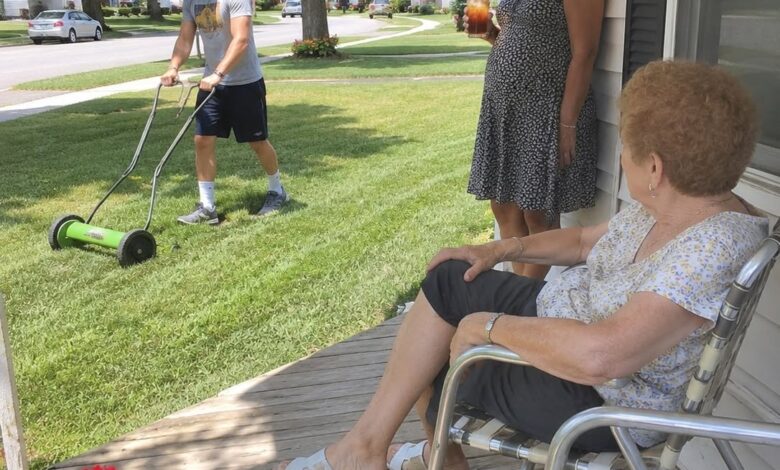
When I rolled the mower out of the shed, Grandma was on the porch.
She’d dragged her old aluminum lawn chair out from beside the back door. The one with the green and white plastic webbing that was half broken on one side. She’d set it right at the top of the porch steps, facing the yard.
She was sitting in it in her blue housecoat. Her hands were folded in her lap.
She didn’t say anything. She just watched me.
She watched me the way she did when I was eleven.
It was the summer after my dad died. My mother had gone to Kansas City. I was living in the back bedroom that used to be my dad’s, with his high school football trophies still on the shelf.
I didn’t talk much that summer. I didn’t cry much either. Mostly I just sat in front of the TV and didn’t watch it.
One Saturday in June, Grandma came into the living room and turned off the TV and stood in front of me with her hands on her hips.
“Get your shoes on,” she said. “I’m going to teach you to mow.”
“Grandpa used to do it.”
“Your grandpa’s gone,” she said. “And your daddy’s gone. And somebody in this family’s got to know how to cut a straight line. Get your shoes on.”
She taught me out there in the hot sun, with her hand on mine on the handle.
“You go down the long way first,” she said. “Fence to fence. Then you come back and overlap by about the width of your hand. You line up the edge of the wheel with the line you just made. You keep your eyes on the end, not on your feet. Your feet’ll follow your eyes.”
My first line was crooked as a snake.
“Again,” she said.
My second line was a little better.
“Again.”
By the end of that summer, I could cut that yard in straight lines so clean they looked like they’d been laid out with a ruler. Dark stripes and light stripes, depending which way the grass bent.
“There,” Grandma said, the first time I did it right. She was sitting in that same lawn chair. “Now you know something your daddy knew. And your grandpa. Now it’s yours.”
Chapter Four: Miss Edna
I cut her yard first.
Front yard, side yard, back yard. Fence to fence. I lined up the wheel with the edge of the last pass, kept my eyes on the far end, and let my feet follow.
The sharp blade sang. That’s the only word for it. A dull blade makes a heavy, choking sound. A sharp one hums, high and clean, and the grass comes off in a fine green spray.
Straight lines. Dark and light. Dark and light.
When I finished the backyard and came around the side of the house, I looked at the front. It looked like a ballfield. The stripes ran all the way down to the street, straight as fence wire.
Grandma was still sitting on the porch. She hadn’t moved.
She didn’t say anything. But she nodded. Once.
I shut off the mower. The silence rang in my ears. I wiped my face on my sleeve.
Then I looked down the street.
Grandma lives on Locust Street, on the east side of Cedar Ridge, Missouri. Population four thousand and something. It’s a short dead-end street, just ten houses. Five on each side. Little ranch houses and a couple of old two-story farmhouses, all built in the fifties and sixties by men who worked at the shoe factory or the railroad or the quarry.
Most of those men are dead now.
I counted it in my head. Nine houses besides Grandma’s. A widow in most of them. Miss Edna Pruitt. Mrs. Halloway. Mrs. Dorothy Banks. Old Mrs. Kessler, who must be ninety-five. Mr. Archie Coleman, who’s not a widow but has been legally blind since his diabetes got bad.
And every single yard on that street was high. Shaggy and brown on top, gone to seed. Dandelions and clover and foxtail grass knee-high along the fences.
It made me mad in a way I can’t really explain.
When I was a kid, Locust Street was the prettiest street in Cedar Ridge. The men took pride in their yards. They’d mow on Saturday mornings and then stand at the curb in the afternoon with cans of Busch and talk about each other’s grass. Grandpa won Yard of the Month from the garden club three summers in a row.
Now it looked like nobody lived there at all.
I looked back at Grandma on the porch.
She was looking down the street too.
I rolled the mower next door.
Miss Edna Pruitt lives in the little yellow house with the green shutters. She’s eighty-one. She taught third grade at Cedar Ridge Elementary for thirty-eight years, and she taught me, and my dad before me. She used to give out butterscotch candies if you got a hundred on your spelling test.
She was sitting on her porch in a straight-backed chair with a big metal bowl in her lap, snapping green beans. When she saw me coming up her driveway with the mower, she stopped snapping.
“Hunter Gaines,” she said. “Is that you?”
“Yes, ma’am.”
“Look at you. In your shorts. Back from overseas.” She looked me up and down over her glasses. “You’ve filled out.”
“The Marines feed you pretty good, ma’am.”
“Well, it shows.” She looked at the mower. Then at her shaggy yard. Then back at me. Her face changed. Something careful came into it.
“I can’t pay you much, honey,” she said.
“I’m not asking you to pay, Miss Edna.”
“Well, I’d want to.” She set down the bowl of beans. “But I have to tell you the truth. I can’t afford much. Your uncle’s price was dear.”
I went still.
“My uncle,” I said.
“Raymond.” She nodded. “He came around in the spring. Said he was doing your grandma’s yard and he’d do mine too. Said I couldn’t keep letting it go, the city would send me a letter.” She shook her head. “Two hundred dollars a month, he wanted. For a yard this size.”
“Did you pay it?”
“Two months,” she said. “April and May. Then I had to tell him no. My pills went up. My insurance changed in January. I just couldn’t.” She looked down at her hands. “He wasn’t very nice about it. He said I’d be sorry when the city fined me.”
Ray had been to her too.
I stood there in her driveway in my PT shorts with the sweat drying on my back, and something went cold in my chest. The same cold I’d felt sometimes overseas, right before things went bad.
Two hundred dollars. From a retired schoolteacher who gave out butterscotch candies.
“I’m not charging anybody today, ma’am,” I said.
She looked at me for a long time over her glasses.
“You were always a sweet boy,” she said finally. “Even when you couldn’t spell ‘necessary.’”
“I still can’t, ma’am.”
She laughed. Then she picked up her bowl of beans and started snapping again.
“Go on, then,” she said. “And watch my roses along the fence. Herbert planted those in 1972.”
I cut her grass. I went slow along the fence line so I wouldn’t nick Herbert’s roses. I raked up the worst of the clippings into a pile by the curb, so they wouldn’t smother the lawn.
When I was done, her yard had stripes too. Dark and light.
Miss Edna stood up from her chair and came to the edge of her porch. She looked at her yard for a long time. She put one hand on the railing.
“Herbert would’ve liked that,” she said quietly.
Chapter Five: Sweet Tea
Word travels faster than a mower.
That’s true anywhere, but it’s especially true on a dead-end street in a small Missouri town on a Saturday morning in July. By the time I finished Miss Edna’s backyard, I could see curtains moving in the windows up and down Locust Street. A screen door creaked open across the road. Then another one.
A woman came across the street toward me, carrying a big plastic pitcher with ice clinking in it.
She was younger than the others. Maybe sixty. She had short gray hair and reading glasses pushed up on her head, and she was wearing scrubs with little cartoon cats on them. I recognized her after a second. Loretta Simms. She was a nurse at the county clinic. She’d given me my shots for kindergarten.
“You look like you need this,” she said, and poured me a big plastic cup of sweet tea.
I drank the whole thing in one go. It was so sweet it made my teeth hurt. It was the best thing I’d tasted in a year.
“Thank you, ma’am.”
“Don’t thank me,” Loretta said. She poured me another one. “Thank your grandma. She’s the one who called me.”
I looked over at Grandma’s porch. She was still sitting in her lawn chair. She raised one hand at me. Just a little.
“She called you?”
“Said her grandson was home from the Marines and was out cutting grass and might need something cold.” Loretta looked down the street. “She didn’t say you were going to do Edna’s too.”
She was quiet for a second. Then she lowered her voice.
“He charged these old women,” she said. “Your uncle. Did you know that?”
“I’m starting to,” I said.
“He went door to door in April. Told them the city was cracking down on tall grass. Told them they’d get fined fifty dollars a day if they didn’t keep it cut. Then he offered to do it for them.” She shook her head. “Two hundred. Two-fifty. Three hundred for Mrs. Banks, because her yard’s bigger.”
“Is that true? About the city?”
“There’s an ordinance,” Loretta said. “Grass over twelve inches. But they send you a letter first and give you ten days. Nobody gets fined fifty dollars a day. I called city hall myself.”
“Did you tell them that? The ladies?”
“I told some of them.” She sighed. “But he’s Opal’s boy. And he was polite about it, at first. And they’re scared, Hunter. Most of them are living on a few hundred dollars more than your grandma. One letter from the city and they think they’re going to lose their houses.”
I looked down Locust Street. At all those shaggy yards. At the curtains moving in the windows.
“Half of them paid him a month or two and then couldn’t anymore,” Loretta said. “So he stopped coming. And their yards went to seed. And now they’re all scared the city’s going to come after them.” She looked at me. “Which is why every one of them is peeking out their window at you right now.”
I drank my second cup of tea. I set the plastic cup on Miss Edna’s porch rail.
Then Loretta asked me the question.
“You gonna do the whole street?”
I looked at all those shaggy yards. Nine houses. Ten counting Grandma’s. A widow in most of them. Seeds blowing off the tops of the grass in the hot wind.
I thought about the checkbook. Ray. 400. Ray. 400.
I thought about Miss Edna saying, I can’t pay you much, honey.
“Yes, ma’am,” I said. “I believe I am.”
Loretta grinned. “Well, all right then.”
She turned around and walked straight up the middle of Locust Street with her pitcher of tea, calling out in her clinic voice, loud enough to wake the dead.
“Dorothy! Margaret! Irene! Archie! Get on out here. Opal’s grandson’s cutting the whole street, and it’s free, and he needs tea.”
Chapter Six: Ten Yards
Ten yards in a Missouri July.
If you’ve never been in Missouri in July, I can’t explain it to you. The air is so thick and wet it’s like breathing through a hot towel. By ten in the morning it was ninety-one degrees. By noon it was ninety-six. The cicadas in the oak trees were so loud they drowned out the mower.
I’d been in a desert overseas. Real desert, a hundred and fifteen degrees in the shade. And I’m telling you, Missouri in July is worse. At least the desert’s dry.
By the third yard, my tan shirt was so soaked it was dark brown. I took it off, wrung it out over the curb like a dishrag, and put it back on wet. It felt good for about four minutes.
The ladies came off their porches.
I didn’t expect that. I thought they’d stay inside in their air conditioning, peeking out the curtains. But they came out one by one. Slowly. With canes and walkers and folding chairs.
Mrs. Dorothy Banks came out first, with a plate of oatmeal cookies wrapped in plastic. Then Mrs. Margaret Halloway, who’s eighty-six and still drives a 1994 Buick to the Piggly Wiggly every Tuesday. Then Mrs. Irene Kessler, who’s ninety-five, wheeled out to the end of her driveway by her great-granddaughter.
Then Mr. Archie Coleman, with his white cane, tapping his way down his front steps.
“Where’s that Marine?” he hollered. “I want to shake his hand. I can’t see him, but I want to shake it.”
By the fifth yard, they’d set up folding chairs in a little row under the big oak tree in Mrs. Banks’s front yard. All of them. Like they were at a parade.
Loretta kept the tea coming. Mrs. Banks kept the cookies coming. Every time I came to the end of a row near the oak tree, someone handed me something. A cookie. A cold washcloth for the back of my neck. A slice of watermelon.
And they talked.
They talked to each other, mostly, but loud enough for me to hear over the mower. They talked about their husbands.
“Clarence would’ve had this yard done by seven a.m.,” Mrs. Halloway said. “He used to wake up the whole street with that old Toro.”
“Herbert used to edge with a pair of scissors,” Miss Edna said. “On his hands and knees. I thought he was crazy.”
“Walt Gaines had the prettiest yard in Cedar Ridge,” Mrs. Banks said. “Three years running.”
“Four,” Grandma said from her porch next door. “Nineteen eighty-eight. They gave it to the Hendersons because they felt sorry for them. Walt never got over it.”
All the ladies laughed.
Then they talked about my dad.
“Danny used to mow my yard when he was twelve,” Mrs. Kessler said, in her thin, papery voice. “Charged me two dollars. And then he’d spend it at the drugstore on a Coke and a candy bar and come back and give me half the candy bar.”
“He was a good boy,” Mrs. Banks said.
“He was a good man,” Miss Edna said.
“You look just like him, Hunter,” Mrs. Halloway called out. “Out there in your little shorts. Just like him.”
I had to turn away and pretend there was something wrong with the mower for a minute.
Grandma never left her chair.
She sat in that broken lawn chair at the top of her porch steps all morning. She didn’t come down to the oak tree with the other ladies. She didn’t call out. She just sat there with her hands folded in her lap.
She watched me the whole morning.
Every time I made a turn at the end of a row, I looked up, and she was looking at me. Every yard. Every row. Straight lines, dark and light, all the way down Locust Street.
Around the seventh yard, a skinny kid on a bike rode up. Maybe fifteen. Long hair, Cardinals hat on backward, a phone sticking out of his back pocket. He stopped at the curb and watched me for a while.
When I shut off the mower to empty the bag, he came over.
“You’re doing Mrs. Banks’s?” he said.
“Yep.”
“I used to do Mrs. Banks’s.” He kicked at the curb. “And your grandma’s. And Miss Edna’s. For a couple months.”
I stopped.
“You did?”
“Yeah. For Ray.” He shrugged. “He paid me twenty-five bucks a yard. I did them on Saturdays with his mower. Well, your grandpa’s mower. He’d drop it off and pick it up.” He looked at the Snapper. “That thing was so dull I was basically beating the grass to death.”
“Twenty-five dollars a yard,” I repeated.
“Yeah. Ray said he had the contracts and I was just the labor. Like a subcontractor.” The kid scratched his neck. “Then he stopped paying me in May. Said the ladies weren’t paying him. So I quit.”
“What’s your name?”
“Tyler. Tyler Simms.”
“Simms. Loretta’s grandson?”
“Yeah.” He looked over at his grandmother, who was pouring tea for Mr. Archie. “She’s been on Ray about it for months. He told her to mind her own business.”
I looked at Tyler. Fifteen years old. Doing the work. Getting paid twenty-five dollars a yard, and then not getting paid at all.
And Ray collecting four hundred from my grandmother. For a yard he never even mowed.
“Tyler,” I said. “You busy right now?”
“Not really.”
“There’s a rake in my grandpa’s shed. On the pegboard, on the left side. Outlined in black marker.” I pointed. “Go get it and rake up behind me. I’ll pay you twenty-five a yard.”
“You said you’re not charging anybody.”
“I’m not charging them,” I said. “I’m paying you. Different thing.”
He grinned. He dropped his bike in the grass and ran for the shed.
Chapter Seven: Raymond
Around one o’clock, a truck slowed down at the end of Locust Street.
I heard it before I saw it. A deep, rattling diesel growl, the kind that makes your chest vibrate. Then it turned the corner.
Ray’s truck. A big white Ram 3500 Cummins with a lift kit and chrome running boards and tires that cost more than my first car. It was shined up so clean the sun bounced off the hood and hit me in the eyes from half a block away.
I knew that truck. Grandma had written me about it in October. Your uncle got himself a new truck. Real big. He drove it to church and parked it across two spaces and the pastor had to say something.
I shut off the mower.
He rolled down Locust Street slowly, at about five miles an hour, like he was in a parade. I watched his head turn from side to side. Looking at the yards.
Every yard on that street had stripes now. Dark and light. Straight as fence wire. The clippings raked into neat piles by the curb, thanks to Tyler. Mrs. Banks’s roses edged. Mr. Archie’s front walk swept.
The ladies under the oak tree had gone quiet. All of them. Mrs. Halloway had her hand on her chest. Miss Edna had set down her tea.
Ray pulled up to the curb right in front of me. He rolled down the window. Cold air from his AC hit me in the face. Country music was playing inside.
Raymond Gaines was fifty-one years old. He had my grandpa’s build, big and heavy through the shoulders, and my grandpa’s nose. But he didn’t have Grandpa’s face. Grandpa’s face was square and plain and still. Ray’s face always moved. He smiled a lot. He talked a lot. He used to slap my dad on the back so hard it left a red mark.
He looked at me in my wet PT shorts. Then he looked up and down the street. Then back at me.
“Well, look who’s home,” he said. “The war hero.”
“Hey, Uncle Ray.”
“You cut the whole street?” he said.
“Yes, sir.”
He looked at the yards again. I watched his eyes count.
“Who’s paying you for all this?” he asked.
“Nobody,” I said.
He looked at me. His smile stayed on his face, but something behind it went still.
“Nobody,” he repeated.
“Nobody,” I said. “I’m not charging anybody, Uncle Ray. It’s just grass.”
He did the math. I watched him do it. I watched it cross his face like a cloud over a field.
Ten yards. Mowed. For free. By his nephew in uniform shorts, in front of every widow on the street.
Nobody on Locust Street was ever going to pay him two hundred dollars a month to cut grass again.
The grin went off his face.
“Now hold on,” he said. His voice changed. It got loud. Friendly-loud, like a salesman. “Hold on a minute here, Hunter. You don’t know the whole story. You’ve been gone a year.”
“I’ve been gone eleven months.”
“These ladies asked me to do this,” he said. He leaned out the window, talking loud so the whole oak tree could hear. “They came to me. I was doing them a favor. Your grandma too. She offered.”
“She offered to pay you four hundred dollars a month.”
“She offered,” Ray said. “I didn’t ask for it. She wanted to help me out. Ask her yourself.”
That’s when Grandma’s voice came from the porch.
“Raymond.”
It wasn’t loud. She didn’t yell. Opal Gaines has never yelled one time in my whole life.
But it carried. It went right down Locust Street, over the cut grass, over the cicadas, into the open window of that shined-up truck.
“Raymond,” she called.
And a grown man in a shined truck turned his head like he was nine years old and had tracked mud on her kitchen floor.
He looked up at the porch.
Grandma was standing up. I hadn’t seen her stand up all day. She was standing at the top of her porch steps in her blue housecoat, holding onto the railing with one hand.
“Turn that truck off,” she said. “And come up here.”
Ray looked at me. Then at the ladies under the oak tree. Then back at his mother.
Then he turned off the truck.
Chapter Eight: What Grandma Said
The silence was enormous.
When a Cummins diesel shuts off, it’s like the whole world stops vibrating at once. Even the cicadas seemed to go quiet. The country music cut off in the middle of a line.
Ray opened his door and climbed down off his chrome running board. He was wearing jeans and a Bass Pro Shops polo shirt and sunglasses on a cord around his neck. He walked across Grandma’s front yard, across my fresh stripes, and stopped at the bottom of her porch steps.
He didn’t go up. He stood at the bottom, looking up at her.
I followed him. I stopped at the edge of the grass, a few feet behind him.
“Mama,” Ray said. “I don’t know what he’s been telling you…”
“He hasn’t told me a thing,” Grandma said. “He’s been cutting grass.”
“Then what’s all this about?”
Grandma looked at him for a long time. She held onto the railing………………………CONTINUED ON NEXT PAGE