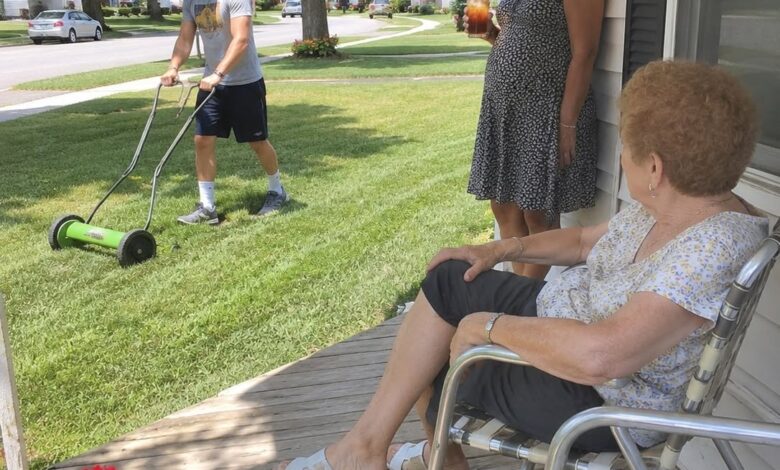
My Uncle Took Money From Grandmas Social Security Just to Cut Her Grass but When I Came Home From Deployment Everything Changed
“I raised two boys in this house,” she said. “Your daddy and I. Two boys.”
“I know, Mama.”
“Danny used to mow Irene Kessler’s yard for two dollars. And then he’d come back and give her half of his candy bar.” She looked down the street at Mrs. Kessler, sitting in her wheelchair at the end of her driveway. “You remember that?”
Ray didn’t answer.
“You used to mow too,” Grandma said. “You remember? You did the Pruitts’ yard. And the Bankses’. Herbert paid you a dollar fifty, and you’d buy baseball cards at the Rexall.”
“Mama…”
“Your daddy taught you both. Right out there. In straight lines.” She pointed at my stripes. “He used to say, a man who cuts a crooked line will tell a crooked story. You remember him saying that?”
Ray’s face had gone red. Not angry red. The other kind.
“I remember,” he said quietly.
“I’ve paid you four hundred dollars every month for eleven months,” Grandma said.
“You offered.”
“I did,” she said. “I did offer. You came to me last August and said Sheila was after you. Said you were behind on the truck. Said you’d see to my yard if I could help you out. And I said yes.”
She paused.
“I said yes because you’re my son,” she said. “And I’ve buried one son. And I’d rather go without than watch you struggle. That’s the truth.”
Behind me, I heard one of the ladies under the oak tree make a small sound.
“But you never once cut my grass, Raymond,” Grandma said.
Ray flinched.
“Tyler Simms cut it,” Grandma said. “Loretta’s grandson. Fifteen years old. On a Saturday morning, with your daddy’s mower, that you never once changed the oil in. I watched him through the window. Every time. You think I didn’t see that?”
She looked past Ray. At the skinny kid in the backward Cardinals hat, standing by the curb with Grandpa’s rake.
“And you stopped paying that boy in May,” she said. “Loretta told me.”
Ray turned around and looked at Tyler. Tyler looked at the ground.
“And then,” Grandma said, and her voice went very quiet, “you went to Edna.”
Ray turned back around.
“You went to Edna Pruitt,” Grandma said. “Who taught you to read. Who stayed after school with you every day in third grade because you couldn’t sound out your words, and never charged your daddy one cent for it.”
Miss Edna, under the oak tree, put her hand over her mouth.
“And you went to Dorothy. And Margaret. And Irene. And you told them the city was going to fine them fifty dollars a day. Women who brought casseroles to this house for a month after your brother died.”
She held onto the railing with both hands now.
“I could stand you taking from me,” she said. “I’m your mother. That’s my business. But you went to them, Raymond.”
Ray didn’t say anything.
He stood at the bottom of those porch steps in his Bass Pro shirt with his head down. His big shoulders were curled in. He looked smaller than I’d ever seen him.
For a long time, nobody said anything.
Then Ray spoke. To the porch steps.
“I lost my job, Mama.”
Grandma went very still.
“In August,” Ray said. “At the plant. They closed the line I was on. Laid off forty of us.” He took a ragged breath. “I didn’t tell Sheila. I didn’t tell anybody. I’d get up every morning and put on my work boots and drive around all day, and come home at five.”
“Raymond.”
“I had the truck payment,” he said. “Eleven hundred a month. And the house. And Sheila’s car. And I couldn’t tell her. I couldn’t.” His voice broke. “Danny would’ve known what to do. Danny always knew what to do. And I’m just… I’m the one who’s left.”
He finally looked up at his mother. His eyes were wet.
“So I came to you,” he said. “Because you always said yes. You always said yes to me.”
Chapter Nine: The County Collector
Nobody on Locust Street said anything after that.
Grandma came down the porch steps. Slowly. One at a time, holding onto the railing. Ray put out his hand to help her and she took it.
When she got to the bottom, she was standing in front of her son, who was a foot and a half taller than her. She reached up and put her hand on his face.
“You should have told me,” she said.
“I was ashamed.”
“I know you were.” She patted his cheek. “But being ashamed is not a reason to steal from widows, Raymond.”
She turned around and looked at the oak tree. At all the ladies in their folding chairs.
“Raymond is going to pay you all back,” she said. “Every cent. Isn’t that right, Raymond?”
Ray looked at the ladies. All of them. Miss Edna. Mrs. Banks. Mrs. Halloway. Mrs. Kessler in her wheelchair.
“Yes, ma’am,” he said quietly.
“Starting next Saturday.”
“Yes, ma’am.”
“And Tyler Simms,” Grandma said. “You owe that boy for May and June.”
Ray looked over at Tyler. Tyler looked back at him.
“Yes, ma’am,” Ray said.
That should have been the end of it. I thought it was.
I thought we’d go inside and eat lunch, and Ray would go home and tell Sheila the truth, and on Monday he’d start looking for a new job. I thought it was all about the grass.
Then on Monday morning, I found the envelope.
It was in the drawer of the little telephone table in the hallway, under the phone book. Grandma had asked me to find her reading glasses, and I opened the drawer, and there it was.
A white envelope from the Pulaski County Collector of Revenue. FINAL NOTICE stamped across the front in red.
I knew I shouldn’t open it. I opened it anyway.
Delinquent Real Estate Taxes, Tax Year 2025. Owner: Opal M. Gaines. Property: 214 Locust Street. Amount due including penalties and interest: $1,312.46.
And at the bottom, in bold:
If taxes remain unpaid, this property will be offered at the annual Collector’s Tax Sale on the fourth Monday in August.
I stood in the hallway holding that notice.
The fourth Monday in August. Five weeks away.
I brought it into the kitchen. Grandma was at the table doing her crossword puzzle. When she saw the envelope in my hand, she put down her pencil.
“Hunter,” she said.
“Grandma. Why didn’t you pay your property taxes?”
She looked at the envelope. She looked confused.
“I did,” she said. “In December. I gave the money to Raymond. Twelve hundred dollars cash. He said he’d take it down to the courthouse for me, so I wouldn’t have to drive on the ice.”
I sat down across from her.
I didn’t say anything. I didn’t have to.
I watched her understand it. I watched it come over her face slowly, the way a shadow comes across a yard when a cloud moves over the sun.
She picked up the notice. She read it with her reading glasses on. She read it twice.
Then she set it down very carefully on the table. She folded her hands on top of it.
“He told me he paid it,” she said. Her voice was small. “He brought me back a receipt.”
“Do you still have the receipt?”
She got up. She went to the drawer by the stove, where she keeps her important papers in a Folgers can. She dug through it. She came back with a folded piece of paper.
It was a receipt. Handwritten. On a page torn out of a spiral notebook. Paid, 12/14, $1,200. Ray.
I drove to the Pulaski County Courthouse in Waynesville that afternoon. Forty minutes each way.
The collector’s office was on the first floor. A lady named Brenda with big earrings and a cardigan looked up Grandma’s property on her computer.
“No payment received for 2025,” she said. “First notice went out in January. Second in April. Final notice in June.” She looked at me over her glasses. “If it’s not paid by the sale, a buyer can bid on the tax certificate. They’d have the right to apply for the deed in a year if it’s not redeemed.”
“Can I pay it now?”
“Are you the owner?”
“I’m her grandson. I’m a Marine. I just got back.”
Brenda looked at me for a long moment.
“Anybody can pay a tax bill, honey,” she said. “The county doesn’t care who writes the check.”
I paid it from my deployment savings. Thirteen hundred and twelve dollars and forty-six cents. Brenda stamped the receipt PAID IN FULL in blue ink and handed it to me.
A real receipt. Printed. With a county seal.
I sat in my rented Corolla in the courthouse parking lot for a long time afterward. I held that receipt in one hand and Ray’s spiral notebook receipt in the other.
Then I drove to my uncle’s house.
Chapter Ten: Supper
Ray and Sheila lived in a brick split-level out on County Road H, on three acres. Sheila worked as a receptionist at the dentist’s office in St. Robert. Their kids were grown and gone. One in Springfield, one in the Army at Fort Leonard Wood.
The white Ram was parked in the driveway. Ray was sitting on the front steps when I pulled in. Like he’d been waiting.
He didn’t get up. He watched me walk across the yard. I could tell from his face he knew.
I held out the county receipt.
“Paid in full,” I said. “Thirteen hundred twelve dollars and forty-six cents. Fourth Monday in August, they would have sold Grandma’s taxes to a stranger.”
He took the receipt. He looked at it for a long time.
“I was going to pay it,” he said. “I swear to God, Hunter. I was going to pay it in January. Then the truck payment came. And then I was going to pay it in February. And then I thought, I’ll get a job by spring, and I’ll pay it, and she’ll never know.”
“You gave her a fake receipt.”
“I know.”
“Out of a spiral notebook.”
“I know.” He put his face in his hands. “I know.”
The front door opened behind him. Sheila came out on the porch in her dentist office scrubs. She looked at me. Then at Ray. Then at the receipt in his hand.
“What’s going on?” she said. “Ray? What’s that?”
Ray didn’t answer.
“Ray. Hunter. What is going on?”
I looked at my uncle. He looked up at me. He looked like a man standing on the edge of a cliff.
“Tell her,” I said. “Or I will.”
He told her.
All of it. Right there on the front steps. The plant. The layoff in August. Driving around every day in his work boots. The truck payment. The lawn money. The widows. Tyler. Grandma’s taxes.
Sheila sat down on the porch swing halfway through. By the end, she had both hands over her mouth.
“Eleven months,” she said. “You’ve been lying to me for eleven months?”
“I’m sorry.”
“Every morning you kissed me goodbye and said have a good day at work.”
“I’m sorry, Sheila.”
“You took money from Opal?” Her voice went up. “From Opal? On her Social Security?”
Ray couldn’t answer.
Sheila stood up. She came down the porch steps and stood in front of me.
“Hunter,” she said. “Come to supper Sunday. You and Opal. At six.” She looked at Ray. “We’re going to sit down as a family and fix this. All of it. And we’re going to do it before anybody loses a house.”
Sunday supper was at Grandma’s, actually. Sheila called and said Grandma should be in her own kitchen, and that she’d bring the food.
She brought pot roast. Ray brought nothing. He stood in the doorway of Grandma’s kitchen like a man walking into church late.
Grandma looked up at him from the stove.
“Sit down, Raymond,” she said. “You look like you’re going to fall over.”
He sat.
We worked it out at that kitchen table. All four of us. With Grandma’s checkbook and her calculator the size of a paperback book.
Ray owed Grandma forty-four hundred dollars for the lawn. Plus twelve hundred for the taxes he never paid. He owed Miss Edna four hundred. Mrs. Banks six hundred. Mrs. Halloway five hundred. Mrs. Kessler four hundred. Tyler Simms two hundred for May and June.
I added it up. Seven thousand, seven hundred dollars.
“I don’t have it,” Ray said. “I don’t have any of it.”
“You have a truck,” Sheila said.
Ray looked at her.
“That truck is worth fifty-two thousand dollars,” Sheila said. “You owe forty-one on it. You sell it on Monday, you clear eleven thousand. That pays back every single person on Locust Street and the taxes, with money left over.”
“Sheila…”
“Or,” she said, “I can call the bank about the truck myself. And then I can call a lawyer about our marriage.”
Ray stared at her.
Then he looked at Grandma.
“Mama,” he said. “Is that what you want?”
Grandma took off her reading glasses. She folded them and set them on top of the checkbook.
“I don’t want anything from you, Raymond,” she said. “Except one thing.”
“What?”
“I want you to cut my grass,” she said. “Yourself. Every Saturday. Not Tyler. Not anybody else. You. With your daddy’s mower. In straight lines.”
Ray didn’t say anything.
“And when you’re done with mine,” Grandma said, “you’re going to cut Edna’s. And Dorothy’s. And Margaret’s. And Irene’s. And Archie’s. Every widow on Locust Street. Every Saturday. For free. Until the end of the season.”
She looked at him.
“That’s what your daddy would’ve had you do,” she said. “That’s what Danny would’ve done.”
Chapter Eleven: Straight Lines
Ray sold the truck on Wednesday.
He sold it to a dealer in Springfield for forty-nine thousand, five hundred. After paying off the loan, he cleared eight thousand, two hundred and some. He bought a 2009 Ford Ranger with a dented tailgate from a guy in Licking for three thousand cash.
On Thursday, he drove that Ranger down Locust Street and stopped at every single house. He knocked on every door. He handed every woman an envelope with cash in it and an apology.
Miss Edna told me about it later. She said he stood on her porch with his hat in his hands and cried.
“I told him I forgave him,” she said. “And then I told him he still needed to work on his spelling. He wrote ‘sincerly’ on the envelope.”
He gave Tyler Simms his two hundred dollars, plus fifty extra.
He gave Grandma back everything. Fifty-six hundred dollars, in a cashier’s check from the Bank of Cedar Ridge. She put it in her savings account and didn’t touch it.
He also gave me back the thirteen hundred and twelve dollars I’d paid for the taxes. I tried not to take it. He wouldn’t let me.
“You’re not paying for my mess,” he said. “You’ve done enough.”
The next Saturday, I was due to leave. My leave was almost over. I had to report back to Camp Lejeune by Monday morning.
I got up at five-thirty. Grandma was already up, frying eggs. Over easy.
At six-thirty, I heard a truck in the driveway. Not a big diesel. A small, rattling four-cylinder. The Ranger.
Ray climbed out. He was wearing old jeans with grass stains on the knees and a T-shirt from a church fish fry in 2014. He walked around to the back of the house and stood in front of the shed.
I went out to meet him with my coffee.
“I don’t remember how to do it right,” he said. He didn’t look at me. “Your grandpa showed me when I was ten. But I was mad about it. I didn’t pay attention.”
“Okay,” I said. “I’ll show you.”
I pulled out the mower. I showed him how to check the oil, and pull the plug wire, and check the blade. I showed him the air filter. I showed him where Grandpa’s tools hung on the pegboard, outlined in black marker.
Then I took him out to the front yard. To the long side, by the fence.
“You go down the long way first,” I said. “Fence to fence. Then you come back and overlap by about the width of your hand. Line up the edge of the wheel with the line you just made.”
He nodded.
“And keep your eyes on the end,” I said. “Not on your feet. Your feet’ll follow your eyes.”
His first line was crooked as a snake.
He shut off the mower and looked at it. He swore under his breath.
“Again,” Grandma called from the porch.
She was sitting in her broken lawn chair at the top of the steps, in her blue housecoat. Her hands were folded in her lap.
Ray looked up at her. He almost smiled.
He started the mower again. His second line was a little better.
“Again,” Grandma said.
It took him an hour and a half to do Grandma’s yard. It took me forty-five minutes the Saturday before. But when he was done, it had stripes. Not perfect ones. A little wobbly near the redbud tree. But stripes.
He was soaked with sweat. He shut off the mower and stood in the middle of the yard, breathing hard, looking at it.
Grandma stood up. She came to the top of the porch steps.
She looked at the yard for a long time.
Then she nodded. Once.
Ray had to turn away and pretend there was something wrong with the mower for a minute.
Then he rolled it next door. To Miss Edna’s.
She was sitting on her porch in her straight-backed chair, snapping green beans. She watched him come up her driveway.
“Raymond Gaines,” she said. “Is that you?”
“Yes, ma’am.”
“You going to watch Herbert’s roses?”
“Yes, ma’am.”
She went back to snapping her beans. Ray started the mower.
I left at noon.
I had a twelve-hour drive to Camp Lejeune. My seabag was in the back of the rented Corolla. I’d washed everything and folded it, and Grandma had packed me a cooler with fried chicken, biscuits, and a mason jar of sweet tea from Loretta.
Grandma walked me out to the car. She held onto my arm going down the porch steps.
At the bottom, she stopped. She looked down Locust Street.
Ray was halfway down the block, at Mrs. Banks’s. Pushing Grandpa’s red Snapper. His shirt was soaked through. Tyler Simms was behind him with Grandpa’s rake, and I could hear Ray telling him something, and Tyler laughing.
Under the big oak tree, the ladies had set up their folding chairs again. Loretta was pouring tea.
“Look at that,” Grandma said quietly.
“Yes, ma’am.”
“Walt would’ve liked to see that.” She squeezed my arm. “And Danny.”
She turned to me. She reached up and put both hands on my face, the way she did when I was eleven.
“You didn’t make a war over grass,” she said.
“No, ma’am.”
“You just cut it.” She patted my cheek. “That’s what your daddy would’ve done. Just cut it. Let everybody else figure out what it meant.”
She hugged me hard. She smelled like bacon grease and Jergens lotion. Ninety pounds, holding on like a steel trap.
“Come home safe,” she said into my shoulder.
“Yes, ma’am.”
Chapter Twelve: The Register
I got a letter from her in October.
I was back at Camp Lejeune, in the barracks, doing a field day with my squad. Scrubbing floors, the way the Marines do every Thursday night whether they need it or not. The mail clerk came through and dropped an envelope on my rack.
Grandma’s handwriting. Slanted blue cursive. Three pages, front and back, like always.
She told me about the church potluck. Mrs. Halloway brought a Jell-O salad nobody would eat. She told me about her blood pressure. The doctor said it was the best it had been in five years.
She told me Ray got a job. A real one. Driving a delivery route for a feed store in Rolla. Thirty-eight thousand a year. Not what he made at the plant, but steady. He and Sheila were seeing a counselor at the church. Sheila had made him cut up every credit card he had, in front of her, at the kitchen table.
She told me Locust Street had won Yard of the Month from the Cedar Ridge Garden Club. The whole street. Not one house. They’d never given it to a whole street before. The garden club ladies came and put a little wooden sign in Miss Edna’s front yard, since hers was in the middle.
She told me Ray had cut every yard on Locust Street every Saturday since I left. Twelve Saturdays in a row. He hadn’t missed one, not even the Saturday it rained, when he waited in the Ranger until it stopped and then did it anyway.
“His lines are getting straighter,” she wrote. “Not as good as yours. But straighter.”
At the end of the letter, there was a photograph. One of those old-fashioned prints from the Walmart photo counter.
It was Locust Street. Taken from Grandma’s porch. All ten yards, in the late afternoon sun. Every one of them striped dark and light, all the way down to the dead end. The ladies were in their folding chairs under the big oak tree. Ray was standing at the curb in a sweaty T-shirt, leaning on Grandpa’s red Snapper, squinting into the camera.
He wasn’t smiling. Not exactly. But he wasn’t not smiling either.
On the back, in Grandma’s slanted blue cursive, she’d written: Taken by Tyler. Saturday, Sept. 27.
There was one more thing in the envelope.
A single page. Torn carefully out of a checkbook register, along the perforation. I recognized it right away. The same lined paper. The same columns. The same blue ink.
The September page.
I unfolded it on my rack.
Ameren Missouri, 81. Cedar Ridge Water, 29. Walmart pharmacy, 12. Church offering, 20. Church offering, 20. Church offering, 20. Church offering, 20.
And then, near the bottom of the page, in the column where the deposits go, in her slanted cursive:
Ray. 400.
Next to it, in pencil, in small letters, she’d written: returned. lawn’s free now.
And under that, in different ink, darker, like she’d gone back and added it later:
Straight lines.
I sat on my rack for a long time holding that page.
All around me, my squad was scrubbing the floor and arguing about whose turn it was to do the head. Somebody had a radio going. Somebody was complaining about the chow hall.
I thought about the night I came home in July. Sitting at Grandma’s kitchen table at midnight with a glass of milk, looking at Ray. 400, Ray. 400, Ray. 400, eleven times in a row, with my stomach in a knot.
I thought about what I could have done. I could have yelled. I could have driven to Ray’s house that same night and dragged him out of bed. I could have called a lawyer, or the sheriff, or the newspaper. I could have made a war of it.
Grandma would’ve let me, too. She would’ve sat in her chair and watched me do it. And then she’d have lost her other son, and I’d have lost my uncle, and Locust Street would still be knee-high in foxtail grass.
Instead I went out to the shed and sharpened a blade.
That’s all. I sharpened a blade, and changed the oil, and cut one yard in straight lines. And then the next one. And then the next one, until there weren’t any more.
And it turned out a straight line is a pretty loud thing to say, if you say it ten times in a row in front of everybody.
I folded the register page back up along its creases. I put it in the photograph’s envelope with the picture of Locust Street.
Then I tucked the whole thing inside my cover, the way Marines carry things they don’t want to lose. Up inside the crown of the hat, against the top of my head.
It’s still there. I carry it every day.
A picture of ten yards in a Missouri summer, striped dark and light, all the way down a dead-end street.
And one line in my grandmother’s checkbook, in slanted blue ink, in the column where the money comes back.