Boy with Down Syndrome Started Mainstream School – On Day Five, the Principal Called His Parents and Said, ‘Come Immediately’
After years of homeschooling, my son with Down syndrome finally started regular school. He came home smiling every day, and we thought he’d found his place. Then, on Friday, the principal called and demanded we come immediately. Why were two police officers waiting for us?
“Mrs. Parker? This is Principal Harris. I need you and your husband to come to school immediately.”
I glanced at the clock. It was 11:17 a.m.
“What’s happened? Is Ethan all right?”
“He’s sitting here in my office.”
“Is he hurt?”
“He’s safe, but there are two police officers here.”
“What? What did Ethan do?”
“I’ve worked in education for 23 years, and I’ve never encountered anything quite like this.”
“Please, tell me what happened.”
“When you arrive, come straight to my office. And don’t speak to any other parents until we’ve talked.”
He hung up.
I stood in the kitchen, staring at my phone.
Five days. Our son had been at school for only five days.
I called my husband, Michael. Ten minutes later, we were hurrying through the school entrance.
The secretary pointed toward the principal’s office.
“He’s expecting you.”
Michael pushed open the door.
Ethan sat beside the window, clutching his blue backpack. His eyes were red.
“Mom!”
He ran into my arms.
“Are you okay, sweetheart?”
He nodded, then whispered, “Please don’t make me leave school.”
I pulled back.
“What?”
“Please, Mom. I want to stay.”
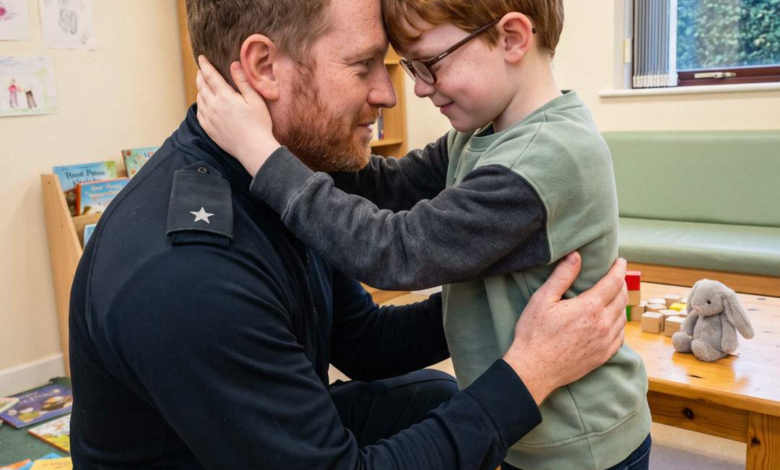
Principal Harris approached us. Two uniformed officers stood near his desk.
One introduced herself as Officer Miller.
“Your son isn’t in trouble,” she said.
“Then why are the police here?”
“There’s been an incident involving several students,” the principal explained.
Michael remained standing.
“What kind of incident?”
“Some children were making fun of Ethan. Another student intervened, and there was a confrontation.”
I looked at Ethan. He stared at his shoes.
Officer Miller explained that she and her colleague were school resource officers.
They’d responded when staff reported a confrontation that might become physical.
“No one was seriously injured,” she assured us.
“Why didn’t you explain that over the phone?” Michael demanded.
Principal Harris lowered his eyes.
“I should have been clearer. I’m sorry.”
I sat beside Ethan.
“Sweetheart, what happened?”
He twisted his backpack strap.
“Oliver got mad.”
“At you?”
“No. At them.”
“Who?”
“The boys at lunch.”
For years, Ethan had studied at home.
He had Down syndrome, and although he was curious and eager to learn, we’d worried about whether a mainstream classroom could meet his needs.
A few weeks earlier, his doctor suggested giving him opportunities to socialize with children his own age.
Ethan was thrilled.
He’d wanted friends for as long as I could remember.
On Monday, he’d come home grinning.
“Mom! I love it!”
On Tuesday, he’d told us about Oliver, a boy who sat beside him.
On Wednesday, he’d said some classmates invited him to lunch.
By Thursday, he was laying out his clothes for the next morning.
We’d begun believing our fears were unnecessary.
Now I wondered what we’d missed.
Principal Harris placed a tablet on his desk.
“There’s something you need to see.”
He played a short video.
Ethan sat at a cafeteria table with three boys nearby. One held up a phone.
“Ethan, say that again.”
Ethan smiled uncertainly.
“Say what?”
“The thing about being famous.”
“I’m going to be a famous scientist.”
The boys laughed.
“Tell everyone your big plan!”
Ethan repeated himself.
The boy moved the phone closer.
“Come on, say it louder.”
Ethan’s smile faded.
“I already said it.”
Another boy imitated his voice.
Michael turned away.
Then Oliver appeared.
“Stop recording him.”
“Relax. We’re joking.”
“He’s not laughing.”
Someone shoved Oliver’s shoulder. Oliver pushed the hand away.
A chair scraped across the floor.
The recording ended.
I stared at the screen.
Ethan loved science. He spent hours asking about stars, insects, and machines.
Those boys had turned his dream into entertainment.
“How long has this been happening?” Michael asked.
“We’re still determining that,” Principal Harris replied.
I turned to Ethan.
“Did they do this before today?”
He looked away.
“Sometimes.”
“Since when?”
He counted on his fingers.
“Wednesday.”
Wednesday.
The day he’d proudly told us children had invited him to lunch.
I remembered hugging him and telling Michael how quickly he was making friends.
Now that invitation meant something different.
I asked whether we could speak with Ethan privately.
The principal agreed, and the officers stepped outside with him.
Michael knelt before our son.
“Buddy, why didn’t you tell us?”
Ethan pressed his lips together.
“Because I like school.”
“We know.”
“You said if school was too hard, I could come home.”
I remembered saying that before his first day.
I’d meant to reassure him that he had choices.
But Ethan believed admitting something was wrong might cost him the school he loved.
“We weren’t going to take you out because someone was unkind,” I said.
He studied my face.
“Promise?”
“I promise we’ll listen and figure out what keeps you safe.”
He nodded.
Michael asked about Oliver.
“He’s my friend,” Ethan said.
“Did he know those boys were teasing you?”
“Yes. He said they weren’t nice.”
“What did you say?”
“I told him I knew.”
I stared at my son.
“You knew?”
“They laugh when I talk sometimes.”
My eyes filled.
“Why did you keep sitting with them?”
“Because they let me.”
Those words hurt more than the video.
Ethan had spent years wanting to belong.
He’d accepted being laughed at because it meant having a place at the table.
Michael sat beside him.
“You deserve friends who are kind.”
“Oliver is.”
“Yes,” Michael said. “He is.”
After a moment, Ethan added, “Oliver was alone too.”
I asked what he meant.
Oliver had transferred to the school two weeks earlier.
On Monday, Ethan noticed him sitting alone and asked whether the empty chair beside him was taken.
They began talking about dinosaurs.
On Tuesday, Ethan invited Oliver to eat lunch with him.
On Wednesday, when the other boys called Ethan over, he asked Oliver to come too.
“But Oliver didn’t like them,” Ethan explained.
“Did he tell you that?”
“He said we should sit somewhere else.”
“Why didn’t you?”
Ethan frowned.
“I thought they might be nice tomorrow.”
I held his hand.
He hadn’t been fooled by every smile. He knew something was wrong but hoped it would change.
Principal Harris returned.
“There’s something else you should know.”
He sat across from us.
“The incident began before today’s video.”
“What happened?”
“Oliver reported the teasing to a lunch supervisor yesterday.”
My stomach sank.
“He told an adult?”
“Yes.”
“And what did she do?”
“She spoke to the students. They said everyone was joking, and she reminded them to be respectful.”
Michael stared at him.
“That was it?”
“She didn’t report the concern to the classroom teacher or administration.”
“Then it happened again,” I said.
“Yes.”
The principal folded his hands.
“We should have followed up yesterday. We’re addressing that failure.”
I wanted to shout.
Instead, I asked what would change.
He explained that the school would document the bullying, meet with the children and their parents, and increase supervision during lunch.
He also proposed regular check-ins with Ethan’s teacher.
“I don’t want Ethan separated from everyone as though he’s the problem,” I said.
“Neither do I.”
Michael added, “And Oliver shouldn’t be punished for defending him.”
Principal Harris sighed.
“That’s another reason I called.”
I stiffened.
“What happened to Oliver?”
“He was initially sent to the office because staff believed he’d started the confrontation.”
“But someone pushed him first.”
“Yes. The video and other students confirmed that.”
The principal paused.
“Oliver refused to apologize for telling the boys to stop.”
“Good,” I said.
“I agree. He shouldn’t apologize for that.”
He explained that Oliver had also insisted Ethan be allowed to explain what happened without anyone interrupting him.
“Your son was frightened,” he said. “Oliver stayed beside him until we brought them here.”
I glanced at Ethan.
“Is that why you were in the office?”
He nodded and said, “Oliver said we should tell the truth.”
Then he added, “I told him he could go, but he said friends don’t leave.”
Michael wiped his eyes.
Principal Harris leaned forward.
“In 23 years, I’ve seen children defend friends before. What struck me today was how determined these two were to protect each other.”
He looked at Ethan.
“Oliver didn’t want Ethan blamed. Ethan kept asking us not to punish Oliver.”
I understood why Ethan had been so frightened when we arrived.
He wasn’t only afraid of losing school.
He was afraid his friend would get into trouble because of him.
Officer Miller returned briefly and confirmed that neither boy had done anything requiring police action.
The school would handle the student behavior…………….READ MORE NEXT PAGE