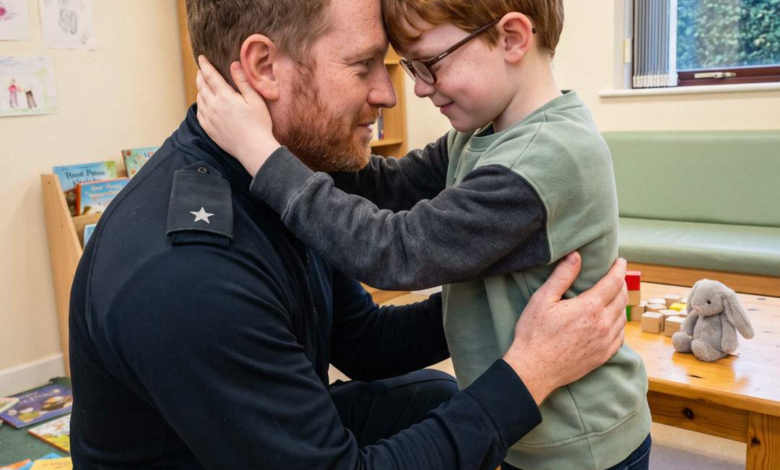
Boy with Down Syndrome Started Mainstream School – On Day Five, the Principal Called His Parents and Said, ‘Come Immediately’
Before leaving, she crouched beside Ethan.
“You did the right thing by telling the adults what happened.”
“Oliver did too,” Ethan replied.
She smiled.
“Yes, he did.”
After the officers left, I asked whether Ethan could return to class.
Principal Harris seemed surprised.
“Would you prefer to take him home?”
I looked at Ethan.
“What would you like?”
“I want to go back.”
Michael glanced at me.
We both wanted to take Ethan home and make sure nobody ever laughed at him again.
But we’d spent years preparing him for opportunities like this.
We couldn’t ask him to be brave and then ignore what he wanted.
I turned to the principal.
“Before he goes back, I want to know who will support him.”
We discussed a plan.
Ethan’s teacher would check in with him daily. A designated staff member would be available at lunch.
The students involved would be addressed separately, and the school would follow up with us.
Ethan would be encouraged to report problems without feeling responsible for solving everything himself.
I also asked that Oliver receive support without being expected to protect Ethan.
“He’s a child too,” I said.
Principal Harris agreed.
Before we left, he asked Ethan whether there was anything he wanted the adults to understand.
Ethan thought carefully.
“I don’t like when they laugh at my words.”
The principal nodded.
“That’s important.”
“And I want to sit with Oliver.”
“We can arrange that.”
Ethan smiled.
Then he looked at me.
“Can I still be a scientist?”
“Of course.”
“Even if I talk differently?”
Michael knelt beside him.
“Talking differently doesn’t make your ideas less important.”
Ethan considered that.
“Okay.”
He picked up his backpack.
“Then I’m going to science class.”
We watched him walk down the hallway with his teacher.
I’d never felt so proud and frightened at the same time.
That evening, Ethan told us about an experiment with magnets.
He demonstrated it using refrigerator magnets and a paper clip.
For the first time all day, he sounded like the excited boy who’d come home Monday.
But after dinner, he became quiet.
“Mom?”
“Yes, sweetheart?”
“Can I tell you something bad without leaving school?”
I put down the dish towel.
“Always.”
He looked relieved.
“One boy called me a baby yesterday.”
I sat beside him.
“How did that make you feel?”
“Mad.”
“That makes sense.”
“I wanted to tell him I’m six.”
I smiled gently.
“You could have.”
He thought about it.
“Next time, I’ll tell my teacher.”
“That’s a good plan.”
Over the following weeks, we stayed in close contact with the school.
Principal Harris followed through on his promises.
The lunch supervisor received additional guidance. The students involved faced school consequences, and their parents were informed.
The class also discussed respectful behavior without singling Ethan out.
Not everything changed overnight.
One afternoon, Ethan was upset because a classmate wouldn’t let him join a game.
Another day, he struggled to finish an assignment as quickly as the others.
We talked through those moments rather than treating every difficult day as proof that school wasn’t right for him.
His teacher provided appropriate classroom support while encouraging him to participate alongside his classmates.
Oliver remained his closest friend.
One Friday, his mother invited Ethan over to play.
When I arrived, she looked nervous.
“I’ve wanted to thank you,” she said.
“For what?”
“For Ethan.”
She explained that Oliver had struggled since transferring schools.
He’d left behind his old friends and spent his first days eating alone.
“He told me he didn’t think anyone would want to sit with the new kid,” she said.
“Then Ethan asked him about dinosaurs.”
She smiled.
“Oliver talked about that all evening.”
I’d thought of Oliver as the boy who defended Ethan.
I hadn’t understood how much Ethan had helped him too.
Their friendship wasn’t built on one child rescuing another.
It began because two lonely boys chose to sit together.
A month later, the school held a science afternoon for families.
Ethan insisted we attend.
He and Oliver had made a poster about the solar system.
Oliver drew the planets, and Ethan helped label them.
When we reached their table, Ethan stood proudly beside his project.
“Welcome to our space station!” he announced.
A few children nearby laughed.
My heart tightened.
But Ethan kept smiling.
“That’s what we’re calling it,” he explained.
Oliver pointed to the poster.
“Ethan came up with the name.”
Then the boys began presenting their work.
Ethan stumbled over a word while describing Saturn.
He stopped, took a breath, and tried again.
Nobody interrupted.
When he finished, Michael clapped.
Ethan grinned.
On our way home, he asked whether Oliver could visit the following weekend.
“Of course,” I said.
Then he asked, “Mom, do you think I’ll have more friends someday?”
I looked at him in the rearview mirror.
“I think you will.”
He nodded.
“But Oliver’s my best friend.”
Michael smiled.
“That’s pretty special.”
“It is,” Ethan said.
That night, after he fell asleep, Michael and I sat in the kitchen.
I remembered the terror of that Friday phone call.
But the hardest discovery wasn’t that some children could be cruel.
It was that Ethan had hidden his hurt because he feared losing something he loved.
We’d thought protecting him meant preventing difficult experiences.
Now we understood that he needed to know we would listen, believe him, and help him face those experiences without taking away his choices.
The following Monday, Ethan woke before his alarm.
He dressed, packed his backpack, and hurried downstairs.
“Come on, Mom! We’re going to be late!”
I handed him his lunch.
“Excited for school?”
He nodded.
“Oliver and I are starting a new project.”
“What’s it about?”
“Dinosaurs!”
I laughed.
At the door, he turned around.
“Mom?”
“Yes?”
“If somebody’s mean today, I’ll tell you.”
I crouched beside him.
“Good. And we’ll figure it out together.”
He hugged me, then ran toward the car.
Five weeks earlier, Ethan had walked into school hoping someone would want to be his friend.
He’d found one.
And along the way, he’d helped us understand something important.
Our job wasn’t to make his world small enough that nothing could hurt him.
It was to make sure he never had to face that world alone.
So here’s the real question: If your child was being bullied at school but desperately wanted to stay because he’d finally made a real friend, would you respect his wishes and work with the school, or take him out to protect him?