My Grandfather Went to the Bank to Withdraw Money for His Tractor but the Teller Humiliated Him and Called Security
Sixty-One Years
The new bank teller called security on my grandfather at 10:14 on a Tuesday morning in October.
I know the exact time because there was a clock over the vault. Big. Round. Brass. The same clock that had been hanging there since before I was born. The only thing in that bank that hadn’t changed.
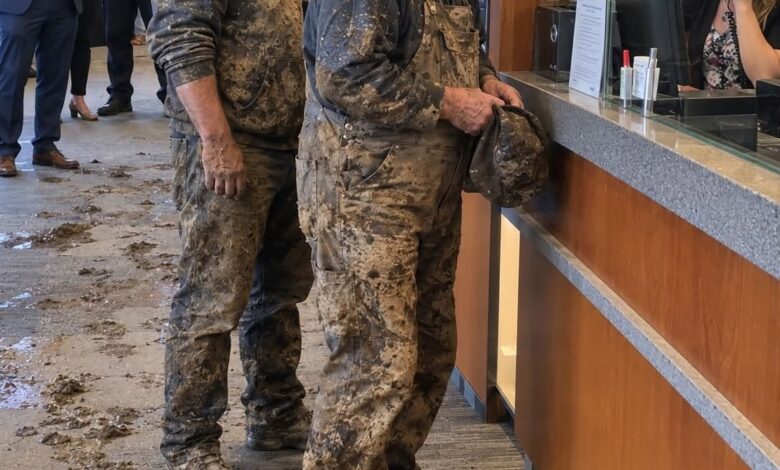
My grandfather was standing at window three in his muddy overalls with his feed-store cap in his hands.
He’d asked to withdraw two thousand dollars.
His own money.
For a tractor part.
But let me back up.
My name is Luke Doyle. I’m twenty years old. I’m a junior at Iowa State University in Ames, studying agricultural engineering.
I grew up on a farm outside Corwith, Iowa. Population three hundred and nine. Two grain elevators, a Casey’s, a Methodist church, a Lutheran church, a bar called the Rusty Spur, and one bank.
Prairie State Bank.
My grandfather is Earl Doyle.
He’s eighty-four years old. He’s farmed the same six hundred and forty acres of corn and soybeans north of Corwith since 1959. His father farmed it before him. And his father before that. The Doyles came from County Mayo in 1882 and bought the first quarter section for four hundred dollars and a team of mules.
My grandfather has never lived anywhere else.
He’s never wanted to.
He’s not a big man. Five-foot-eight. A hundred and fifty pounds. But he’s hard. Hard like old oak. His hands are enormous. Scarred. Knuckles like walnuts. He lost the tip of his left ring finger to a corn picker in 1967 and went back to work the same afternoon.
He has blue eyes that look right through you. A face lined like a plowed field. A voice so quiet you have to lean in.
He’s never raised it in my life.
My grandmother was June Doyle.
She died four years ago. Pancreatic cancer. They were married sixty-one years.
He doesn’t talk about her much.
But every morning, he sets two coffee cups on the kitchen table.
And every morning, he puts one back in the cupboard. Unused.
I was home that October to help with the harvest.
I do it every year. Since I was twelve. I drive the grain cart. Grandpa runs the combine. My dad, Mike, drives the semi to the elevator in Corwith. My mom brings lunch to the field at noon in a cooler. Sandwiches and potato salad and a thermos of coffee.
We’d been going for nine days. Sixteen hours a day. Corn was coming in at two hundred and four bushels an acre. Grandpa said it was the best year since 2004.
On Monday night, around eleven, the combine broke a belt.
The feeder house drive belt. On his John Deere 9670. A 2008. He bought it used in 2012 and has kept it running ever since with baling wire and stubbornness.
The belt snapped in the north field. In the dark. Halfway through a pass.
Grandpa climbed down from the cab with a flashlight. He looked at it. He said one word I’d never heard him say before.
Then he climbed back up and shut it down.
The next morning, he called the parts dealer.
Kenny Lindqvist. At Lindqvist Implement in Algona. Twenty miles east.
Kenny didn’t have the belt in stock. It’s a special part. For an older model. He’d have to order it from a warehouse in Moline. Overnight.
Two thousand dollars.
And Kenny only takes cash for special orders.
“I got burned three times last year, Earl,” Kenny said on the phone. “Checks bounced. Cards declined. Guys went bankrupt. I’m sorry. It’s cash or nothing on the special stuff.”
“Cash is fine,” Grandpa said.
So around ten o’clock that Tuesday, we took his truck into town.
Grandpa’s truck is a 1994 Ford F-250.
Red. Or it was red. It’s more of a rust color now. Three hundred and eleven thousand miles. A cracked windshield. A feed-store calendar from 2019 still on the dash because my grandmother hung it there and he won’t take it down.
He drove. He always drives. He’s driven that truck to town and back every day for thirty years.
I looked at him on the way.
He was wearing what he always wears.
Bib overalls. Denim. Faded almost white at the knees. A flannel shirt underneath. Red and black. A feed-store cap from the Corwith Co-op. Mesh back. A little grease stain on the bill.
And his boots.
Brown leather work boots. Red Wings. Resoled four times.
Covered in mud from the north field. Up to the ankles. Black Iowa mud. Thick. Still wet.
“Grandpa,” I said. “You want to stop at the house first? Change your boots?”
He looked at me.
“Why?”
“I don’t know,” I said. “The bank’s kind of fancy now. They remodeled.”
Grandpa looked back at the road.
“I’ve been going to that bank since 1963,” he said. “In these boots. Or ones like ’em.”
He didn’t change.
He never changes his clothes for anyone.
The bank looked completely different from when I was little.
When I was a kid, Prairie State Bank was a little brick building on Main Street. One story. Wood paneling. A linoleum floor. A water cooler. A bowl of Dum-Dums on the counter. Two tellers. Mrs. Halvorsen and Mrs. Pederson. They knew everybody. They gave me a sucker every time.
They tore it all out two years ago.
Now it had glass doors. Automatic. With a little whoosh when they open.
Gray carpet. New. Wall to wall.
Pendant lights hanging from the ceiling. Modern. Black metal.
A big TV on the wall showing interest rates and a commercial for home equity loans.
And a fancy coffee machine. In the corner. The kind with little pods. And a sign that said Complimentary for Our Valued Customers.
The only thing that looked the same was the clock.
Over the vault door. Big. Round. Brass. With Roman numerals.
And the corner office in the back.
Glass walls now. But the same corner. Where the president always sat.
There was a line. Four people.
A woman in her forties. Expensive coat. Blonde highlights. A Coach purse.
A young guy in a John Deere jacket.
An older couple holding hands.
There was a new teller at window three.
I didn’t recognize her.
Mrs. Halvorsen retired in 2021. Mrs. Pederson moved to Mason City to be near her grandkids.
This teller was maybe twenty-five. Long dark hair. Perfect makeup. A white blouse. A name tag that said ASHLYN.
Perfect fingernails. Long. Painted a shiny pink. Little sparkles on the tips.
We waited in line.
Grandpa held his cap in his hands.
He always takes his cap off indoors. In church. In the doctor’s office. At the Casey’s. At funerals.
He says a man takes his hat off when he walks into somebody else’s place.
The woman in the Coach purse looked at him.
At his overalls. At his boots.
She wrinkled her nose. She stepped a little farther away.
When it was our turn, Grandpa walked up to window three.
His boots left little prints on the new gray carpet.
Mud. Black. Shaped like Red Wing soles.
“Morning, miss,” Grandpa said. “I’d like to withdraw two thousand dollars, please.”
She stared at his boots.
Then she looked at the mud prints on the carpet. From the door to the window. A trail.
Then she looked back up at him.
Her face did something. A little twitch. Around the mouth.
“Do you have an account with us, sir?” she asked.
“Sixty-one years,” Grandpa said.
She typed on her computer.
Frowned.
Typed some more.
Frowned harder.
I could see the screen from where I was standing. A little. At an angle.
She’d pulled up something. A customer profile. She was scrolling.
Her eyes got wide for a second.
Then narrow.
“I’ll need two forms of ID,” she said.
Grandpa reached into the bib pocket of his overalls.
He took out a wallet. Leather. Brown. Cracked. Held together with a rubber band. My grandmother bought it for him at Younkers in Des Moines in 1981.
He slid off the rubber band.
He took out his driver’s license. And his Medicare card.
He put them on the counter.
She picked up the license.
She held it up to the ceiling light.
Tilted it. Back and forth. Like she was checking a fake twenty-dollar bill.
She looked at the photo. She looked at him. She looked at the photo again.
“That’s a lot of cash,” she said. “What’s it for?”
“Tractor part,” Grandpa said.
Behind us, the woman with the Coach purse snickered.
Out loud. A little snort. Through her nose.
The teller heard it.
She smiled.
A really fake smile. The kind people give when they’re about to tell you no.
“Sir,” she said. “People in your—”
She paused.
“—situation,” she said, “usually find the ATM easier. Less paperwork.”
People in your situation.
My grandfather looked at her.
He didn’t change expression.
“The ATM won’t give me two thousand,” he said.
“Then maybe,” she said, “you don’t need two thousand.”
My face got hot.
I’m not proud of what I felt next. But I’ll tell you.
For one second, I was embarrassed.
Not for her. For him.
For the overalls. The boots. The mud on the carpet. The cap in his hands. The rubber band on the wallet.
For one second, I saw him the way she saw him.
An old man. A dirty old farmer. Who didn’t belong in a place with a fancy coffee machine.
Then I was ashamed of being embarrassed.
And then I was angry.
“He’s asking for his own money,” I said.
She looked at me. Then back at Grandpa.
She picked up the phone on her desk.
She pressed a button.
“Rick?” she said. “Can you come to window three? I’ve got a gentleman getting agitated.”
Agitated.
Grandpa wasn’t agitated at all.
He just stood there. Holding his cap in both hands. In front of his chest. The way he holds it during the Pledge of Allegiance at the Corwith Fourth of July parade.
Like he was at church.
The security guard walked up.
Thirties. Big. Heavy. A gray uniform shirt with a patch that said SECURITY. A name tag. RICK.
He walked across the lobby from the door. Slowly. With his thumbs hooked in his belt.
He stopped next to Grandpa.
His right hand moved.
It rested right on his belt.
Right next to a holster. With a pepper spray canister in it.
“Sir,” Rick said. “I’m going to need you to step aside.”
Grandpa stepped aside.
He didn’t argue. He didn’t put up a fight.
He took two steps to the left. Away from the window. Toward the coffee machine.
The woman with the Coach purse was smiling now. Openly. Watching.
The young guy in the John Deere jacket was looking at the floor.
The older couple holding hands looked uncomfortable.
Grandpa didn’t look at any of them.
He didn’t look at Rick. Or the teller. Or the coffee machine.
He looked right past all of it.
Straight across the lobby.
At the glass office in the back corner.
“Miss,” he said.
The teller looked at him.
“Is Tom Callahan still in the corner office?”
The teller smirked.
She actually smirked. A little half-smile. She looked at the woman with the Coach purse. Like they were sharing a joke.
“Mr. Callahan,” she said, “is the bank president. He doesn’t come out for withdrawals.”
“Would you tell him Earl Doyle is out front?”
“Sir…”
“Just my name,” Grandpa said. “That’s all I’m asking.”
She let out a sigh.
A big one. Loud. So everybody in line could hear.
She rolled her eyes.
She picked up the phone. She pressed a button. She leaned back in her chair.
She held the phone up a little. So her voice would carry.
Like it was a big joke for everyone in line.
“Mr. Callahan,” she said. “Sorry to bother you. There’s an Earl Doyle out here.”
She smiled at the woman with the Coach purse.
“Says you know him?”
Ten seconds later, the door to that corner office flew open.
It slammed against the glass wall.
So hard the whole wall shook.
Everybody in the bank jumped.
Tom Callahan came out.
Sixty years old. Tall. Silver hair. A three-piece suit. Charcoal gray. A gold watch chain across the vest. Wire-rimmed glasses.
He didn’t walk.
He basically sprinted.
Across the gray carpet. Past the TV with the interest rates. Past the coffee machine.
He stopped right in front of Grandpa.
He looked at him.
At his overalls. His boots. His cap in his hands.
His face changed.
Then he looked at the security guard.
At Rick’s hand. Still resting on his belt. Next to the pepper spray.
He looked at it for a long time.
Then he slowly turned around.
To face the teller.
And the very first thing he said made the woman who’d laughed in line walk out of the building.
“Ashlyn,” Tom Callahan said.
His voice was very quiet.
“That man’s name is on the deed to this building.”
The woman with the Coach purse turned around.
She walked out.
Fast. Through the glass doors. Whoosh.
She didn’t finish her transaction.
Nobody else moved.
Ashlyn stared at Tom Callahan.
Her mouth was open.
“I—sir—I don’t—”
“Rick,” Tom Callahan said.
He didn’t look at the security guard. He kept looking at Ashlyn.
“Take your hand off your belt.”
Rick took his hand off his belt.
“Now step back,” Tom Callahan said.
Rick stepped back.
Then Tom Callahan turned to my grandfather.
And he did something I’ll never forget.
He put his hand on Grandpa’s shoulder.
On the strap of his overalls.
Right on the mud.
He didn’t seem to notice the mud.
“Earl,” he said. His voice cracked. “I’m so sorry. I’m so sorry. I didn’t know you were here. Nobody told me.”
Grandpa looked at him.
“It’s all right, Tommy,” he said.
Tommy.
Nobody calls Tom Callahan Tommy. He’s the president of Prairie State Bank. He’s on the board of the Iowa Bankers Association. He has his picture on a billboard on Highway 69.
My grandfather called him Tommy.
And Tom Callahan’s face crumpled.
Just for a second.
“It’s not all right,” Tom said. “It’s not. Come on. Come back to my office. Both of you.”
He looked at me.
“You’re Luke,” he said. “Mike’s boy.”
“Yes, sir.”
“You were this big,” he said. He held his hand at his waist. “Last time I saw you. At June’s funeral.”
“Yes, sir.”
He looked back at Ashlyn.
“Ashlyn,” he said. “Process Mr. Doyle’s withdrawal. Two thousand dollars. In hundreds. And bring it to my office.”
Ashlyn swallowed.
“Yes, sir.”
“And Ashlyn,” Tom said.
She looked up.
“After that,” he said, “I’d like you to come in too. And sit down. There’s something you need to hear.”
The corner office was the same.
Glass walls now. But the same desk. Big. Dark oak. A banker’s lamp with a green glass shade. The same desk that sat in the old building.
There were pictures on the walls.
Old ones. Black and white. In frames.
The original Prairie State Bank. 1919. A wooden storefront with a false front and a horse tied outside.
The brick building. 1948. With a sign. PRAIRIE STATE BANK — DEPOSITS INSURED.
And one more.
Small. Black and white. In a cheap frame. Faded.
A man and a woman. In their forties. Standing in front of the old brick bank. In winter. Snow on the ground.
The man was wearing bib overalls. And a feed-store cap. And muddy boots.
The woman was wearing a wool coat and a scarf.
They were holding a piece of paper between them.
Smiling.
I’d never seen it before.
I walked up to it.
I looked closer.
It was my grandfather.
Forty years younger. But it was him. Same overalls. Same cap. Same way of standing with his weight on his left foot because of a bad knee from high school football.
And my grandmother.
June Doyle. In her forties. With her hair in a bun. Laughing.
At the bottom of the frame, a little brass plate.
EARL & JUNE DOYLE
February 14, 1986
“The day they saved Prairie State Bank.”
I turned around.
Grandpa was sitting in the leather chair across from Tom’s desk.
With his cap in his lap.
Looking at the floor.
“Grandpa,” I said. “What is this?”
He didn’t answer.
Tom Callahan sat down behind his desk.
He took off his glasses.
He rubbed his eyes.
“He’s never told you,” Tom said. “Has he.”
It wasn’t a question.
“Told me what?”
Tom looked at Grandpa.
Grandpa looked at the floor.
“Earl,” Tom said. “Can I tell him?”
Grandpa didn’t say anything for a long time.
Then he shrugged.
“It was a long time ago, Tommy,” he said.
“Not to me,” Tom said.
There was a knock on the door.
Ashlyn.
She came in carrying a white bank envelope. Thick.
She put it on the desk in front of Grandpa.
“Two thousand dollars, Mr. Doyle,” she said quietly. “In hundreds.”
Grandpa didn’t touch it.
“Thank you, miss,” he said.
“Sit down, Ashlyn,” Tom said.
She sat. In the other chair. Next to me. Very straight. Her hands in her lap. Her perfect pink nails.
She looked like she was going to throw up.
“In 1985,” Tom said, “Iowa was in the middle of the worst farm crisis since the Great Depression.”
He looked at Ashlyn.
“You’re from Chicago, aren’t you?” he said.
“Naperville,” she said.
“You know anything about the farm crisis?”
She shook her head.
“Interest rates hit eighteen percent,” Tom said. “Land values dropped by half. In two years. A farm worth a million dollars in 1980 was worth five hundred thousand by 1985. But the loan against it was still a million.”
He shook his head.
“Farmers couldn’t pay,” he said. “Banks foreclosed. Families lost land they’d had for a hundred years. There were auctions every weekend. Men hanged themselves in their barns.”
“Banks failed too,” Tom said. “Hundreds of them. All across the Midwest. Because the farmers couldn’t pay, the banks couldn’t pay. In Iowa alone, more than a hundred banks closed between 1984 and 1987.”
He looked at the photo on the wall.
“Prairie State almost did,” he said.
“My father was the president,” Tom said. “Walter Callahan. He ran this bank from 1962 to 1991.”
He looked at Grandpa.
“In January of 1986,” he said, “the regulators came. The FDIC. Two men in suits from Kansas City. They went through our books for a week.”
He swallowed.
“They said we were insolvent,” Tom said. “Too many bad farm loans. Not enough capital. They gave my father thirty days. Raise a hundred and fifty thousand dollars in new capital. Or they’d shut us down.”
“A hundred and fifty thousand dollars,” Tom said. “In 1986. In a town of three hundred people. In the middle of a farm crisis.”
He laughed. A short, bitter laugh.
“Nobody had a hundred and fifty dollars,” he said.
“And then word got out,” Tom said. “That the bank was in trouble.”
He looked at Ashlyn.
“Do you know what a bank run is?” he asked.
“When everybody tries to take their money out at once,” she said quietly.
“When everybody tries to take their money out at once,” Tom said. “Because they’re afraid it’s going to be gone tomorrow.”
“It started on a Monday,” Tom said. “February tenth. People lined up outside the door at seven in the morning. The line went down Main Street. Past the Casey’s. Past the Lutheran church.”
He looked at Grandpa.
“Farmers,” he said. “Widows. Teachers. The guy who ran the grain elevator. Everybody wanted their money.”
“And the bank didn’t have it,” I said.
“The bank didn’t have it,” Tom said. “Not all of it. Not at once. If the run kept going for three days, we’d have to close the doors. And if we closed the doors, the regulators would never let us open them again.”
“I was nineteen,” Tom said. “A sophomore at Iowa State. I came home that weekend. I stood in the lobby. In the old building. With the wood paneling. And I watched my father stand at the front window. Looking at that line.”
He shook his head.
“He was fifty-one years old,” Tom said. “I’d never seen him scared. That day, he was terrified.”
“On Wednesday morning,” Tom said, “February twelfth, the line was longer than ever. Two hundred people. In the snow. Ten degrees.”
He looked at the photo.
“And then a truck pulled up,” he said.
“A red Ford,” Tom said. “A ‘79 F-100. Covered in mud.”
He looked at Grandpa.
“Earl got out,” he said. “In overalls. And a feed-store cap. And muddy boots. And June got out of the passenger side.”
“They didn’t get in line,” Tom said.
“They walked right past it,” Tom said. “Past two hundred people. To the front door. Earl knocked. My father opened it.”
He looked at me.
“Your grandfather walked into this bank,” Tom said, “took off his cap, and said, Walt, how much do you need?”
I looked at my grandfather.
He was still looking at the floor.
“My father told him,” Tom said. “A hundred and fifty thousand. In twenty-eight days.”
He shook his head.
“And Earl reached into the bib pocket of his overalls,” Tom said, “and took out a piece of paper.”
He looked at the photo on the wall.
At the piece of paper my grandparents were holding between them. Smiling.
“A cashier’s check,” Tom said. “From the Federal Land Bank in Omaha.”
He looked at me.
“Earl and June had mortgaged their farm,” he said. “The Doyle place. Six hundred and forty acres. That had been in the family for a hundred years. Free and clear. Never had a dollar of debt on it.”
My breath stopped.
“They mortgaged it,” Tom said. “On Tuesday. They drove to Omaha. Four hours in a snowstorm. They signed the papers. They got a check.”
He looked at Grandpa.
“Eighty-six thousand dollars,” he said.
“Earl handed it to my father,” Tom said. “And said, Put it in as capital. Buy stock with it. Whatever you need to do.”
“My father said, Earl, I can’t take this. If the bank fails, you lose your farm.”
Tom looked at my grandfather.
“Do you know what Earl said?”
I shook my head.
“He said,” Tom said, “Walt, if this bank fails, half of Kossuth County loses their farms anyway. Mine’s just one more.”
I looked at my grandfather.
He was turning his cap in his hands. Around and around. By the bill.
He still hadn’t looked up.
“But that wasn’t enough,” Tom said. “Eighty-six thousand. We needed a hundred and fifty. And there were still two hundred people in line.”
He looked at the window. At the glass doors. At Main Street.
“So Earl went back outside,” Tom said.
“He walked out the front door,” Tom said. “And he stood on the steps. In the snow. In his overalls. In front of two hundred people.”
He looked at Ashlyn.
“And he took his cap off,” Tom said. “And he said, I just put my farm in this bank. Every acre. If you take your money out, you’re taking it out of my pocket. And out of your neighbors’. And out of your own kids’ futures. Because if this bank closes, there’s no bank in Corwith. And there’s no bank, there’s no loans. And there’s no loans, there’s no spring planting. For anybody.”
“He said,” Tom said, “I’m not asking you to put money in. I’m asking you to leave it where it is. For thirty days. And trust your neighbors.”
The office was silent.
“And then June stood up next to him,” Tom said. “And she said, If anybody here can’t make it thirty days without their money, come see me. I’ll bring you a casserole. And I’ll lend you twenty dollars out of my egg money.”
I laughed.
I couldn’t help it. Through the tears.
That was Grandma.
That was exactly Grandma.
“Half the line went home,” Tom said.
“That afternoon,” Tom said. “Half of them. They just turned around and went home.”
He shook his head.
“And the next morning,” he said, “farmers started coming in. Not to withdraw. To deposit. Ten dollars. Fifty. A hundred. Old Mrs. Brekke brought in a coffee can with four hundred and twelve dollars in quarters and dimes. She’d been saving it since 1941.”
“In twenty-six days,” Tom said, “we raised a hundred and sixty-one thousand dollars.”
He looked at the photo.
“From three hundred people,” he said. “In a farm crisis.”
“The regulators came back in March,” Tom said. “They counted the capital. They looked at the books.”
He looked at Grandpa.
“Prairie State Bank stayed open,” he said.
“That picture,” Tom said. He pointed at the wall. “My father took it. On Valentine’s Day. February fourteenth, 1986. The day Earl and June bought the stock.”
He looked at it for a long time.
“My father hung it in this office,” he said. “The day it was taken. It’s been here thirty-eight years. It’s been in every remodel. It’ll be here after I’m gone.”
“Earl owns thirty-one percent of this bank,” Tom said.
I stared at him.
“Thirty-one percent?”
“From the stock he bought in ‘86,” Tom said. “He never sold a share. He’s never taken a dividend. Not once. In thirty-eight years. He reinvests every penny.”
He looked at Grandpa.
“He’s the largest shareholder of Prairie State Bank,” Tom said. “He’s on the board of directors. He’s been on the board since 1986. He’s never missed a meeting.”
“He’s never missed a meeting,” I said slowly.
“First Tuesday of every month,” Tom said. “Seven p.m. In this office. In overalls.”
I turned to Grandpa.
“Grandpa,” I said. “Is that true? You go to board meetings? You own a third of the bank?”
He shrugged.
“Somebody had to keep an eye on it,” he said.
“And this building,” Tom said. “This one. The new one. The glass doors and the gray carpet and the coffee machine.”
He looked at Ashlyn.
“When we decided to remodel two years ago,” he said, “we needed a loan. A big one. Four hundred thousand dollars.”
He shook his head.
“No bank in Des Moines would give it to us,” he said. “We’re too small. Too rural. Too much farm exposure.”
He looked at Grandpa……………………READ MORE NEXT PAGE 2