The Old Phone Captured What My Husband Planned to Say Next
The Old Phone Captured What My Husband Planned to Say Next
The hospital-room door swung inward, and my husband walked through it.
Until that second, I had been holding on to one fragile fact: the truth had finally left our house before he could reshape it.
My youngest daughter had made sure of that.
She was still beside my bed, swallowed inside an oversized hoodie, her hands hidden in the sleeves the way they had been since I arrived at the hospital. My sister was close enough to reach either of us. The old phone—the one my husband had forgotten about because its screen was cracked and its battery barely lasted—was no longer just a useless piece of family clutter.
It was the reason I could no longer pretend this was another accident.
And it was the reason my husband could no longer be the first person to explain what had happened.
Hours earlier, none of that had felt possible.
The hospital blanket scratched against my skin every time I shifted. Someone had left a paper cup of coffee beside the bed, but it went cold before I managed to take a sip. I remember staring at that cup because it was easier than looking at my daughter.
She would not look at the door.
That should have told me everything.
For years, I had convinced myself I was protecting my children by making our home look normal from the outside.
A bruise became a clumsy accident with a cabinet.
A ripped shirt became something that happened while I was carrying laundry.
A canceled visit became exhaustion.
If someone asked why I seemed distracted, I said I had not slept well. If a relative noticed tension between my husband and me, I found some ordinary explanation and delivered it quickly enough that the conversation moved on.
I became skilled at making serious things sound small.
That skill had kept me functioning.
It had also helped hide what my children were already seeing.
At the hospital, the visible injuries were documented. Then a staff member asked about older ones.
That question was different.
I looked at the wristband around my arm instead of answering.
My daughter did it for me.
“It wasn’t the first time.”
Her voice was barely above a whisper.I turned toward her so fast the blanket pulled against my side.
“What do you mean?”
She folded herself tighter into the chair.
Then she started telling me what she had learned.
She knew the sound of her father’s footsteps when he was angry.
She knew when her grandmother would move close enough to watch but stay far enough away to later claim she had not participated.
She knew when to take her little sister into another room.
She knew when an argument was about to become something worse.
I had spent years thinking I was keeping the worst parts of my marriage away from my daughters.
Instead, my youngest had been studying the danger the way a child should never have to study anything.
She had been learning timing.
She had been learning distance.
She had been learning escape.
And, eventually, she had learned how to preserve proof.
That was where the old phone came in.
It had once belonged to the family. The screen was cracked. The battery drained quickly. My husband stopped paying attention to it because, as far as he was concerned, it was practically useless.
My daughter kept it.
Not because she wanted another device.
Not because she was secretly playing games.
Not because she cared about the pictures stored on it.
She kept it because nobody checked it anymore.
The thing everyone else considered worthless became the one thing she could use without being watched.
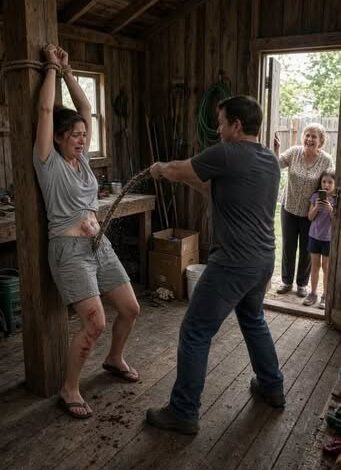
When my husband pulled me toward the shed, she grabbed it.
When he tied my hands to the wooden beam, she followed at enough of a distance that he did not notice.
When my mother-in-law stood outside the doorway laughing and telling me to remember my place, my daughter stayed hidden and recorded what she could.
She did not run into the shed.
She did not scream at him.
She did something far more calculated for a frightened child: she stayed out of sight long enough to get the truth beyond our property.
Then she sent the video to my sister.
I asked her why.
Why my sister?
My daughter finally lifted her eyes to mine.
“Because she always believes you before he starts talking.”
I can still remember the exact feeling that sentence created.
It was not only shame.
It was recognition.
My daughter understood something about my marriage that I had never admitted out loud.
My husband did not rely only on anger.
He relied on what came afterward.
After the damage, he became calmer.
After the shouting, his voice softened.
After I was frightened, he became reasonable.
By the time someone outside our house asked what had happened, he often sounded more composed than I did.
That mattered.
People tend to trust the person who sounds certain.
My husband understood that.
He could transform rage into a misunderstanding before anyone else finished explaining the original event.
My mother-in-law helped him.
She would lower her voice, shake her head, and describe whatever had happened as a private family matter that had gotten out of hand.
Private.
That word had covered a lot in our house.
Private meant nobody else needed details.
Private meant I should stop embarrassing the family.
Private meant the children should not repeat things.
Private meant the version told outside the house belonged to whoever spoke first.
But my daughter had broken that pattern before either of them realized it.
She had sent the video away.
The truth was already somewhere they could not reach.
That changed the entire shape of the day.
A little later, I heard quick footsteps in the hospital corridor.
My daughter reacted before I did.
Her shoulders lifted. Her body went rigid. For a moment, I thought she might be afraid her father had found us already.
Then my sister appeared in the doorway.
She had her purse in one hand and her phone in the other.
The expression on her face changed when she saw me, but she did not fill the room with questions.
That was one of the things I needed most.
She crossed to us, kissed the top of my daughter’s head, and pulled a chair closer to the bed.
“I got it,” she said.
Three words.
They nearly broke me.
Because for once, “I got it” did not mean someone had heard my husband’s version.
It meant the video had arrived.
It meant somebody outside our home had seen enough to understand why we were there.
My sister looked at my daughter first.
“You did exactly what you needed to do.”
There was no lecture about danger. No demand that she explain why she had followed us. No dramatic praise that turned her into some kind of hero.
Just recognition.
Then my sister turned toward me.
“There’s something in that video you need to hear again.”
I thought I knew what she meant.
I remembered my mother-in-law laughing.
I remembered her telling me to remember my place.
Those words had been impossible to miss.
My sister shook her head.
“Not her.”
My daughter became completely still.
My sister unlocked her phone and found the video.
Then she lowered the volume until only the three of us could hear.
The first sounds brought the shed back immediately.
The scrape against the wooden beam.
My husband’s voice………………..READ MORE NEXT PAGE 2