The Old Phone Captured What My Husband Planned to Say Next
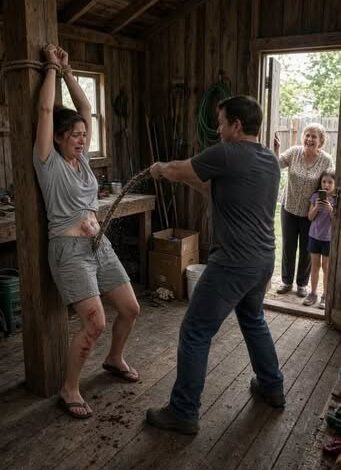
My mother-in-law at the doorway.
There are moments when memory feels visual, and there are moments when sound is worse.
Hearing it from outside myself was worse.
In the shed, fear had narrowed my attention to survival. I remembered pieces. A voice. A movement. The rope. The doorway. My mother-in-law’s laughter.
But the recording had caught something I had not processed while it was happening.
My sister stopped the clip.
She looked at my daughter.
Then she looked at me.
Finally, she placed the phone into my hand.
That handoff mattered more than I understood at first.
For years, other people had told me what happened after something terrible occurred.
My husband told me what I had caused.
My mother-in-law told me what I should forgive.
I told relatives what version would create the least trouble.
Now my sister handed me the record and let me hear it for myself.
No interpretation first.
No softened summary.
No family explanation.
Just the words.
Later, with my daughter sitting closer to the bed, I asked my sister to play the section again.
My husband’s voice came through first, low and angry.
Then my mother-in-law laughed.
Then came the sentence I had missed.
My husband told his mother not to worry.
Once I was frightened enough, he said, I would tell everyone that I had fallen in the shed.
There was no theatrical confession in the recording.
That was what made it so devastating.
He was not announcing guilt for an audience.
He was discussing the explanation before anybody outside the family had even asked for one.
The excuse was already prepared.
I had spent years believing I was spontaneously covering for him because I was scared, embarrassed, confused, or desperate to keep the family intact.
Hearing those words made me realize he counted on that behavior.
He expected me to explain the injuries for him.
He expected fear to do part of his work.
My daughter had understood enough to keep recording.
“That’s why I kept recording,” she whispered.
I looked at her hands.
They were still mostly inside her sleeves.
I thought about how young those hands were and how carefully they had held that cracked phone.
I thought about how many times she must have watched adults decide what reality was going to be inside our house.
My sister did not tell me what decision to make next.
She waited.
That was unfamiliar too.
For years, decisions had seemed to arrive already made.
My husband decided when an argument was over.
My mother-in-law decided what counted as a family matter.
I decided which excuse would cause the least damage.
Even my daughters had adapted their behavior around those decisions.
But in that hospital room, my sister simply waited for me.
For once, there was space between what had happened and what somebody else demanded I do about it.
I handed the phone back toward my daughter.
“Keep the original,” I told her.
That was all.
It did not sound like a grand declaration.
It did not feel like one either.
But it was the first time that day I made a choice based on preserving the truth instead of preserving the appearance of our family.
My daughter closed both hands around the phone.
The cracked screen disappeared between her sleeves.
And suddenly that old device carried a different meaning.
Before, it had been discarded technology.
Then it became a hiding place.
Then a witness.
Now it was something my daughter had been explicitly told not to surrender.
The facts stayed the same.
My husband had taken me to the shed.
My hands had been tied to the wooden beam.
My mother-in-law had stood outside the door laughing.
The hospital had documented what could be seen, including older injuries.
My daughter had recorded part of what happened and sent it to my sister.
And the recording contained the plan for the excuse they expected me to repeat.
What changed was not the past.
What changed was who controlled the first version of it.
My husband had always depended on arriving after the damage with a calm explanation.
My daughter had finally beaten him to that moment.
She had sent the truth first.
That was why the hospital room felt different even before the door opened.
The fear was still there.
My daughter was still watching entrances.
I was still injured.
My sister was still holding herself together beside us.
Nothing about those facts was magically repaired.
But the old sequence had been interrupted.
Damage.
Fear.
Excuse.
Silence.
This time there was something between fear and excuse.
A recording.
A sent message.
A sister who received it.
A daughter who understood that evidence mattered because adults had failed to protect the truth with words alone.
And then came the sound that pulled all of us back toward the doorway.
The handle moved.
The door opened.
The man whose explanation had always arrived so quickly had finally reached the room after his own words already had.
My husband stepped inside.