How Many Animals Do You Actually See? The Optical Illusion That Challenges Your Eyes
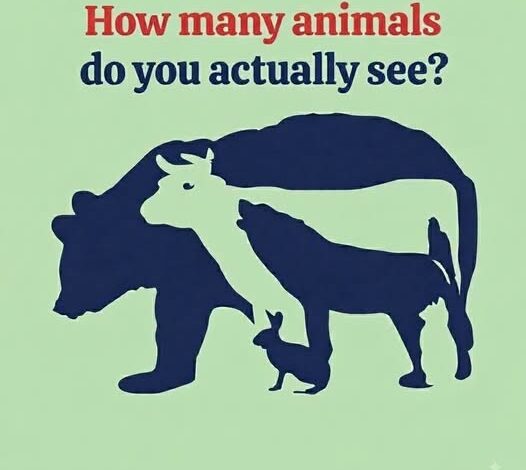
At first glance, this image looks simple: dark and light animal silhouettes arranged against a pale background. The cow in the center and bear on the left are easy to recognize. But once you are asked how many animals are actually hidden in the picture, everything changes. Suddenly, you begin searching for shapes within shapes.
The largest animals naturally capture your attention first. The central cow has a clear head, horns, body, legs, and tail, while the dark bear on the left forms another obvious silhouette. These large figures become visual anchors, making it surprisingly easy to overlook smaller animals hidden among their outlines.
The real trick is the overlapping shapes. Some animals are not drawn with separate outlines but are created using parts of other silhouettes or the spaces between them. This technique forces your brain to interpret the same lines in different ways, making the puzzle much harder than it initially appears.
Negative space is especially important. The empty areas surrounding an animal can form another creature’s head, body, or legs. Instead of concentrating only on the dark shapes, examine the gaps between them. A curved space or unusual outline might suddenly become recognizable as another animal.
If you want to solve it yourself, examine the image section by section. Start on the left, then move toward the central cow. Look closely around their heads, legs, backs, and undersides. Don’t assume every dark area belongs to the largest animal; follow individual outlines and look for separate shapes.
Near the lower center, a small mouse can be spotted. On the right, a small cat appears beneath the larger silhouettes. These smaller figures are easy to miss because your eyes naturally focus on the larger, higher-contrast animals first.
This puzzle also demonstrates how visual perception works. Our brains quickly organize familiar shapes and can ignore information that doesn’t seem important. This is related to inattentional blindness, where concentrating on one object can prevent us from noticing something else that is clearly visible.
So, how many animals are there? The clearly recognizable figures include the bear, cow, mouse, and cat, while additional overlapping shapes may produce different interpretations. The real challenge is to carefully trace every outline and decide which shapes are intentionally separate animals. Sometimes, the hardest thing to see is what is right in front of you.
The appeal of “How Many Animals Do You Actually See? The Optical Illusion That Challenges Your Eyes” comes from the gap between looking and truly noticing. Visual puzzles encourage the brain to make a quick first interpretation, then challenge it to reconsider the same shapes, outlines, and empty spaces from another angle. The image does not change; attention does.
One useful method is to stop searching for a complete object and examine smaller regions instead. Trace strong lines, compare areas of light and shadow, and look at the spaces between obvious figures. Rotating the image mentally, changing viewing distance, or briefly looking away can interrupt the first pattern the brain selected.
People often reach different answers because perception is influenced by expectation. Once someone decides what the picture probably contains, the brain tends to favor details that support that guess. A second viewer may notice another pattern immediately. Neither response measures intelligence or character in a scientific way; it simply shows how efficiently perception organizes complicated information.
That makes the challenge enjoyable to share. Comparing answers can reveal several valid ways of scanning the same scene, while the eventual discovery creates the satisfying feeling of seeing something that was present all along. There is no need to rush. The point is careful observation, not competition.
The broader lesson is simple: first impressions are useful, but they are not always complete. Slowing down, checking assumptions, and changing perspective can reveal details that speed conceals. The puzzle remains lighthearted, but the habit it exercises—looking again before deciding—has value far beyond the image itself.
A careful reading of “How Many Animals Do You Actually See? The Optical Illusion That Challenges Your Eyes” also benefits from returning to the source’s central details after the initial emotional reaction passes. The sequence matters because each detail explains the next, and removing that context can make a reasonable account sound more sensational than it is. Keeping the chronology intact helps readers understand both the immediate event and the choices that followed.
It is equally important to distinguish observation from assumption. The source offers a defined set of facts and experiences; anything beyond them should be labeled as uncertainty rather than presented as truth. That discipline protects the people involved and keeps the article focused on its real subject.
What remains is a practical reminder to pause, look closely, and respond with proportion. Whether the issue involves a family, a public claim, a safety warning, or a difficult loss, the most useful response is informed, humane, and connected to the evidence actually available.