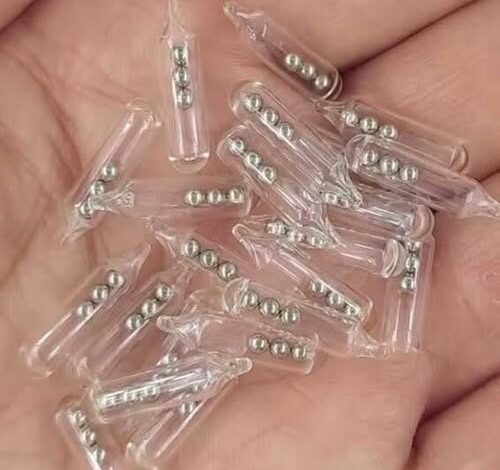
Mystery Object Explained: Small Glass Tubes With Three Tiny Ball Bearings
Those Tiny Glass Tubes With Three Balls May Have a Fascinating History
If you’ve ever come across a tiny glass capsule containing several small metal balls, you may have wondered what on earth it was used for.
At first glance, it can look like a miniature scientific instrument, an old medical component, or simply an unusual piece of glass.
But there’s a good chance it came from something much more familiar: a vintage leveling instrument.
 What Is It?
Small glass capsules like these can be associated with older spirit levels, including circular or “bullseye” levels used to determine whether a surface or machine was properly aligned.
Traditional spirit levels usually contain a curved glass vial with liquid and an air bubble. When the bubble settles between marked lines, the user knows the surface is level.
Circular levels work on a slightly different principle. Their rounded design can indicate levelness in two directions at once, making them useful for machinery, surveying equipment, carpentry, masonry, and other precision work.
Some older or specialized instruments also incorporated small metal balls or other mechanical indicators. The exact design varied considerably depending on the manufacturer, period, and intended application.
 Why Use Small Metal Balls?
The idea is beautifully simple: gravity provides the reference point.
In certain specialized instruments, mechanical indicators could make the instrument easier to read, particularly where vibration, lighting, or working conditions made a conventional bubble difficult to observe.
Rather than relying entirely on electronics or digital sensors, older tools used carefully shaped glass, metal, liquid, and gravity to provide a visual indication of alignment.
That simplicity is part of what makes these pieces so interesting today.
 Where Might You Find One?
If you discover a tiny sealed glass capsule like this, it may have originally been fitted into:
- An antique wooden or metal spirit level
- A machinist’s or engineer’s tool
- Machinery-alignment equipment
- Surveying or measuring instruments
- Older workshop equipment
They can turn up in estate-sale toolboxes, inherited workshops, antique tool collections, flea markets, or old drawers that haven’t been opened in decades.
If the capsule is mounted inside a metal housing or has a rounded glass profile, its connection to an old leveling instrument becomes even more plausible.
 Handle Older Glass Carefully
One important point is worth remembering: don’t open, puncture, or deliberately break an old sealed vial.
The liquid used in historical instruments varied by design and manufacturer. While many spirit-level fluids were relatively ordinary, older equipment can sometimes contain substances that shouldn’t be handled unnecessarily.
If the capsule is intact, leave it sealed.
If it is cracked, leaking, or damaged, avoid direct contact with the contents and handle it according to local household hazardous-material guidance.
 What Can You Do With It?
If you’ve identified an old leveling component, there are several simple options.
Preserve it.
Vintage measuring instruments are interesting examples of mechanical engineering and craftsmanship.
Display it.
A small shadow box containing the capsule alongside an old level, measuring tools, or workshop photographs can make an attractive piece of industrial-history memorabilia.
Research it.
Look for manufacturer’s marks, serial numbers, mounting rings, or distinctive shapes. Those details can sometimes reveal the original instrument.
And if you’re considering repurposing it for artwork or jewelry, make sure the glass is completely intact and securely handled.
 What It Probably Isn’t
Despite its unusual appearance, a small glass capsule with metal indicators isn’t automatically a chemical container, medical device, or modern electronic sensor.
Its appearance and mounting can provide important clues, but identification should be based on the complete object rather than the vial alone.
 A Tiny Piece of Engineering History
There’s something remarkable about these little components.
Before digital inclinometers and electronic sensors became commonplace, craftsmen and engineers could achieve impressive precision with remarkably simple principles.
A carefully shaped piece of glass.
A small amount of liquid.
A few precisely made metal components.
And the constant pull of gravity.
That’s what makes an old leveling component more than just a strange object found in a forgotten drawer.
It can be a tiny reminder of an era when precision depended on craftsmanship, physics, and beautifully simple mechanical ideas.
So if you’ve found one, take a closer look.
That little glass capsule may have spent decades helping someone keep a machine, structure, or instrument perfectly aligned.