The Day My Son Threatened to Leave Home Because I Wouldn’t Buy Him a Luxury Car, I Realized I Had Created a Monster
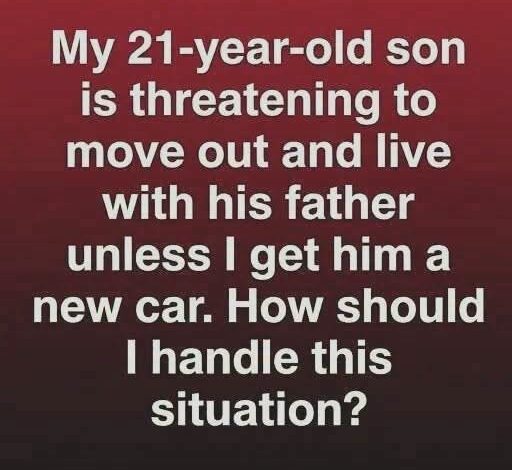
The deafening silence in my home is a jagged reminder that I have failed my own child. My son, a young man I once taught to be independent, stood in our kitchen just hours ago and delivered an ultimatum that shattered my heart: buy him the luxury car he demanded, or he would pack his bags and vanish from my life forever. He wasn’t asking for help; he was extorting me, weaponizing his presence and my love for him to secure a material status symbol. In that chilling moment, I realized I hadn’t raised a son—I had raised a master of emotional manipulation.
For years, I believed I was doing the right thing. I worked long hours to provide a comfortable life, shielding my son from the harsher realities of financial struggle. I thought my generosity was a form of love, a way to give him the opportunities I never had. But as the years passed, that “love” morphed into a culture of entitlement. Today, my son doesn’t see a father; he sees a bank account. He looks at his peers driving brand-new models and, rather than feeling inspired to work for his own, he feels slighted by his own family. He views my refusal to purchase a vehicle I cannot afford—and that he has not earned—as a personal betrayal of the highest order.
The standoff began with a simple “no,” but it quickly spiraled into a nightmare of accusations. He didn’t argue from a place of logic or need; he argued from a place of pure status. To him, the car is a commodity that confirms his worth. By threatening to leave, he is betting that my fear of losing him is stronger than my commitment to his character. He is gambling on my guilt, hoping that if he pushes hard enough, my common sense will crumble under the weight of his manufactured misery. But as I sat in the quiet of my living room, watching the sun dip below the horizon, the clarity of the situation hit me with the force of a physical blow.
If I give in, I am not being a good father. I am merely paying a ransom for his temporary approval. If I buy that car, I am not teaching him about the value of work or the satisfaction of earning one’s way; I am reinforcing the toxic delusion that his love is a bargaining chip and that the world owes him a soft landing. I have spent years being his sponsor, and in doing so, I have actively hindered his growth. The pain of this confrontation is sharp, but it is necessary. It is the painful, long-overdue moment where the mask of “provider” finally falls away to reveal the reality of an enabler.
He is an adult. He has the agency to walk out that door, to find his own path, and to face the consequences of his own choices. If he truly believes that life will be better elsewhere—that someone else will be willing to fund his illusions without question—he is free to test that theory. But I can no longer participate in this charade. I have to decide if my role in his life is to be a mentor or a financier. True dignity, for both of us, lies in the refusal to be coerced. By holding the line, I am not pushing him away; I am finally giving him the space to become the man I hoped he would be.
The path ahead is daunting. It requires a level of steely resolve that I have never had to summon before, especially when it comes to my own flesh and blood. I am fully prepared to offer him guidance, support, and the tools he needs to succeed on his own merits. I will help him build a resume, I will offer advice on budgeting, and I will be there to celebrate his actual accomplishments. But the wallet is closed. The cycle of enabling, which has nurtured this entitlement for so long, ends today.
If he chooses to walk away, the door will technically remain open, but it will be a door to a relationship built on mutual respect and shared values, not on demands for material gain. The car he wants is no longer a conversation about transportation; it is a battle for his future. He will have to fight that battle and win it on his own terms, in the real world where things are earned, not expected. If he leaves, he will leave with the knowledge that he is capable of fending for himself. That realization—that he is a person of substance who can survive and thrive without my direct intervention—is a far greater gift than any set of car keys could ever provide.
I know he will try to weaponize the silence. He will try to make me feel guilty for the “suffering” I am inflicting upon him. But I have seen the rot beneath the surface of our dynamic, and I am no longer willing to paint over it. The car is not a symbol of my failure as a father; it is the final catalyst for his liberation. It is time for him to grow up, and it is time for me to stop being the financier of his illusions. If this is the price of his independence, it is a price I am finally ready to pay.