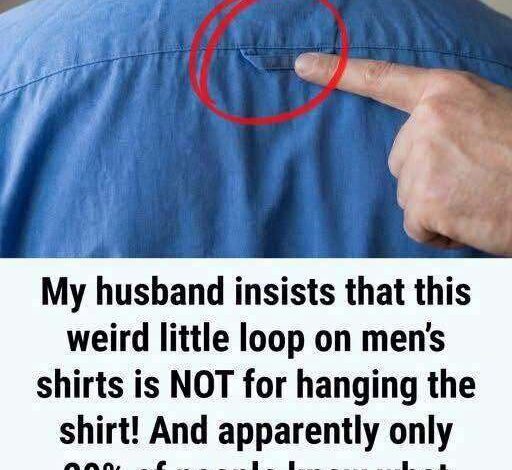
The Secret Meaning Behind That Tiny Loop on Your Shirt: A Hidden History of Romance and Rebellion
You have likely seen it a thousand times—that tiny, seemingly insignificant fabric loop sewn onto the back of your button-down shirts—and dismissed it as nothing more than a piece of stray thread or a manufacturing quirk. But what if I told you that this microscopic detail was once a powerful social signaling device that could dictate your entire dating life? That innocent little loop was once the epicenter of campus gossip, Ivy League status, and even clandestine romantic status updates. Beneath that simple stitching lies a history of rebellion, Ivy League culture, and a secret language that defined a generation.
Long before the locker loop became a standard aesthetic detail in modern menswear, it served a strictly utilitarian purpose born out of the cramped, chaotic environment of mid-century academic life. In the early 1960s, the renowned clothing brand GANT revolutionized campus fashion by introducing what they officially dubbed the “locker loop.” At the time, university students were struggling to keep their pristine oxford shirts wrinkle-free in the confined, dusty spaces of crowded gym lockers, where the luxury of a traditional wooden hanger was nowhere to be found. By sewing a small, durable loop onto the back of the shirt’s yoke, GANT provided a genius solution: students could simply hook their shirts onto a locker prong, ensuring they remained crisp and professional for their next lecture.
However, the locker loop was never destined to remain a mere piece of functional hardware. As the popularity of the Ivy League aesthetic exploded, this small design flourish became a badge of honor, a visual shorthand for a specific social stratum. Wearing a shirt featuring a locker loop signaled that you were part of the collegiate elite—a world of rowing teams, library study sessions, and the unspoken confidence of university culture. What began as a humble tool for garment preservation swiftly transformed into a potent symbol of fashion identity. To wear a shirt with an intact locker loop was to align yourself with a legacy of preppy sophistication that transcended the halls of the university.
Yet, it was the social customs and the folklore that sprung up around this tiny detail that truly cemented its legendary status. On various college campuses, the locker loop evolved into a primitive but highly effective social media profile. It became an open secret among students that a torn or removed locker loop carried a distinct, unspoken message: the wearer was no longer on the market. By ripping off the loop, a student was essentially declaring themselves “taken,” effectively broadcasting their relationship status to anyone who knew the code. Conversely, a shirt with a perfectly preserved loop was a subtle invitation, indicating that the wearer was unattached and potentially open to romantic advances.
This localized tradition added a thrilling, almost illicit layer of intrigue to an otherwise mundane garment. Imagine walking across a busy quad, your eyes scanning the shirts of your peers, deciphering the romantic availability of the crowd based solely on the integrity of their collar hardware. While these customs naturally varied from one university to the next—and were often whispered about with a mix of academic seriousness and teenage mischief—they imbued the shirt with a sense of narrative and urgency. It turned a simple piece of oxford cloth into a vessel for human connection, heartbreak, and pursuit.
As the decades rolled on, the functional necessity of the locker loop began to wane. With the advent of better storage, specialized hangers, and evolving laundry habits, the original purpose of the loop—hanging shirts in gym lockers—became largely obsolete. Yet, the feature refused to vanish from the garment industry. It became a point of contention and debate among purists and designers alike. Some saw it as a redundant vestige of the past, while others championed it as a hallmark of high-quality, thoughtful garment construction. The presence of a locker loop began to signal that a brand respected the history of the oxford shirt and was committed to maintaining the traditions of classic tailoring.
In today’s fashion landscape, the locker loop exists in a strange, liminal space. Modern designers treat it with a sense of playful experimentation. You might find them in contrasting neon colors, exaggerated sizes, or placed in unconventional spots on the shirt, effectively stripping away their history to make a purely aesthetic statement. For some, the loop is still a convenient tool for air-drying a shirt on a shower hook, a small nod to its original, practical roots. For others, it is simply a decorative flair, a piece of fashion trivia that most people never bother to research.
Despite its diminutive size, the shirt back loop remains a fascinating microcosm of the way history, utility, and human behavior intersect within the world of fashion. It connects our contemporary closets to a vibrant, bygone era where clothing was an extension of one’s social identity. It reminds us that every rivet, every button, and every stray stitch has the potential to carry a story if we are willing to look closely enough. We may no longer use these loops to signal our dating status in the college quad, but their enduring presence on our backs is a testament to the fact that fashion is never just about fabric. It is about the traditions we choose to carry forward, the secrets we keep, and the small, seemingly insignificant details that endure long after their original purpose has been forgotten. The next time you reach for your favorite button-down, take a moment to look at the back of the collar. You aren’t just looking at a loop of fabric; you are looking at a piece of history that helped define a generation.