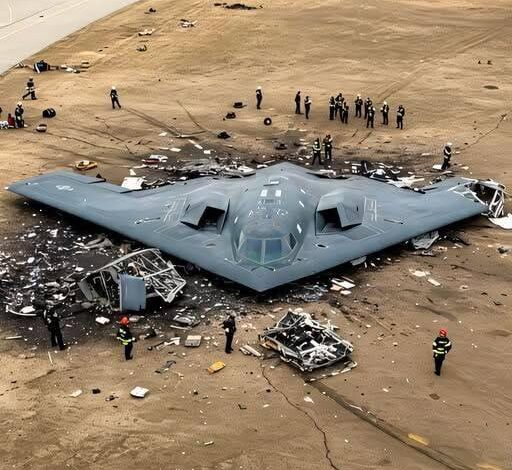
Tragedy in Guam! B-2 Spirit Stealth Bomber Lost After Takeoff
The morning of March 2, 2026, began with a chilling development at Andersen Air Force Base in Guam, as reports confirmed a catastrophic aviation mishap involving a B-2 Spirit stealth bomber. In what is being described as a somber day for the United States Air Force and the Global Strike Command, the multi-billion-dollar aircraft crashed and ignited on the runway environment shortly after takeoff. For those stationed at this critical strategic hub in the Pacific, the sight of a “flying wing”—a marvel of modern engineering and a symbol of American power—engulfed in a plume of thick black smoke served as a jarring reminder of the volatility inherent in military flight operations.
The B-2 Spirit is far more than an airplane; it is a cornerstone of the U.S. strategic triad and perhaps the most sophisticated piece of military hardware ever to take to the skies. Its loss is not merely a budgetary setback but a significant blow to the nation’s operational capacity. As emergency response teams worked frantically to suppress the flames and secure the wreckage, the immediate focus of the military community shifted from the hardware to the human element, specifically the two pilots tasked with maneuvering this complex machine.
The Mechanics of the Mishap: What We Know
Details regarding the crash remain fluid as the Air Force begins the arduous process of securing the site. Preliminary data suggests that the incident occurred moments after the aircraft became airborne. Eyewitness accounts and early reports indicate that the bomber struggled to maintain its climb profile before impacting the runway environment within the base perimeter. The resulting fire was significant, necessitating an immediate and massive response from Andersen’s crash-fire-rescue teams.
Andersen Air Force Base serves as the “tip of the spear” for U.S. operations in the Indo-Pacific. It is a location where routine training missions carry immense strategic weight. The fact that this crash occurred during what was likely a standard sortie underscores the reality that even the most meticulously maintained aircraft are subject to the unforgiving laws of physics and the potential for catastrophic mechanical failure.
The Irreplaceable Asset: A Fleet in Crisis
To understand why the loss of a single B-2 Spirit is a national emergency, one must look at the inventory numbers. Before this incident, the U.S. Air Force maintained a tiny fleet of only 20 active B-2 aircraft. This number was already down from the original 21 following the historic loss of the Spirit of Kansas in 2008—the only other total hull loss in the program’s history.
Unlike the B-52 Stratofortress or the B-1B Lancer, the B-2 is no longer in production. There is no factory line to restart and no “boneyard” of spare airframes to pull from. Each aircraft is an irreplaceable national asset, valued at approximately $2.2 billion per unit when adjusted for inflation and development costs. With only 19 aircraft potentially remaining in the inventory, the Air Force’s ability to project stealthy, long-range nuclear and conventional power has been mathematically diminished. The B-2 is the only aircraft in the world capable of carrying large-diameter bunker-buster munitions while remaining virtually invisible to sophisticated enemy radar systems. Losing 5% of that specific capability in a single morning is a strategic setback of the highest order.
The Human Element: The Airmen at the Center
While analysts pore over the loss of the airframe, the Air Force leadership remains singularly focused on the safety and well-being of the crew. The B-2 Spirit is operated by just two pilots who undergo some of the most rigorous training in the world. Their expertise is as rare and valuable as the aircraft they fly.
As of this afternoon, official word on the status of the aircrew is pending. In the 2008 crash, both pilots were able to eject successfully just moments before the wing impacted the ground. The aviation community is holding its collective breath, hoping for a similar miracle in the Guam jungle. The focus of the base commander and the Chaplain’s office at Andersen remains on supporting the families of the personnel involved and the first responders who witnessed the trauma of the crash.
Investigative Protocol: The Safety Investigation Board
In the wake of such a significant loss, the Air Force will convene a formal Safety Investigation Board (SIB). This board is composed of experts in aerodynamics, maintenance, human factors, and meteorology. Their task is to strip away the emotion of the day and find the cold, hard root cause of the failure.
The investigation will leave no stone unturned. They will examine the possibility of “Foreign Object Debris” (FOD) or bird strikes, which are a constant hazard in the tropical environment of Guam. They will scrutinize the maintenance logs to see if a systemic issue with the flight control computers or the complex hydraulic systems played a role. Crucially, they will look at environmental factors; Guam’s humidity and salt air are notoriously hard on the B-2’s sensitive radar-absorbent skin and electronic components.
Until the SIB can rule out a fleet-wide mechanical flaw, it is highly likely that the remaining B-2 aircraft will be placed on a “safety stand-down” or subjected to rigorous inspections. This temporary grounding happens at a time of heightened regional tensions, further complicating the strategic calculus for Global Strike Command.
Strategic Consequences and the Future of Stealth
The loss of a B-2 Spirit at Andersen AFB resonates far beyond the runway. It impacts the scheduling of the Continuous Bomber Presence (CBP) in the Pacific and may accelerate the push for the next-generation B-21 Raider. However, the B-21 is still in the early stages of its flight testing and production ramp-up. For the foreseeable future, the U.S. is dependent on the aging Spirit fleet to penetrate the world’s most contested airspace.
The B-2 Spirit, with its iconic “flying wing” silhouette, has been the face of American technological superiority since it was first unveiled in the late 1980s. To see it defeated by a runway in Guam is a humbling moment for the military-industrial complex. It serves as a stark reminder that even the most “invisible” aircraft are vulnerable to the mundane hazards of takeoff and landing.
Conclusion: A Community in Reflection
As the sun sets over Andersen Air Force Base, the recovery efforts continue under the glow of portable lights. The fire has been extinguished, but the investigation is just beginning. The tarmac is scarred, and a multi-billion dollar hole has been ripped in the national defense budget. Yet, the true cost of the day will be measured in the hearts of the airmen who lost a “sister ship” and the families waiting for news.
The B-2 Spirit fleet is a small, tight-knit community. Every pilot, maintainer, and fueler knows these 20 aircraft by name. Tonight, one of those names—whether it be the Spirit of South Carolina or the Spirit of Mississippi—has been stricken from the active list. We wait for further updates from the Air Force, standing in solidarity with the personnel at Andersen AFB and hoping for the best possible news regarding the brave men and women who fly the most complex machines ever built.