The Man Who Kept the Promise!
The Man Who Kept the Promise
I didn’t understand what mercy looked like until I saw it through bulletproof glass.
For three years, a biker I had never met brought my infant daughter to prison every single week. No excuses. No missed visits. No “something came up.” Just a steady, impossible kind of faithfulness that made the world feel less cruel for an hour at a time.
My name is Marcus Williams. I’m serving an eight-year sentence for armed robbery. I was twenty-three when I went in. I was twenty-four when my wife, Ellie, died a day and a half after giving birth. And I was twenty-four when a stranger named Thomas Crawford became the reason my daughter didn’t disappear into the foster system before I ever had a chance to know her.
I’m not asking anyone to feel sorry for me. I did what I did. I walked into a convenience store with a gun because I was in debt to people who don’t forgive late payments. I didn’t hit anyone. I didn’t shoot anyone. But I scared a man who was just trying to do his job, and that trauma is its own kind of violence. I still see his face sometimes when the lights go out. I earned my sentence.
But my daughter didn’t earn any of this. And Ellie didn’t deserve to die alone in a hospital bed while I sat locked behind concrete sixty miles away, not even allowed to say goodbye.
Ellie was eight months pregnant when they arrested me. She showed up to court anyway. I’ll never forget her sitting behind the defense table, hands pressed against her belly like she was trying to shield the baby from everything happening in that room.
The judge didn’t raise his voice. He didn’t need to.
“Eight years,” he said.
Ellie’s chair scraped back as she collapsed. One moment she was upright, the next she was on her knees, gasping like her lungs forgot how to work. The stress shoved her into early labor right there in the courthouse. People started shouting. Someone called for medical help. They rushed her out. I stood in shackles and watched doors close, hearing my name spoken like I was a problem to be managed, not a person.
I begged the deputy to let me see her. I begged like rules could be moved by desperation.
“She’s alone,” I said. “She’s in labor. Please.”
They didn’t care. Policies don’t care. Doors don’t care.
I found out Ellie was dead through the prison chaplain.
He came to my cell with that careful face people wear when they’re about to drop something on your life that you can’t catch.
“Mr. Williams,” he said, “I’m sorry to inform you that your wife passed away due to complications from childbirth. Your daughter survived.”
Sixteen words. A whole life erased.
I didn’t fall apart in a dramatic way. My body didn’t perform grief. It just went numb. My ears rang. The walls felt like they were leaning inward. Ellie was gone. My daughter was alive. And I had never even held her.
I knew the foster system. I grew up in it. Group homes, temporary placements, strangers’ kitchens where you learned not to leave your food unattended. Love was always conditional, always something you had to earn and could still lose for reasons no one would explain.
Ellie was the first person who ever chose me on purpose.
Her family hated that choice. They cut her off when she married me. When she got pregnant, they got worse. They said the quiet, poisonous kinds of racist things that don’t leave bruises but still break bones inside you. They told her she was ruining her life.
Ellie didn’t flinch. She told them, “You don’t get to decide who my family is.”
When she died, Child Protective Services took custody of our daughter.
Her name was Destiny. She was three days old and already had a case number. A file. A worker. A future being decided by people who had never looked into her eyes.
I called every day.
I begged for information. Who had her? Was she safe? Was she eating? Was she warm?
No one told me anything. To them, I wasn’t a father. I was a convict. My parental rights were “under review,” like love could be audited and approved on a schedule.
Two weeks after Ellie died, they told me I had a visitor.
I expected my lawyer or the chaplain. Someone official. Someone with paperwork and bad news.
Instead, I walked into the visitation room and stopped so hard the guard behind me snapped, “Keep moving.”
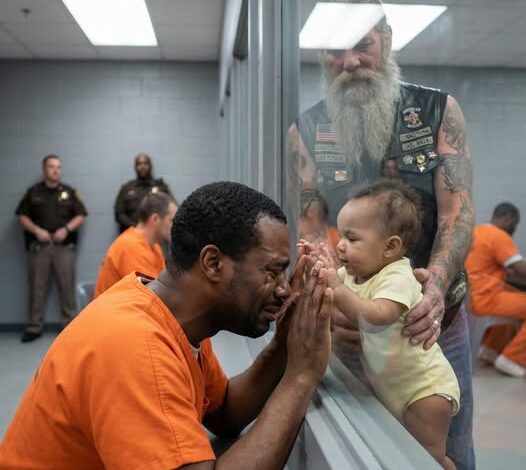
On the other side of the glass sat an older white man with a long gray beard and a leather vest covered in patches. Hands like tree bark. Weathered. Real. And in his arms, wrapped in a pink blanket, was my daughter.
My knees almost gave out.
I had seen Destiny once in a single blurry photo my lawyer managed to get me. I’d stared at it until the corners curled, until the paper went soft from my fingers. But a picture isn’t a baby. A picture doesn’t breathe. A picture doesn’t shift in someone’s arms and make tiny noises like the world is still new.
This was real.
The man looked up first.
“Marcus Williams?” he asked, voice rough but gentle.
My throat worked, but sound didn’t come. I couldn’t stop staring at Destiny.
“My name is Thomas Crawford,” he said. “I was with your wife when she died.”
That sentence hit me like a fist.
“How?” I finally managed. “Why? Who are you?”
Thomas adjusted the blanket so I could see my daughter’s face clearly. She slept with her mouth slightly open, peaceful and impossibly small.
“I volunteer at County General,” he said. “I sit with patients who are dying and alone. I hold their hand so they don’t leave this world with nobody beside them.”
When he said Ellie’s name, his voice shook.
“Ellie was alone,” he continued. “Her family refused to come. You weren’t allowed. The coordinator called me. I got there two hours before she passed.”
My palm pressed against the glass without thinking.
“Was she scared?” I asked.
Thomas swallowed. “She was worried about the baby,” he said softly. “And about you. She kept saying your name like it was a prayer.”
Something in my chest cracked open.
Thomas looked down at Destiny.
“She made me promise something,” he said. “She begged me to keep your daughter out of foster care. She said she knew what the system did to you. She didn’t want that life for Destiny.”
I stared at him, trying to understand the shape of what he was telling me.
“You promised a dying woman you’d raise her child?” I whispered.
Thomas didn’t blink. “I promised a mother I would protect her child,” he said. “That’s what a man is supposed to do.”
Then he added, almost like a dark joke, “CPS didn’t want to release her to me. Nearly seventy. Single. Motorcycle club vest. Not their idea of stable.”
“So how did you do it?” I asked.
“I fought,” he said simply. “I brought forty-three people to vouch for me. I hired an attorney. I did every check, every evaluation, every parenting class they demanded. Six weeks later, they granted me emergency foster custody.”
He paused, then said the part that still makes my throat tighten.
“I told the court I would bring Destiny to see you every week until your release.”
Every week. Until my release.
I didn’t understand that level of commitment. People had never done that for me. People left. People got tired. People decided you weren’t worth the trouble.
“Why?” I asked. “You don’t even know me.”
Thomas looked straight at me through the glass.
“Because fifty years ago, I lived your life,” he said quietly. “I was twenty-two and in prison for reckless choices. My pregnant wife died in a car accident. My son went into foster care. The system decided I was unfit.”
His jaw tightened, and I recognized that look immediately: grief that never goes away, just learns to sit still.
“By the time I got out,” he said, “he’d been adopted in a closed case. I never saw him again.”
The air felt heavy.
“For thirty years I’ve tried to make amends,” Thomas continued. “I volunteer. I help where I can. I try to become the man I should’ve been back then.”
He glanced down at Destiny, then back at me.
“When Ellie begged me, I knew I couldn’t refuse. I couldn’t watch it happen again.”
I pressed my forehead to the glass and shook. Not because I was weak. Because gratitude hurts when you don’t believe you deserve it.
Thomas kept his word.
Every week, without exception, for three full years, he drove two hours each way so my daughter could see me through that glass. I watched her grow through a barrier designed to remind you what you are.
I saw her first smile. Her first laugh. The first time she recognized my face and kicked her legs like joy lived in her bones. The first time she reached for me with tiny hands that couldn’t cross the distance.
And every week, Thomas sat there holding her steady, making sure she knew her father’s face, making sure I didn’t disappear from her life the way my own parents disappeared from mine.
He didn’t owe me anything. He didn’t owe Ellie anything. But he gave us everything anyway: a bridge, a chance, proof that promises still mean something in a world that tries to convince you they don’t.
That’s what mercy looked like.
Not forgiveness without consequence. Not pretending I didn’t do wrong.
Just one man showing up again and again, keeping a promise to a dying mother, so a little girl wouldn’t grow up believing she was alone.