A Close Call Made Him Understand Love in a Whole New Way
I never expected a single night to carry so much fear—and so much clarity. It began with sharp, relentless contractions and ended with a truth that changed the way my husband and I understood love. Between those two points was a fear so palpable I could taste it, and a silence that almost cost us everything.
Earlier that day, we’d argued. Not a huge fight—just a lingering disagreement that hung in the air. We went about our evening separately, assuming there would be time later to fix things. We always believed in “later.”
Then the contractions started.
At first, I tried to stay calm—timing them, breathing through the pain, telling myself it was too early. But as the pain intensified, instinct took over. I reached for my husband.
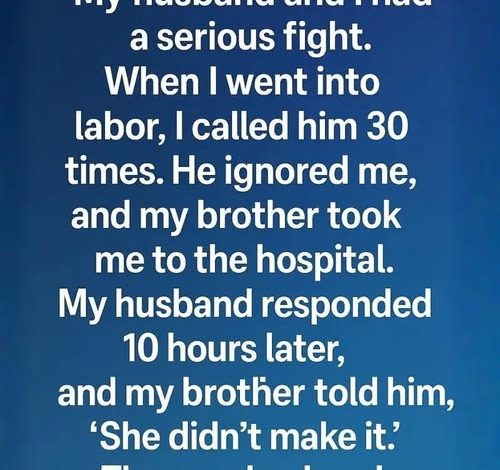
No answer.
I called again. Still nothing.
With each missed call, the room seemed smaller, the fear louder. I texted, I called, over and over. By the tenth attempt, tears ran down my face. By the twentieth, panic had taken root. By the thirtieth, I knew I couldn’t do this alone.
My brother arrived within minutes. He didn’t ask questions—he just helped me into the car and drove, steady and grounding, while everything inside me spun out of control. Every contraction hurt, but the deeper pain was the empty seat beside me—the knowledge that when I needed my husband most, he wasn’t there.
At the hospital, the lights were harsh, the hallways endless. Nurses moved efficiently while I clung to my phone, hoping for it to ring. Silence.
Hours passed. Then finally, a call came.
My brother answered. His voice cracked as he spoke four words meant to shake the world:
“She didn’t make it.”
Those words landed exactly as intended.
Later, my husband told me he dropped the phone, his legs giving way. Every missed call replayed in his mind, a harsh reminder of how easily he had neglected what mattered most. He drove to the hospital in a daze, convinced he had lost me—that his silence had already done irreparable damage.
He sat in the waiting room, hollow, waiting for what he feared most. Minutes stretched. Guilt pressed down on him like a weight.
Then the doctor appeared.
The nightmare shattered. I was alive—exhausted, shaken, but alive. And in my arms was our daughter.
My husband broke completely. Relief and guilt collided, and he sobbed without restraint, holding us as though letting go might make us vanish. His words—apologies, regret, love—tumbled out raw and unfiltered. My brother’s cruel trick forced him to see how close he had come to losing everything.
In the weeks that followed, something changed.
There were no grand declarations, no dramatic vows. Instead, there was presence. He attended early feedings, even when tired. He changed diapers without being asked. He learned the rhythms of our daughter’s cries. He held my hand longer, lingered near us, looked at us as if memorizing every detail.
Love stopped being theory.
It became action.
Our relationship didn’t become perfect. We still disagreed, still snapped at each other sometimes. But silence no longer felt safe. We talked things through, because we understood what silence could cost.
Sometimes, late at night, I watch him rock our daughter to sleep. His voice softens, trembles, and he whispers the same sentence every time—part confession, part promise:
“I almost lost both of you.”
That night stripped away pride, distraction, and the illusion that time is guaranteed. What remained was stronger: a love that isn’t loud, but steady. A love that doesn’t wait for tomorrow to fix what we avoid today.
I learned something too. Strength isn’t just surviving pain—it’s letting it change you. Fear teaches you what matters. Love isn’t proven in calm moments—it’s proven in how deeply it shows up when everything is on the line.
We came frighteningly close to a different ending—one where regret would have been permanent, where apologies would have arrived too late. That knowledge stays with us, not as a threat, but as a reminder.
Life doesn’t announce which moments will matter forever. Sometimes they arrive uninvited, demanding attention. Almost losing someone can break you—but it can also burn away the unnecessary and leave only what’s real.
Our love didn’t become flawless that night.
It became real.
And true love—the kind built on presence, humility, and vulnerability—is the kind that lasts.