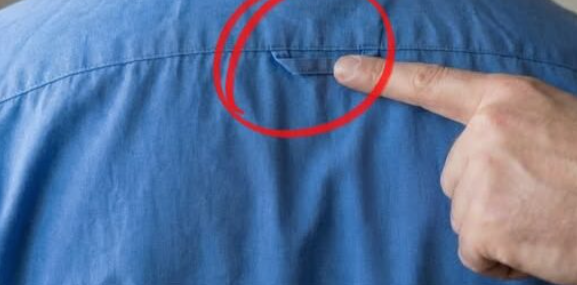
Why Button-Down Shirts Feature a Loop on the Back!
In the meticulous world of menswear, where every stitch and seam often serves a calculated purpose, few details are as ubiquitous yet misunderstood as the small fabric loop situated on the back of a button-down shirt. Located precisely where the box pleat meets the yoke, just below the collar, this “locker loop” is a design element that most modern wearers overlook entirely. To the uninitiated, it might appear to be a manufacturing vestige or a decorative flourish, yet its presence is a testament to over a century of maritime necessity, collegiate social signaling, and the evolution of American garment manufacturing.
The genesis of the locker loop is rooted in the practical, cramped realities of life at sea. In the early 20th century, specifically within the United States Navy, storage was a luxury that sailors simply did not have. Aboard ships, traditional closets with hangers were nonexistent; instead, sailors were allotted small lockers and rows of wall-mounted hooks. When a sailor needed to store his dress shirt without it becoming a crumpled mess on the deck, he couldn’t rely on a wooden hanger. The solution was the “backstay loop.” By reinforcing a small strip of fabric into the construction of the shirt, sailors could hang their garments directly onto hooks. This kept the shirts elevated, allowed air to circulate, and maintained the crispness of the fabric in an environment defined by humidity and limited space. It was a triumph of utility, a small piece of fabric that solved a significant daily frustration for those in uniform.
Following the conclusion of World War II, many military innovations began to bleed into civilian life, and the locker loop was no exception. As veterans returned home and enrolled in universities, their utilitarian sensibilities influenced the “Ivy League” aesthetic that would come to define mid-century American fashion. In the 1960s, the legendary shirt-maker Gant began incorporating the locker loop into their iconic Oxford cloth button-down shirts. Marketed specifically to college students at prestigious institutions like Yale and Harvard, the loop was rebranded as a feature for the modern, active young man.
On campus, the utility of the loop remained—students could hang their shirts in gymnasium lockers while changing for sports without worrying about wrinkles. However, the locker loop soon transcended its functional origins and entered the realm of romantic folklore. In the social ecosystem of 1960s universities, the loop became a silent communicator of relationship status. According to collegiate legend, a young man would intentionally snip the loop off his shirt to signal that he was “steady” or “pinned” to a girlfriend. Conversely, girls might wear their boyfriend’s college pin or scarf. This practice turned a mundane architectural detail of a garment into a social signifier, a way to navigate the complexities of campus dating without saying a word. The “taken” status was literally woven into the fabric of one’s wardrobe, making the locker loop one of the earliest examples of a fashion trend doubling as a relationship status update.
As the decades progressed and the “Preppy” look became a permanent fixture in the global fashion lexicon, the locker loop survived, though its primary function shifted once more. By the time the 1980s and 90s arrived, the widespread availability of inexpensive hangers and the expansion of home closet space rendered the loop functionally obsolete for the average person. Yet, designers refused to let it go. For brands like Brooks Brothers, Ralph Lauren, and J.Crew, the loop became a “heritage” detail—a nod to the authenticity and history of the American button-down. It became a mark of quality and attention to detail. In the eyes of menswear enthusiasts, a shirt with a locker loop feels more “correct,” possessing a lineage that connects the modern wearer to the sailors of the Atlantic and the scholars of the mid-century.
In the contemporary era, the locker loop has found a tertiary life as a travel and fitness hack. For the frequent flyer or the business traveler navigating a hotel room with insufficient hangers, that century-old maritime trick still holds water. Hanging a shirt by the loop on a bathroom door hook while taking a hot shower allows the steam to naturally release wrinkles, a technique far more effective than trying to balance a shirt over a standard wire hanger. In the world of high-end tailoring, brands often use the loop as a canvas for subtle branding, adding a pop of contrast color, a bit of grosgrain ribbon, or specialized stitching that acts as a “secret handshake” for those who know what to look for.
Despite its storied past, the loop remains a polarizing feature. Some modern minimalist designers omit it entirely, viewing it as an unnecessary snag hazard or a cluttered detail that breaks the clean lines of a slim-fit shirt. Others have moved it to the interior of the collar to maintain the function while hiding the form. Yet, for those who appreciate the narrative of their clothing, the locker loop remains a charming anomaly. It is a reminder that fashion is rarely just about how we look; it is about how we lived. It represents a time when garments were expected to be durable and versatile, serving the needs of the wearer in the most efficient way possible.
When you notice that small loop on your favorite Oxford shirt today, you aren’t just looking at a bit of scrap fabric. You are looking at a design that has traveled from the humid bowels of a naval destroyer to the hallowed halls of the Ivy League and into the modern corporate boardroom. It is a survivor of changing trends and technological advancements. Whether you use it to hang your shirt after a workout or simply appreciate it as a quiet homage to the sailors and students of the past, the locker loop serves as a subtle bridge between the utilitarian world of the 1900s and the aesthetic-driven world of today. It is a small piece of history that continues to hang on, reminding us that even the most overlooked details often have the loudest stories to tell.