The Terrifying Truth About Why Snakes Are Invading Your Home And The One Move You Must Make Now
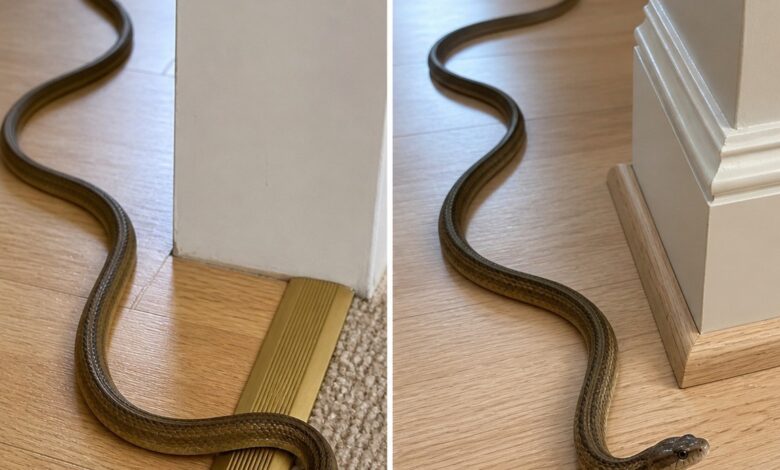
Imagine walking down the quiet, dimly lit hallway of your own home, only to flick on the light and come face to face with a slithering, scaly intruder coiled in the corner. It is a homeowner’s worst nightmare—a sudden, heart-stopping encounter that turns your private sanctuary into a scene of pure panic. Finding a snake inside your living room or basement is not just an unsettling shock; it is a signal that something is fundamentally wrong with your home’s defenses. If you think you are safe, think again. These silent predators are hunting for something, and your house is the perfect trap.
While it is easy to assume that snakes enter our homes with malicious intent, the reality is far more calculated. These reptiles are not interested in terrorizing you; they are driven by the most primitive, unrelenting forces of nature: the desperate search for food, warmth, and reliable shelter. When you spot a snake in your home, you are witnessing a creature acting on pure survival instinct. To transition from raw fear to rational action, you must first understand the environmental magnets pulling these creatures across your threshold. It is a biological invasion that requires an immediate, strategic response.
In the vast majority of cases, a snake enters a home because it is following a scent trail. If your residence has a secondary, unseen infestation of mice, rats, or other rodents, you are inadvertently hosting a massive, all-you-can-eat buffet for a hungry serpent. These pests establish complex habitats in quiet, forgotten corners of your basement or crawl spaces, and snakes are evolutionarily hardwired to track them. Your home is essentially a restaurant for the reptile, and until you remove the food source, the uninvited guests will keep arriving. Beyond hunting, snakes are often just looking for a dark, undisturbed place to hide from their own predators. Cluttered storage areas, laundry rooms, and damp basements provide the perfect, low-light security they crave.
Weather is the second most common driver of these infiltrations. When the external environment becomes too hostile, snakes are forced to adapt or perish. During periods of extreme climate fluctuation—such as scorching, record-breaking heatwaves, relentless torrential downpours, or sudden, bone-chilling winter cold snaps—snakes look for a stable microhabitat. Your home offers an artificial, climate-controlled refuge that shields them from the harsh, erratic realities of the outdoor world. During a summer drought, a snake might slither toward the cool, humid environment of a bathroom or a basement drain in search of water. Conversely, during the first drop in autumn temperatures, the heat radiating from your furnace or fireplace acts like a massive, glowing magnet for a cold-blooded creature desperate to maintain its core body temperature.
When you are finally confronted with a snake, your initial wave of adrenaline and fear can severely cloud your judgment, leading to dangerous, impulsive reactions. It is critical to remember that while many common snake species are entirely non-venomous and actually provide a service by eating rodents, you cannot afford to gamble on a visual identification in the heat of the moment. The average person lacks the specialized training to distinguish a harmless garter snake from a deadly venomous viper in the dim light of a hallway. Therefore, the only safe, logical choice is to treat every single encounter with extreme caution and total respect. Assuming the worst is the only way to ensure you maintain a safe distance and avoid a catastrophic mistake.
If you find yourself staring at a snake in your living space, the primary rule is to remain as still and calm as possible. Take a slow, measured breath, step backward, and keep a significant distance between yourself and the reptile. Do not make any sudden lunges, do not scream, and under no circumstances should you attempt to touch, kill, or handle the animal. The overwhelming majority of human snake bites occur when individuals try to capture or provoke the creature. If you can do so safely, slowly back out of the room and close the door, sealing the snake within that space. Immediately move your children and household pets to a completely different, secure area of the house. Once the area is contained, your next step is to call professional wildlife removal services or qualified pest control experts. These professionals possess the proper safety equipment, specialized training, and tactical knowledge required to capture the snake without risking your life or harming the animal.
Once the intruder has been safely removed, the focus must shift entirely toward heavy-duty, long-term prevention. You cannot simply wait for the next snake to show up; you must make your home an impenetrable fortress. Start by conducting a rigorous, top-to-bottom inspection of your home’s exterior. Snakes can squeeze through remarkably small cracks and gaps. Use high-quality weatherstripping, specialized mesh, and professional-grade silicone caulk to seal every single gap around doors, windows, utility pipes, and foundation cracks. If a mouse can fit through it, a juvenile snake can follow.
After sealing the perimeter, move to interior and exterior organization. The goal is to eliminate every single hiding spot that a snake might find attractive. Indoors, this means clearing out clutter, removing stacks of cardboard, and ensuring that storage areas are well-ventilated and brightly lit. Outdoors, keep your grass mown to a short height to remove the cover snakes use for movement. Trim all bushes and tree branches at least three feet away from your home’s siding, and clear away any woodpiles, brush, or debris that might offer a refuge for rodents and, consequently, their predators. By proactively removing the food sources, water access, and dark hiding spots, you are sending a clear, biological message that your home is not a sanctuary for serpents. Taking these steps today is the only way to guarantee that your home remains a secure, private, and snake-free environment for you and your family.