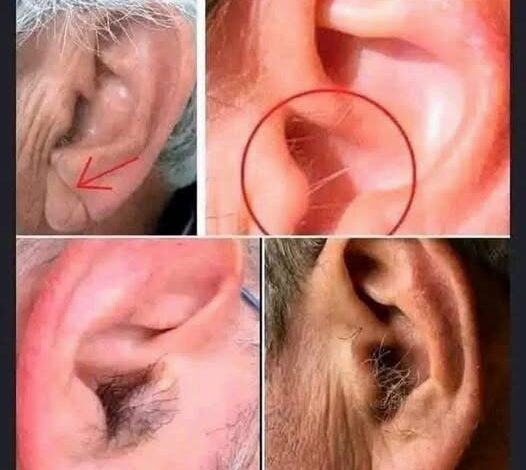
THE SHOCKING TRUTH ABOUT AGING: Why Your Body Is Suddenly Sprouting Hair Where You Least Expect It
You wake up, glance in the mirror, and suddenly spot it—a dark, thick strand of hair sprouting defiantly from your ear. You freeze. Panic sets in. Is this a sign of a mysterious illness? Is your body falling apart? You’ve spent your entire life grooming your scalp and shaving your face, but no one warned you about this strange, creeping invasion. You are not alone, and you are definitely not dying. In fact, this startling change is a hidden biological reality that millions of people face every single day. Stop the panic; the truth behind this phenomenon is far more fascinating than you ever imagined.
For many, the first appearance of ear hair feels like a betrayal by the body. It often happens after fifty or sixty, leading to immediate embarrassment and frantic googling. Yet, this is not a medical crisis or a sign of some exotic decline. It is simply the body’s internal clock and chemical landscape shifting over time. While the hair on your head may begin to thin, your body’s hair follicles are busy responding to a lifelong accumulation of hormonal signals. It is a natural, albeit unexpected, chapter in the human aging process.
The primary driver behind this growth is the complex interplay of your hormones and your genetic blueprint. Over the course of many decades, your hair follicles—especially those in the nose and ears—become increasingly sensitive to androgens like testosterone. While testosterone is famously associated with male virility and puberty, its influence continues to shift throughout a lifetime. In men, these follicles may eventually be “primed” to produce terminal hair—the thick, dark, and stiff variety—rather than the fine, invisible “vellus” hair (or peach fuzz) that covers much of our bodies from birth.
Women may notice similar changes, particularly after menopause when estrogen levels drop, though prominent ear hair is statistically much more common in men. This isn’t a failure of your health; it is a manifestation of your unique genetic predispositions. Your body is simply following a biological script written by your ancestors, determining where and how thick your hair grows based on patterns that have likely been passed down through generations.
There is a persistent myth that ear hair serves no purpose, but that couldn’t be further from the truth. Evolution designed these hairs as a defensive barrier. Just like the hair in your nose, ear hair acts as a natural filter, trapping dust, preventing debris from entering the ear canal, and keeping insects at bay. It works in tandem with earwax to protect your delicate inner ear. While the visual tufts might feel unsightly in a modern aesthetic context, they are actually working quietly to keep your sensory pathways clean and protected.
If you find the appearance bothersome, you are not trapped with it. However, the approach to “taming” the wild growth matters. Because the ear canal is a sensitive, fragile environment, safety must be your top priority. Small, rounded-tip scissors or modern electric trimmers are the preferred tools. It is strongly advised to avoid deep plucking, which can cause painful ingrown hairs or infections, and to stay away from sharp, pointed tools that could accidentally damage your eardrum.
Ultimately, finding a random hair growing from your ear is not a red flag for disease. It is a reminder that you are human, that you are aging, and that your body is constantly adapting. It is a sign of life, not decay. Instead of viewing it with fear or embarrassment, try to see it for what it is: a completely normal, biological evolution. Your body has survived decades of environment, stress, and growth. A few stray hairs are just the final, visible testament to a life well-lived. Embrace the change, groom it if you choose, and rest easy knowing that you are perfectly, biologically normal.