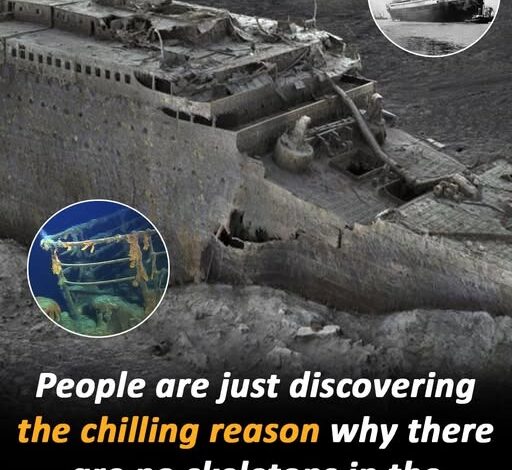
The mysterious absence of bodies in Titanics wreckage!
The RMS Titanic remains the most famous maritime disaster in human history, a haunting symbol of industrial ambition meeting the indifferent power of the natural world. On April 15, 1912, the “unsinkable” vessel succumbed to the icy waters of the North Atlantic after a fatal collision with an iceberg, claiming more than 1,500 lives. For decades, the ship rested in the silent, crushing darkness of the abyss, its exact location a mystery until the pioneering expedition of Dr. Robert Ballard in 1985. However, the discovery of the wreck introduced a new, chilling enigma that has captivated historians and the public alike: the total absence of human remains. Despite the catastrophic loss of life, the debris field and the hollowed-out hulls of the ship appear devoid of the people who once inhabited them, leaving behind an eerie landscape of “ghostly” artifacts.
To understand why the Titanic is a steel tomb without bodies, one must first appreciate the staggering environment in which it rests. The wreckage lies 12,000 feet beneath the ocean surface, a depth that subjects the structure to nearly 400 times the atmospheric pressure found at sea level. In this realm, the water temperature hovers perpetually just above freezing. For a long time, popular imagination suggested that these frigid, pressurized conditions might have acted as a deep-freeze, preserving the victims in a state of suspended animation. Reality, however, is far more predatory. The deep ocean is not a barren wasteland; it is a highly specialized ecosystem where nutrients are scarce, and any biological matter is immediately integrated into the food chain.
When the Titanic sank, those who did not make it to lifeboats were plunged into the water. Many stayed afloat in life jackets, eventually succumbing to hypothermia, while others were pulled down with the ship itself. In the immediate aftermath, recovery ships managed to retrieve 337 bodies from the surface, but the vast majority remained missing. For those who went down with the wreck or settled on the seafloor, the process of reclamation began almost instantly. Deep-sea scavengers, including fish, crustaceans, and specialized bacteria, are incredibly efficient at detecting organic material. In a matter of weeks or months, soft tissue would have been consumed by these marine organisms, leaving only the skeletal remains behind.
Yet, even the bones are gone. This is where the chemistry of the deep ocean plays its final, decisive hand. Dr. Robert Ballard has frequently explained the concept of the Calcium Carbonate Compensation Depth (CCD). At relatively shallow depths, bones can be preserved for centuries, but as one descends past approximately 3,000 to 10,000 feet—depending on the specific chemistry of the region—the water becomes under-saturated with calcium carbonate. Because bone is primarily composed of this mineral, the seawater essentially becomes an acid to the skeleton. Once the flesh is removed by scavengers, the exposed bone begins a slow process of dissolution. Over the seventy-three years that passed between the sinking and the discovery of the wreck, the Atlantic Ocean literally dissolved the physical evidence of the 1,500 souls lost that night.
The only “bodies” that remain are those suggested by the things the scavengers could not eat. Scattered across the five-by-three-mile debris field are pairs of shoes and leather boots, resting side-by-side on the silt. Leather is often treated with tannins during the manufacturing process, a chemical that makes it unpalatable to marine life. These shoes serve as somber markers; they are the outlines of where a person once lay before they were reclaimed by the sea. James Cameron, the filmmaker and explorer who has visited the site thirty-three times, has noted that while he has never seen a single human bone, the sight of a pair of shoes lying together is perhaps more haunting than a skeleton would be. It is a domestic image in a terrifyingly alien environment, a reminder of the human scale of the tragedy.
The preservation of the ship itself is also reaching a critical juncture. While the bow remains recognizable, its silhouette slicing through the silt, it is being consumed from the inside out by “halomonas titanicae,” a species of iron-eating bacteria. These organisms create “rusticles”—fragile, icicle-like structures of oxidized metal—that hang from the railings and portholes. As the bacteria metabolize the ship’s iron, the structural integrity of the Titanic weakens every year. Experts predict that within several decades, the upper decks will collapse entirely, and eventually, the great ship will be reduced to a massive rust stain on the ocean floor. The ship is undergoing the same inevitable cycle of return that the passengers experienced a century ago.
The tragedy of the Titanic is not merely a historical event but a continuing narrative of human curiosity and risk. This was underscored in the summer of 2023 by the Titan submersible disaster. In an attempt to view the legendary wreck, five individuals lost their lives when their carbon-fiber vessel suffered a catastrophic implosion during its descent. The victims included seasoned explorers and enthusiasts, such as Paul-Henri Nargeolet, a man who had spent a lifetime studying the Titanic. The fact that a modern vessel vanished in the same waters as the liner it sought to visit served as a grim reminder that the deep ocean remains one of the most hostile and unforgiving environments on Earth. It is a place that does not easily tolerate human presence, and it is a place that eventually erases all traces of those who enter it.
For many, the disappearance of the bodies is a source of profound horror, a final indignity in a series of terrifying events. However, there is an alternative perspective held by some historians and descendants of the survivors. There is a certain poetic finality in the idea that the victims were not left to rot in a dark hull, but were instead integrated into the vast, eternal cycle of the Atlantic. They have become part of the sea itself. The absence of remains reinforces the status of the Titanic as a hallowed ground—a memorial that exists not through physical monuments, but through the memory of what was lost.
As the hull continues to disintegrate and the remaining artifacts are slowly buried by shifting currents and sediment, the mystery of the Titanic transitions from a tangible wreck into a legend. The science of the deep explains the missing bodies through chemistry and biology, but the emotional impact remains unchanged. The ship stands as a monument to the fragility of human engineering when pitted against the elemental forces of the world. Even as the steel turns to dust and the shoes are buried by the sands of time, the story of the 1,