The Heirloom From The Grave How My Future Daughter in Law Unlocked a 25 Year Old Family Secret
I spent the better part of Tuesday afternoon in a state of rhythmic domesticity, the kind of focused calm that usually precedes a major family milestone. My kitchen was thick with the scent of rosemary roast chicken and the sharp, bright tang of my mother’s signature lemon pie. This wasn’t just dinner; it was an audition for a new life. My only son, Will, was bringing home Claire, the woman he intended to marry. I wanted the house to smell like history and safety, like a place where she belonged. I had no idea that when she walked through my front door, she would be carrying a piece of my history that was supposed to be six feet underground.
The doorbell rang at exactly seven. Will entered first, wearing that wide, boyish grin that always made him look ten years younger. Behind him stood Claire. she was radiant, possessing a natural grace that immediately put my nerves at ease. I hugged them both, feeling the genuine warmth in Claire’s embrace. As I took her coat and draped it over the banister, I turned back to lead them into the living room. That was when she unwound her silk scarf, and the world suddenly tilted on its axis.
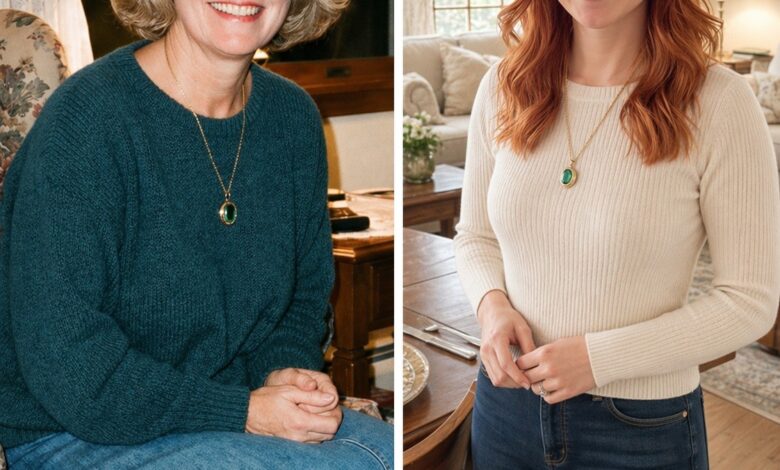
Resting against her collarbone was an oval gold pendant. In its center sat a deep, forest-green stone, framed by intricate gold engravings of tiny leaves so delicate they appeared to be woven from lace. My breath hitched, caught in a throat that had gone suddenly dry. I knew that necklace. I knew the weight of it, the specific luster of that emerald, and most importantly, I knew the secret hidden on its edge.
Twenty-five years ago, I had stood over my mother’s open casket. With trembling hands, I had tucked that very necklace into the folds of her burial dress, resting it against her heart just as she had requested. I was the last person to touch it before the lid was closed. Yet, here it was, shimmering under my hallway lights, pulsing with a life it wasn’t supposed to have.
“It’s a vintage piece,” Claire said softly, noticing my fixed stare. She reached up to touch the stone with a fond smile. “Do you like it?”
“It’s… it’s extraordinary,” I managed to whisper, my voice sounding like it belonged to someone else. “Where did such a treasure come from?”
“My father gave it to me,” she replied. “He’s had it since I was a little girl, but he made me wait until I was eighteen to wear it. He calls it my lucky charm.”
I navigated dinner like a ghost haunting my own home. I served the chicken, I passed the potatoes, and I smiled when Will told jokes, but my mind was a chaotic storm. There were no “duplicates” of that necklace. It was a custom Victorian piece brought over from the old country, passed down through three generations. I knew about the tiny, microscopic hinge on the left side that transformed the pendant into a locket—a detail my mother had shared with me in a whisper when I was twelve.
The moment their car pulled out of the driveway, I didn’t clean the table. I went straight to the attic. I pulled down the dusty albums and spread them across the kitchen floor. There she was—my mother at her wedding, at my graduation, at Christmas dinner—always wearing the green stone. I took a magnifying glass to the photos. The leaf patterns were identical. The hinge was there.
My heart hammered against my ribs. If Claire had the necklace, and her father had owned it for twenty-five years, it meant it had been stolen before my mother was even cold in the ground. The only people with access to the body before the funeral were the staff at the funeral home and my brother, Dan.
I couldn’t wait. I called Claire’s father, a man I had never met, under the guise of wanting to introduce myself before the wedding planning began. I steered the conversation toward the jewelry, claiming to be a collector. The silence on the other end of the line was heavy and suspicious.
“It was a private purchase,” he said, his voice tightening. “A long time ago. I don’t recall the specifics.”
“Did you buy it from a dealer?” I pressed, my politeness wearing thin.
“Why is this so important to you?” he snapped. “It was a legal transaction. I have to go.”
The dial tone hummed in my ear, but the defensiveness in his voice told me everything. He wasn’t a thief, but he knew the necklace had a murky past.
The next day, I met Claire for coffee. I asked to see the piece up close. When she placed it in my hand, my thumb instinctively found the hidden catch. It clicked open. The interior was empty, but the floral engraving inside the lid was unmistakable. It was the mark of my family’s past. I felt a wave of nausea. Someone had robbed my mother’s grave—or rather, they had robbed her before she ever reached it.
I didn’t go to the police. I went to Dan’s house.
My brother was sitting on his porch, nursing a beer and watching the sunset. He looked older, tired, and entirely unsuspecting. When I sat down and laid the photographs of our mother on the table, his smile faltered. When I told him about Claire’s necklace and her father’s “private purchase” twenty-five years ago, the color drained from his face until he was the shade of ash.
“I can go to the authorities, Dan,” I said, my voice cold and steady. “Or you can tell me how our mother’s dying wish ended up sold for cash.”
Dan broke. He put his head in his hands and confessed to a sin a quarter-century old. He had been in deep gambling debt back then—desperate, drowning, and terrified. He had seen the necklace as a lifeline rather than a legacy. The night before the funeral, he had slipped into the viewing room and swapped the genuine heirloom with a high-quality gold-plated replica he’d scrambled to find. He sold the original to a business associate—Claire’s father—for $25,000.
“It was going into the dirt, Maureen!” he sobbed. “It was going to be wasted! I thought… I thought it could save my life instead of rotting in a box.”
I walked away from him that night feeling a profound sense of betrayal, but also a strange, nagging curiosity. Why had my mother been so adamant about burying it? She wasn’t a superstitious woman.
I returned to the attic and dug deeper into the boxes I hadn’t touched in decades. At the bottom of a trunk filled with old linens, I found her diary. I flipped to the final entries, written in a shaky hand just weeks before she passed.
“I watched this necklace destroy the love between my mother and her sister,” she had written. “They spent thirty years refusing to speak because of who ‘deserved’ the stone. I see the way Dan looks at it, and the way Maureen treasures it. I will not let a piece of gold turn my children into enemies. Let it go into the earth with me. Let them keep each other instead.”
The irony was a physical weight in the room. Her attempt to save us from greed had inadvertently fueled it. Dan had committed a betrayal to “save” himself, and I had spent twenty-four hours fueled by a righteous anger that could have severed our bond forever.
I called Dan back. I read him the passage. We both cried—for the mother we missed, for the mistakes he’d made, and for the grace she had tried to afford us. I realized then that the necklace hadn’t been lost. It had traveled through a stranger’s house to find the one woman who would bring it back into our bloodline legally and through love.
When Will and Claire came over for dinner that Sunday, I looked at the green stone shimmering on her neck and didn’t see a stolen object. I saw a miracle. My mother wanted the necklace gone to protect her family; instead, the necklace had returned to ensure its growth. As I served the lemon pie, I realized that some heirlooms are simply too powerful to stay buried.