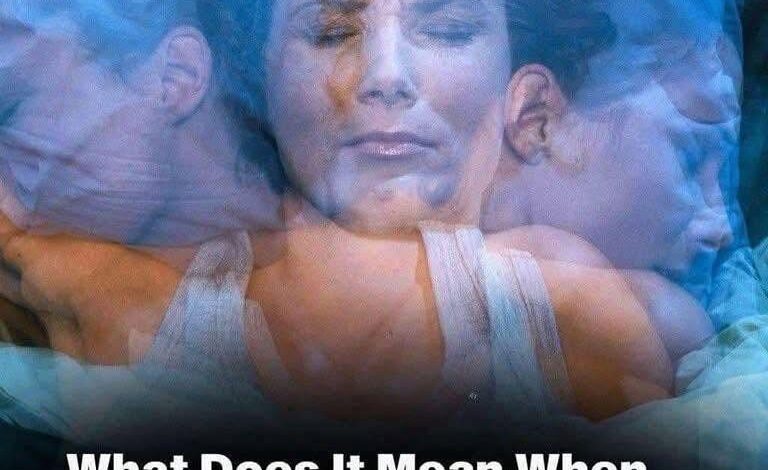
The Haunting Truth: When the Dead Visit You in Your Dreams, It’s Not Just a Coincidence
You wake up in a cold sweat, your heart pounding against your ribs, because they were just there—standing in your room, looking at you with eyes you haven’t seen in years. You know they are gone, yet the dream felt so visceral, so terrifyingly real, that you can almost still smell their perfume or hear their voice whispering your name. Is this just a random glitch in your brain’s REM cycle, or is something far more supernatural happening while you sleep? The mystery behind visiting spirits in dreams has plagued humanity for centuries, and the chilling answer might just change how you perceive reality forever.
Dreams have always been a subject of intense fascination, blurring the line between the physical world and the intangible realms of the mind. For some, they are merely the byproduct of neuronal firing—random electrical noise that the brain attempts to interpret as a narrative once we wake. For others, they are profound, spiritual portals. When we dream of a person who has passed away, the experience often carries a weight that transcends typical dreaming. It feels deliberate, heavy, and deeply significant, leaving us to wonder if we are being visited by a force we cannot comprehend while we are awake.
To understand these dreams, we must first look at the psychological landscape of the dreamer. Experts often categorize these occurrences into four primary types. The most common interpretation is that the brain is simply attempting to process the immense, complex pain of loss. Grief is not a linear experience; it is a sprawling, chaotic process that manifests in our subconscious long after we believe we have moved on. If there were unresolved issues, unspoken words, or lingering regrets before that person’s passing, the subconscious mind may use these dreams as a battlefield to resolve that guilt. These aren’t necessarily hauntings; they are internal reckonings, an attempt by the psyche to achieve a closure that was denied in reality.
However, some dream analysts suggest a different layer of meaning. If you see yourself displaying the same habits or personality traits that the deceased person was known for—especially negative ones, like addictive behaviors or specific temperaments—it may be a warning from your own mind. In this view, dreaming of the deceased is a metaphorical mirror, forcing you to confront those aspects of yourself that have become dormant or dangerous. It is a psychological intervention, a way for your inner self to draw a line between the past and your present identity.
Conversely, there are cultures and schools of thought that lean toward the metaphysical. In many indigenous traditions, such as those of the Aboriginal people of Australia, dreaming is not an accidental firing of neurons but an intrinsic, spiritual existence. In this context, dreaming of a deceased person is viewed as a genuine visitation. If you find yourself in a dream where the departed appear healthy, well-dressed, and radiating a sense of peace or happiness, it is often interpreted by practitioners as a sign that they are truly at rest and are reaching out to offer comfort—a spiritual “hello” from beyond the veil. The emotional residue left by these dreams is often the key to interpretation; if you wake up feeling a profound sense of peace rather than the terror of a nightmare, it is taken as a comforting presence rather than an intrusion.
Dr. Rubin Naiman, a noted expert in the psychology of sleep, suggests that the act of dream interpretation is fundamentally about expanding our awareness. He describes the process as a way of “decoding” the dream, pushing us toward a deeper understanding of our own consciousness. When we dream of the dead, we are essentially navigating the transition of our own lives. These dreams often surge during periods of immense change—a new career, a relocation to a new city, or the beginning of a significant relationship. They appear when our own world is in flux, serving as a psychological anchor that connects our current reality to our past roots.
Neuroscientists, however, often remain skeptical, favoring the “maintenance” theory. They suggest that during REM sleep, the brain is performing critical housekeeping tasks, clearing out old data and consolidating memories. In this process, the brain may accidentally “kick up dust,” shuffling through the visual and emotional archives of our past. In this interpretation, seeing a deceased loved one is effectively a random search result in your brain’s filing system. Yet, even if we accept this scientific explanation, it does not diminish the significance of the experience. A memory is not “meaningless” just because it was triggered by a mechanical process. If the dream forces you to reflect on your life, your grief, or your values, it has served a vital purpose.
The duality of the dream state—being both a biological necessity and potentially a spiritual gateway—is what makes these experiences so difficult to categorize. Whether you believe your dreams are visiting spirits or simply a manifestation of your subconscious working through trauma, the impact is undeniably real. They serve as a reminder of the connections we have forged with others and the indelible marks those people have left on our psyches. They provide a space to revisit the past, to make amends with our own reflection, and to navigate the complexities of our grief in a realm where time and physical barriers do not exist.
Ultimately, the meaning of these dreams is defined by you. If you wake up from a dream about a loved one who has passed away, pay close attention to the emotional aftermath. Did you feel a sense of relief? Did you wake up feeling like you were being urged to change something about your life? The dream itself is the canvas, but your life is the frame. By examining how these encounters make us feel and how they influence our waking state, we can gain insight into the deep, hidden parts of our souls. We may never have definitive proof of what happens when we close our eyes, but as long as these visits continue to offer insight, clarity, and comfort, they will remain one of the most powerful and meaningful experiences of the human condition. Embrace them not with fear, but with curiosity, for they are the bridges between who we were and who we are becoming.