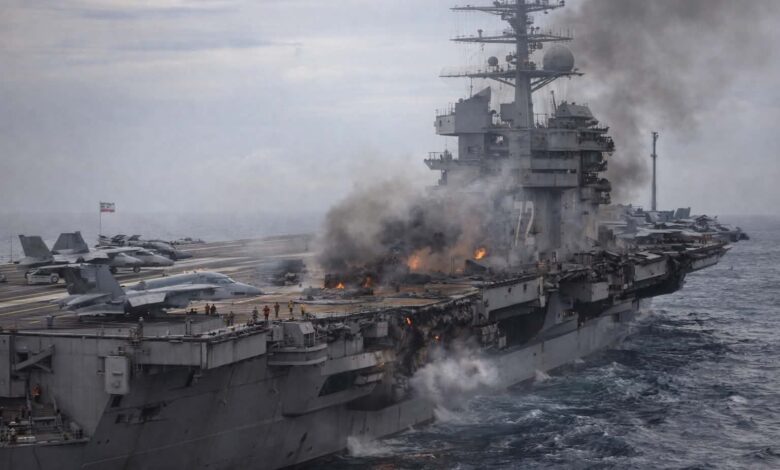
Tehran Claims Direct Strike on USS Abraham Lincoln as Regional Conflict Reaches Breaking Point
The waters of the Arabian Sea have become the epicenter of a terrifying geopolitical standoff following explosive claims from Tehran that a U.S. aircraft carrier was targeted in a retaliatory missile strike. As the sun rose over the Gulf, state-linked media in Iran began broadcasting reports of a “direct hit” on the USS Abraham Lincoln (CVN-72), one of the most formidable assets in the United States Navy’s global arsenal. While the Pentagon has moved swiftly to dismiss these assertions as a “dangerous fabrication,” the mere suggestion of a strike on a Nimitz-class carrier has sent shockwaves through international markets and elevated military alert levels to their highest point in decades.
The purported attack comes on the heels of Operation Epic Fury, a massive joint military campaign involving U.S. and Israeli forces aimed at neutralizing offensive capabilities within the region. According to official statements from the Iranian Revolutionary Guard Corps (IRGC), the launch of multiple ballistic missiles was a calculated response to what they described as “unprovoked aggression.” Iranian officials framed the operation as a demonstration of their “forbidden” missile technology, claiming that the sheer volume of the barrage forced the massive carrier to retreat from its station near the strategic Strait of Hormuz.
However, the narrative from Washington tells a vastly different story. U.S. Central Command (CENTCOM) issued a terse but firm rebuttal, stating that the USS Abraham Lincoln remains “fully operational and unaffected.” According to defense officials, any missiles launched toward the carrier strike group either failed mid-flight or “didn’t even come close” to their target. To reinforce this point, the Navy released footage of F/A-18E Super Hornets continuing routine flight operations from the Lincoln’s deck, a move designed to project strength and stability in the face of what the U.S. administration has labeled “AI-generated disinformation.”
The stakes of this maritime confrontation cannot be overstated. The USS Abraham Lincoln is more than just a ship; it is a floating city and a symbol of American power, carrying dozens of advanced aircraft and thousands of personnel. Any confirmed damage to such a vessel would represent a historic escalation, potentially crossing a “red line” that could trigger a full-scale regional conflict. Even as a fragile ceasefire is discussed in diplomatic circles, the “fog of war” remains thick, with both sides utilizing media platforms to control the narrative of victory and resilience.
Beyond the immediate military implications, the uncertainty has sparked chaos in the global economy. Oil prices saw immediate volatility as traders weighed the risk of a total blockage of the Strait of Hormuz—the world’s most important oil transit chokepoint. Regional governments are currently holding emergency sessions, desperate to prevent a miscalculation that could turn the Gulf into a “graveyard of ships.”
As the USS Abraham Lincoln continues its patrol, the world remains on edge. Whether the Iranian claims are a desperate attempt at psychological warfare or a precursor to a more significant kinetic engagement remains to have its final chapter written. For now, the carrier remains a silent sentinel in a sea of rising tensions, and the international community is left to wonder how much longer the current standoff can hold before the situation reaches a point of no return. Stay tuned as we monitor this fluid and high-stakes development.