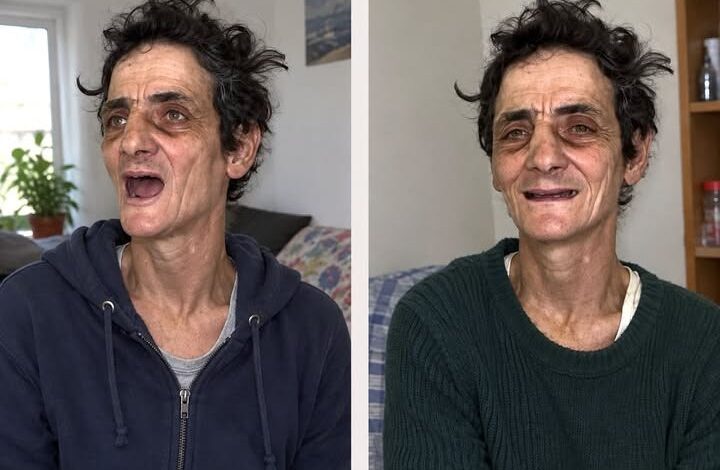
She Spent Years Living on the Streets — Then One Stranger Decided to See Her
For years, Rita lived in a world where people looked through her rather than at her.
She pushed a cart filled with empty bottles through the streets, collecting whatever she could find and turning it into enough money for the simplest necessities. A meal. A warm drink. A place to rest when she could find one.
Day after day, she repeated the same routine.
There were no guarantees.
Some days brought enough bottles to eat. Other days brought hunger. Cold nights followed long days on her feet, and loneliness became something she learned to carry without complaint.
People passed her constantly.
Some stared.
Some ignored her.
Most simply kept walking.
To them, she was another person struggling on the streets.
But Rita hadn’t always been there.
There had been a life before the cart, before the bottles, before the cold nights and the feeling of being invisible.
And there had been a son.
His death changed everything.
The grief was more than Rita could carry. After losing him, the future that had once seemed possible slowly disappeared. Her sense of purpose weakened, and without a strong support system to catch her, one loss became followed by another.
Eventually, she found herself homeless.
The world didn’t stop when Rita’s life fell apart.
The city continued moving.
Cars drove past. People went to work. Families went shopping. Friends met for coffee. Children played.
And Rita remained on the outside of it all.
She hadn’t stopped wanting a better life.
She simply didn’t know how to get back to one.
The Woman Behind the Cart
What people saw was an exhausted woman collecting bottles.
What they didn’t see was everything that had happened before that moment.
They didn’t see the mother who had loved her son.
They didn’t see the grief she carried.
They didn’t see the years of rejection or the countless times she had tried to find a way forward.
They saw worn clothing and a tired face.
And sometimes, that was enough for people to decide they already knew her story.
Rita’s appearance became another barrier.
Even when she was willing to work and rebuild her life, opportunities were difficult to find. Poverty creates problems that can reinforce one another: without money, it becomes harder to maintain health and appearance; without stable housing, it becomes harder to find employment; without employment, stable housing becomes even more difficult to achieve.
The cycle can become almost impossible to break alone.
Then someone stopped.
A Stranger Saw More Than a Homeless Woman
Makeup artist Shafag Novruz encountered Rita and saw something that others had overlooked.
She didn’t simply see a woman who needed a makeover.
She saw a person.
Before the makeup brushes came out, Shafag reportedly helped Rita receive dental care.
That detail mattered.
It wasn’t about lipstick or hairstyle.
It was about health.
It was about addressing something that had likely affected Rita’s confidence and well-being for years.
The message was simple:
You are worth taking care of.
Then came the smaller acts of restoration.
Her hands were cared for.
Her feet were cared for.
Her hair was washed, lightened, and styled.
None of these things could erase Rita’s past.
They couldn’t bring her son back.
They couldn’t undo years of homelessness.
They couldn’t magically solve poverty.
But they could do something else.
They could remind her that she still mattered.
The Mirror Became a Different Place
For someone who has spent years being ignored, looking in a mirror can become an uncomfortable experience.
Rita had become accustomed to seeing the evidence of her struggles reflected back at her.
Then, slowly, that image began to change.
Her hair was styled.
Her appearance was refreshed.
Her smile became more visible.
But the most striking change wasn’t something a makeup artist could create.
It was the expression on Rita’s face.
Her shoulders appeared lighter.
Her eyes seemed brighter.
She began to carry herself differently.
For perhaps the first time in years, the reflection looking back at her wasn’t simply a reminder of everything she had lost.
It showed her something else.
Possibility.
It Was Never Really About Makeup
The transformation attracted attention because it was visually dramatic.
But the deeper story was never about cosmetics.
Makeup can change someone’s appearance for an afternoon.
It cannot provide housing.
It cannot replace lost family members.
It cannot guarantee employment.
And it cannot repair years of grief.
What Shafag’s kindness offered Rita was something more fundamental: the experience of being treated as someone deserving of care.
That distinction matters.
A makeover can be temporary.
Dignity is not supposed to be.
The Power of Being Seen
Homelessness often creates a strange kind of invisibility.
A person can walk through a crowded city surrounded by thousands of people and still feel completely alone.
People may notice the poverty without noticing the person experiencing it.
They may see a sleeping bag without wondering who is inside it.
They may see someone asking for help without asking what happened before that moment.
They may see an old coat, a shopping cart, or a collection of empty bottles.
But behind those objects is a human being with memories, relationships, fears, talents, regrets, and hopes.
Rita’s story became powerful because someone stopped long enough to look beyond the surface.
A Second Chance Doesn’t Erase the First Life
Rita’s transformation didn’t mean her previous life suddenly became meaningless.
The years of struggle were part of her story.
So was the grief.
So was the loss of her son.
So were the nights spent wondering where her next meal would come from.
But surviving those years also revealed something that had been hidden beneath the exhaustion.
Rita had resilience.
She had continued moving even when there seemed to be nowhere to go.
She had continued collecting bottles.
She had continued searching for food.
She had continued waking up each morning.
That isn’t the kind of strength that makes headlines.
It is quiet strength.
The kind that exists simply because someone refuses to disappear completely.
What Her Story Really Reveals
Rita’s story eventually traveled far beyond the streets where she had spent so many years.
People were fascinated by the transformation they could see.
But the more important transformation happened underneath.
Someone had reminded Rita that she was still visible.
Still worthy.
Still capable of imagining something beyond survival.
Her story also raises an uncomfortable question about the way society treats people experiencing homelessness.
How many people are walking through our cities carrying stories that nobody has bothered to hear?
How many have talents they haven’t been able to use because poverty has closed every practical door?
How many have been reduced to their circumstances rather than remembered as people?
Rita’s life is a reminder that homelessness is not an identity.
It is a circumstance.
And circumstances can change.
Sometimes the first step is practical help.
Sometimes it is medical care.
Sometimes it is employment, housing, counseling, family support, or access to social services.
And sometimes, before any of those things can happen, someone simply needs to stop and treat a struggling person like a human being.
The Woman Who Hadn’t Really Disappeared
For years, Rita may have felt as though the world had forgotten her.
But she hadn’t disappeared.
She had been there the entire time, pushing her cart through the streets, carrying grief that few people could see and surviving circumstances that would have broken many others.
The makeover didn’t create a new Rita.
It revealed the person who had been there all along.
The woman beneath the worn clothes.
The mother beneath the grief.
The human being beneath the label.
And perhaps that’s the most meaningful part of her story.
Sometimes transformation isn’t about becoming someone else.
Sometimes it’s about finally being given the chance to see yourself again.
Rita spent years surviving one day at a time.
Then someone stopped.
Someone looked past the bottles, past the worn clothing, past the assumptions.
Someone saw Rita.
And for the first time in a long time, Rita was given an opportunity to see herself, too—not as the woman the world had overlooked, but as someone who still had a future.