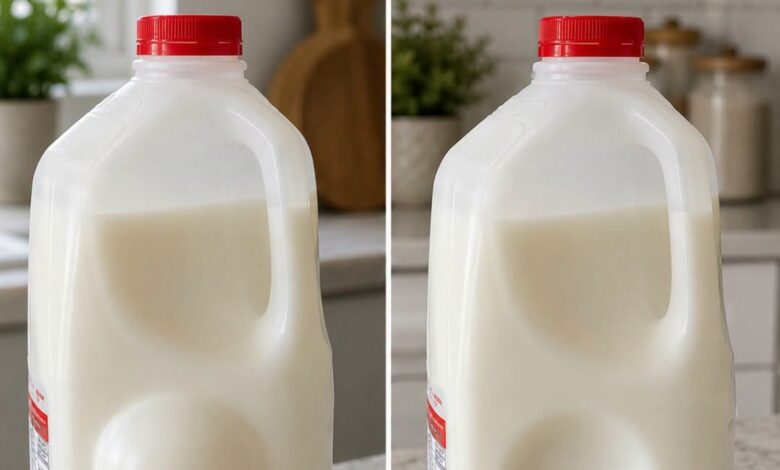
Purpose of the Circular Dent on Milk Jugs
A small circular indentation on the side of a plastic milk jug may look like a meaningless detail, but it is actually part of the container’s engineering. The recessed circle is designed to help the jug cope with pressure, movement, and changes in temperature while using as little plastic as possible. It performs several practical jobs from the time the milk is packaged until the container reaches a refrigerator.
Milk does not remain at one perfectly constant temperature during its journey. It is chilled at the dairy, moved through warehouses, transported in trucks, placed in store coolers, carried home, and repeatedly taken out of the refrigerator. As the liquid and the air inside the jug become slightly warmer or colder, their volume changes. Those changes can create stress inside a container whose walls are intentionally thin and lightweight.
The circular dent gives that pressure somewhere to go. Because the recessed section is more flexible than a broad, completely flat wall, it can move inward or outward as conditions change. Instead of forcing the entire jug to bulge, crack, or split, the shaped area absorbs part of the stress. It acts as a controlled flexible zone that lets the package adjust without losing its basic shape.
This same flexibility is useful when milk jugs are handled during shipping. Containers are packed closely together, stacked, moved along conveyor systems, placed into crates, and loaded onto delivery vehicles. Even careful handling can involve bumps, vibrations, or an occasional drop. A rigid container might transfer the full force of an impact directly through its sidewall. The circular indentation helps spread that force across a wider area and gives the wall a little room to flex.
That may seem like a minor advantage, but it can prevent leaks and large amounts of waste. A split jug can damage other products around it, create a difficult cleanup, and force a store or distributor to discard more than one item. A small structural feature that reduces the chance of failure therefore matters throughout the supply chain, not only in a customer’s kitchen.
The indentation also strengthens the jug without requiring manufacturers to make the entire container thicker. A completely flat sheet of plastic can bend easily, while a molded curve or recessed shape adds stiffness. The principle is similar to the way folds, arches, and ridges give strength to structures made from relatively thin material. By shaping the wall strategically, designers can make the container more stable while limiting the amount of plastic needed to produce it.
Using less material reduces the jug’s weight and lowers the amount of plastic involved in manufacturing and transport. When the design is repeated across millions of containers, even a modest reduction per jug can become significant. The circular feature is therefore not simply decorative. It helps balance durability, cost, efficiency, and material use.
The dent can sometimes provide another clue about what is happening inside the jug. If milk spoils, bacterial activity may produce gas. As gas builds up, pressure inside the sealed container can increase and may push the recessed circle outward. A circle that has noticeably popped out can be a warning that the jug has experienced unusual internal pressure.
However, the shape should not be treated as the only test of whether milk is safe to drink. A dent can move because of temperature, handling, freezing, or other physical conditions, and spoiled milk will not always cause an obvious change in the container. The date on the package, proper refrigeration, smell, appearance, and the condition of the seal all remain important. When there is doubt about a dairy product’s safety, it is better to be cautious.
The feature is especially clever because it completes all these tasks without requiring a separate part. There is no valve to attach, no additional mechanism to maintain, and nothing for the customer to operate. The function is created during molding as part of the jug itself. Once formed, the circle continues working passively throughout filling, shipping, storage, and everyday use.
So the next time a gallon of milk is taken from the refrigerator, the circle on its side deserves a second look. That quiet indentation helps the jug adjust to pressure, endure ordinary impacts, hold its shape with less plastic, and sometimes reveal that conditions inside have changed. What appears to be an accidental dimple is actually a compact example of thoughtful packaging design.