Our Neighbor Stole My 13 Year Old Grandsons 180 Basketball Hoop So I Built Him a New One Right Across From the School
“It’s still there,” he said. “The dent.”
“Yeah,” Vernon said. “It is.”
“Are you going to get it fixed?”
Vernon looked at the dent for a long time. Then he did something I didn’t expect. He almost smiled.
“No,” he said. “I think I’ll leave it.”
Brody looked up at him, confused.
“Your grandpa poured a slab four feet deep,” Vernon said, nodding at my yard. “Below the frost line. Lars Engebretson told me about it at the Cenex. Said Arne Bjornson dug that hole by hand and set those anchor bolts like he was building a grain bin.” He looked over at me. “Said he did it so it’d still be standing when you’re forty.”
He looked back down at Brody.
“I’ve been driving around this town for six years,” Vernon said, “trying to keep everything the way it was. My truck. My house. Not a scratch on anything.” He put his gloved hand flat on the tailgate, right over the dent. “And there’s nothing underneath any of it. Nothing below the frost line. I just kept it shiny.”
He tapped the dent with one finger.
“I’m going to leave this right where it is,” he said. “So I remember.”
Brody didn’t say anything. He looked at the dent. Then he looked at Vernon.
“Mr. Pask,” he said. “Do you want to shoot?”
Vernon stared at him.
“I haven’t shot a basketball in thirty years,” he said.
“That’s okay,” Brody said. “My grandpa’s terrible too.”
So Vernon Pask took off his good Carhartt jacket and laid it on the tailgate of his blue Chevy pickup. He walked up my front yard in his work boots and his flannel shirt, onto the ten-by-ten slab of four-thousand-PSI concrete I’d poured on Wednesday, under the black-and-white backboard.
Brody handed him my old flat Wilson.
Vernon held it in both hands for a long moment, turning it over. Then he squared up at the free throw line, bent his knees, and shot.
It missed. Badly. It hit the side of the backboard and bounced off into Marlys’s old flower bed.
Brody burst out laughing. So did I. And after a second, so did Vernon. A big, rusty laugh, like something that hadn’t been opened in a long time.
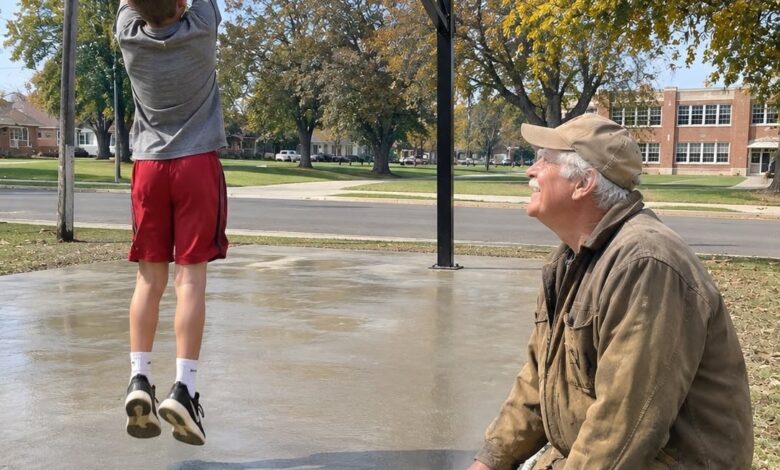
We shot until noon, the three of us. A thirteen-year-old boy, a retired grain elevator manager, and a retired road grader operator, on a slab in a front yard across the street from Harlan Middle School, in the bright cold October sun.
Vernon wasn’t any good. Neither was I. Brody spent most of the morning teaching us. Elbow in. Bend your knees. Follow through like you’re reaching into a cookie jar on a high shelf. Mr. Haldorson’s words, coming out of my grandson’s mouth.
“Tanner used to say that,” he said quietly. “The cookie jar thing. His coach told him that.”
That afternoon, we put Brody’s hoop back up at the end of Kirsten’s driveway on Elm Street. Vernon carried the bag of sand from his truck. I poured. Brody held the funnel. We filled the base to the top so it’d never tip over in a prairie wind.
Then Vernon did something else. He went into his garage and came out pushing his big rolling toolbox. He got down on his hands and knees on Kirsten’s driveway and adjusted the hoop’s base and backboard, so the rim faced slightly away from his driveway. Toward the street instead. Toward the empty lot on the other side, where a stray rebound would land in the grass.
“There,” he said, standing up with a grunt. “Now you can’t hit my truck if you try.”
Then he walked over and opened his own garage door. He backed his blue Silverado out of the driveway and pulled it into the garage. He closed the door.
“I’ll park it in here from now on,” he said. “Should’ve been doing that anyway. Linda always said so.”
Kirsten came home from her double at the nursing home at 9:30 that night. She found Brody at the end of the driveway, shooting free throws under the streetlight, with his hoop back where it belonged.
And beside him, in a lawn chair at the edge of the driveway with a cup of coffee, was Vernon Pask. Rebounding.
She stood at the end of the driveway in her scrubs. Then she called me.
“Dad,” she said. “What did you do?”
“I poured some concrete,” I said.
It snowed the second week of November, eight inches overnight. The first big storm of the winter, coming down out of North Dakota on a wind that drifted it four feet deep against the north side of every house in Harlan.
I got up at six to shovel the slab. By the time I got my boots on and came out the front door, somebody had already cleared it. Down to the bare concrete, swept clean, with the snow piled neatly along the edges. The walk to my front step was cleared too, and the sidewalk along Third Street, all the way to the corner.
There were tire tracks in my driveway. A snowblower’s.
Vernon Pask has a big Ariens two-stage snowblower, the kind with headlights. I heard it once in December at five-thirty in the morning, coming down Third Street in the dark.
He never mentioned it. I never thanked him. But every time it snowed that winter, my slab was clear by six.
The kids shot all winter. Not every day. Some days it was ten below with a wind chill of thirty-five below, and even thirteen-year-old boys know better. But on the days when the sun came out and the temperature got up into the twenties, they’d be out there after school in their winter coats and stocking caps and mittens with the fingers cut off, shooting.
I kept a thermos of hot chocolate on the front step. And a plate of Marlys’s oatmeal butterscotch cookies, which I’d learned to bake from her old recipe card.
Two days before Christmas, a car I didn’t recognize pulled up in front of Vernon’s house on Elm Street. A silver rental car with Colorado plates.
Kirsten called me. “Dad,” she said. “I think Vernon’s son is here.”
I found out later what happened.
In November, Vernon had driven to Denver. Fourteen hours, by himself, in his blue Silverado, with the dent the size of a quarter on the tailgate. He didn’t call first. He just showed up at Tanner’s apartment on a Tuesday evening and knocked on the door.
Tanner opened it. He stood there in the doorway staring at his father.
Vernon didn’t say much. He told me later he’d practiced it the whole fourteen hours and still couldn’t get it right. He just said, “I’m sorry I took your hoop down.” And then he cried, standing in the hallway of an apartment building in Denver in his Carhartt jacket.
They talked until three in the morning. Vernon stayed two days.
Tanner came home for Christmas.
On Christmas Eve, at two in the afternoon, I was in my kitchen making a batch of lefse when I heard a sound out front.
Thump. Thump. Clang.
I looked out the window.
Vernon was standing on my slab in his Carhartt jacket and stocking cap. Beside him was a tall man in his thirties in a Denver Broncos jacket, with Vernon’s jaw and Vernon’s big shoulders. And Brody, in his hoodie and his winter coat, holding a basketball.
Brody was showing Tanner something. His elbow. Elbow in. Bend your knees.
Tanner laughed. He took the ball. He squared up. And he shot.
It went in. Nothing but net.
Vernon stood under the hoop and watched his son’s shot drop through, and then he looked over toward my front window. He saw me standing there with flour on my hands.
He lifted one gloved hand and waved.
I waved back.
In the spring, Vernon came by my house on a Sunday morning in April. He’d just washed the truck. He did it in his own driveway now, the way he always had, but he did it on Saturday afternoons instead of Sunday mornings, so he could go to church with Brody and Kirsten and me.
He was holding something. A small square of paper. He held it out.
It was a photograph. Him and Tanner and Brody on my slab on Christmas Eve, in front of the black-and-white backboard. Kirsten had taken it on her phone and printed it out at the Walgreens in Brookings.
On the back, Vernon had written something in pencil, in his blocky road-crew handwriting.
Below the frost line.
“I’m putting a copy in the glove box,” he said. “Next to the registration.”
The dent’s still there on the tailgate of his blue 2004 Silverado. The size of a quarter, just above the bumper. He’s had a dozen people at the Cenex tell him they know a guy in Brookings who could pop it out for fifty bucks.
He always says no.
“That dent,” he tells them, “is the best thing that ever happened to this truck.”
They think he’s crazy. He doesn’t care.
Brody’s fourteen now. He made the eighth-grade A team this winter. He’s still terrible at defense, and Mr. Haldorson says he dribbles like he’s chasing a chicken. But he’s the best free-throw shooter on the team. Eighty-one percent. His elbow’s always in.
He mows lawns again this summer. Mrs. Engebretson’s, the parsonage, the Kjelstad sisters. And Vernon Pask’s. Vernon insisted on paying him twelve dollars, even though he’s not a widow.
Brody gave Vernon back the twenty dollars. Vernon tried to give it back. They’ve been passing it back and forth for six months now, sneaking it into each other’s coat pockets, under each other’s windshield wipers, into the mailbox. Last I heard, it was taped inside the lid of Vernon’s toolbox.
The slab is still out there in my front yard across the street from Harlan Middle School, with the pole and the black-and-white backboard. Kids come after school almost every day. Sometimes twenty of them. I keep the cookies coming.
People ask me sometimes why I went to all that trouble. A four-foot footing, rebar, four-thousand-PSI concrete, anchor bolts, a six-hundred-and-forty-dollar hoop, for a thirteen-year-old whose hoop got taken.
They say I should have just called the sheriff. Gotten the hoop back the easy way, in an afternoon.
Here’s what I tell them.
Concrete takes twenty-eight days to reach its full strength. You can’t rush it. You pour it, and you cover it, and you keep it wet, and you wait. You check it every morning, and every morning, the answer is not yet.
Most things that last are like that. You can’t make them strong by being angry. You can’t make them strong by taking things away from people, or by locking things in a garage, or by keeping everything shiny on the outside. You have to dig down below the frost line, where the ground doesn’t heave in the winter. Then you pour something solid, and you set your anchors straight, and you wait for it to cure.
Vernon Pask figured that out. It took him a dented tailgate and a thirteen-year-old’s note and a fourteen-hour drive to Denver, but he figured it out.
Last Saturday morning, Brody was out on the slab at 7:45, shooting free throws before his summer mowing route. I was rebounding, the way I always do.
At eight o’clock sharp, a blue 2004 Chevy Silverado came down Third Street. It slowed down in front of my yard.
This time, it pulled up at the curb and stopped. Vernon got out in his Carhartt jacket with a cup of coffee from the Cenex in each hand. He walked up the yard and handed one to me. Then he set his own on my front step and held out his hands for the ball.
Brody passed it to him.
Vernon squared up at the line. Elbow in. Knees bent. Follow-through like he was reaching for a cookie jar on a high shelf.
It went in.
He didn’t holler. He just looked over at Brody, and then at me, and grinned. Then he went and got the ball and shot again.