My Stepmom Refused to Give Me Money for a Prom Dress – My Brother Sewed One from Our Late Mom’s Jeans Collection, and What Happened Next Made Her Jaw Drop
I was seventeen the year my little brother made me a prom dress out of our late mother’s jeans, and by the end of that night, the whole school knew exactly what kind of woman my stepmother was.
My brother Noah was fifteen. He had always been quiet in the way people mistake for softness, but there was steel in him when it mattered.
Our mom died when I was twelve. Dad remarried Carla two years later, and when he died of a heart attack last year, the house changed faster than grief could settle. Carla took over everything at once—the bills, the mail, the bank accounts, the locks on the filing cabinet, the tone of every room.
Mom had left money behind for Noah and me. Dad used to call it our “important-things fund.” College. Emergencies. Milestones. The kind of moments parents save for because they want their kids to feel protected, even if they aren’t there to see it.
Apparently Carla had her own definition of important.
When I brought up prom, she was in the kitchen scrolling through her phone like the rest of us were background noise.
“Prom is in three weeks,” I said. “I need a dress.”
She didn’t even look up at first. “Prom dresses are a ridiculous waste of money.”
“Mom left money for things like this.”
That made her glance at me. Not kindly. Just enough to let me know she’d heard me and planned to hurt me with it.
“That money keeps this house running now.”
I stood there, trying to keep my voice even. “Dad said it was ours.”
She laughed then, one of those tiny cutting laughs that somehow hurts worse than yelling.
“And honestly?” she said. “No one wants to see you prancing around in some overpriced princess costume.”
I felt the words hit like a slap.
“So there is money,” I said. “You’re just not letting me use it.”
Her chair scraped back against the floor. “Watch your tone.”
“You’re using our money.”
Her face went flat in a way that always meant danger.
“I am keeping this family afloat,” she said. “You have no idea what things cost.”
“Then why did Dad say the money was ours?”
“Because your father,” she snapped, “was bad with money and bad with boundaries.”
I went upstairs and cried into my pillow like I was twelve again and the world had just cracked open.
Two nights later, Noah came into my room carrying a stack of old denim.
I looked up and froze.
Mom’s jeans.
Not just one pair. Several. Folded carefully in his arms like something sacred.
He set them down on my bed and asked, “Do you trust me?”
“With what?”
He nodded toward the denim. “I took sewing last year, remember?”
I stared at him. Then at the jeans. Then back at him.
“What are you talking about?”
He hesitated, suddenly looking much younger than fifteen. “I think I can make you a dress.”
I blinked.
“You can make a dress?”
He panicked instantly. “I mean, maybe not, maybe it’ll be terrible, and if you hate the idea that’s fine, I just thought—”
I grabbed his wrist before he could finish.
“No,” I said. “I love the idea.”
So that’s what we did.
We worked in secret whenever Carla went out or locked herself in her room with the television too loud. Noah dug Mom’s old sewing machine out of the laundry closet and set it up on the kitchen table like he was preparing for surgery.
The whole thing felt fragile and impossible at first.
But then it didn’t.
It felt like Mom was there with us somehow—in the faded denim, in the careful way Noah handled every piece, in the hush that settled over the kitchen while the machine buzzed and stitched.
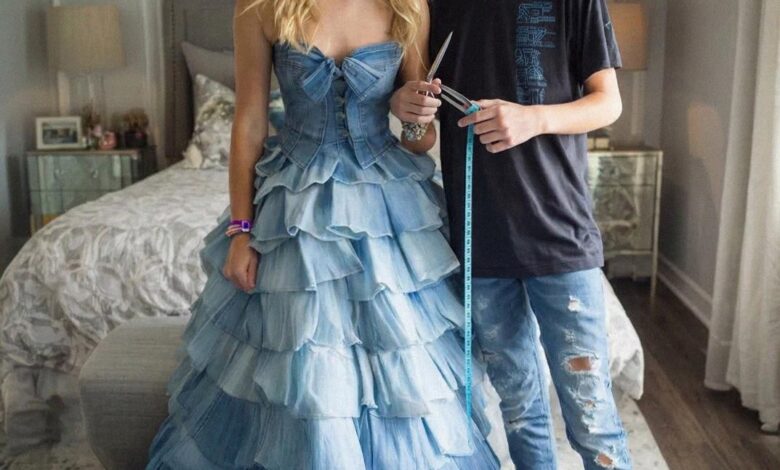
He worked with a kind of concentration that made me stop breathing sometimes. He used the different shades of blue like they were deliberate brushstrokes. He kept pockets in places that made the skirt feel alive. He turned seams into structure, old wear into beauty.
When he finished, the dress was fitted through the waist and opened into a flowing skirt made of panels in different washes of denim. It looked modern and sharp and unlike anything I’d ever seen.
I touched one of the faded pieces and whispered, “You made this.”
He shrugged like it was nothing, but his ears turned red.
The next morning, Carla saw it hanging on my bedroom door.
She stopped in the hallway. Walked closer.
For one second, I thought maybe even she would have enough decency to recognize what it was.
Then she laughed.
Not because she was surprised. Because she was delighted.
“Please tell me you are not serious.”
I stepped into the hall. “That’s my prom dress.”
She laughed harder. “That patchwork mess?”
Noah came out of his room right away, like he had heard the exact tone in her voice and knew what was happening.
“I’m wearing it,” I said.
Carla looked between us, smiling with that slow mean smile people use when they’ve found the weak spot.
“If you wear that,” she said, “the whole school will laugh at you.”
Noah went rigid beside me.
“It’s fine,” I said quietly.
“No, actually, it isn’t.” She waved at the dress. “It looks pathetic.”
Noah’s face turned bright red. “I made it.”
That seemed to please her even more.
“You made it?” she asked sweetly. “That explains a lot.”
I took a step forward. “Enough.”
She ignored me.
“Oh, this should be fun,” she said. “You’re going to show up to prom in a dress made out of old jeans like some kind of charity project, and you think people are going to clap?”
I looked at her and said, very quietly, “I’d rather wear something made with love than something bought by stealing from kids.”
The hallway went silent.
Her face changed.
“Get out of my sight,” she said, “before I really say what I think.”
I wore the dress anyway.
Noah helped zip me into it that night, his hands shaking the whole time.
I turned to look at him.
“Hey,” I said.
“What?”
“If one person laughs, I am haunting them.”
That got a small smile out of him.
“Good,” he said. “They should be afraid.”
Carla had announced earlier that she wanted to “see the disaster in person.” I overheard her on the phone telling someone, “Come early. I need witnesses for this.”
She thought she was attending my humiliation.
What happened instead was better than anything I could have planned.
At prom check-in, people stared at the dress.
But not the way Carla expected.
One girl from choir came up first. “Wait,” she said, eyes wide. “Your dress is denim?”
Another girl touched her own chest and said, “Where did you get that?”
A teacher leaned in for a better look. “This is beautiful.”
I was still braced for the laughter, still waiting for the room to turn cruel. I didn’t trust it yet. Carla was standing toward the back with her phone already raised, watching me too closely, like she was waiting for the exact second it all fell apart.
But it didn’t.
As the night went on, more people asked about the dress. The stitching. The shape. The way the old denim had been transformed into something unforgettable.
Then came the student showcase portion of the evening, when the principal stepped onto the stage for the usual announcements. Thanking teachers. Reminding us to be safe. Smiling that practiced school-event smile.
And then everything changed.
His gaze shifted over the room and stopped near the back.
Near Carla.
He lowered the microphone slightly and said, “Can someone zoom the camera toward the back row? Toward that woman there?”
The projection screen lit up with Carla’s face.
At first she smiled. She actually thought this was some kind of cute parent moment.
Then the principal said, slowly, “I know you.”
The room went still.
Carla gave a nervous laugh. “I’m sorry?”
He stepped off the stage, still holding the microphone, and moved closer.
“You’re Carla,” he said.
She straightened. “Yes. And I think this is inappropriate.”
He ignored that completely.
He looked at me. Then at Noah, who had come with Tessa’s mom and was standing near the wall. Then back at Carla.
“I knew their mother,” he said. “Very well.”
My skin went cold.
He continued, voice calm and clear enough for the whole room to hear.
“She volunteered here. Raised money here. Talked constantly about her children. And she made it very clear, more than once, that the money she set aside was for their futures and their milestones.”
Carla’s face drained.
“This is not your business,” she snapped.
“It became my business,” he said, “when I learned one of my students nearly skipped prom because she was told there was no money for a dress.”
A murmur rolled through the room.
Then he pointed toward me.
“And then I heard that her younger brother made one by hand from their late mother’s jeans.”
Now everyone was staring openly.
Carla tried to recover. “You’re taking gossip and turning it into theater.”
“No,” he said evenly. “I’m saying that mocking a child over a dress made from her mother’s clothing would already be cruel. Doing it while controlling money meant for those children is worse.”
Then a man stepped forward from the side aisle.
I recognized him vaguely from Dad’s funeral.
He took the spare mic a teacher handed him and introduced himself as the attorney who had handled Mom’s estate.
Carla spun toward him so fast I thought she might fall.
He didn’t raise his voice. He didn’t need to.
He explained that he had been trying for months to get responses regarding the trust left for Noah and me and had received nothing but delays. He said he had become concerned enough to contact the school himself.
Carla hissed, “This is harassment.”
He answered, “No. This is documentation.”
My legs were shaking by then. Tessa squeezed my hand so hard it hurt.
And then the principal looked at me and said, gently, “Would you come up here?”
I don’t remember crossing the floor. I remember the lights feeling too bright and the room blurring at the edges.
When I got to the stage, he smiled at me in a completely different way than he had looked at Carla.
“Tell everyone who made your dress.”
I swallowed hard.
“My brother,” I said.
He nodded. “Noah, come here too.”
Noah looked like he wanted the ground to split open and save him, but he came.
The principal turned toward the crowd and gestured to the dress.
“This,” he said, “is talent. This is care. This is love.”
For one breathless second, the room stayed silent.
Then people started clapping.
Not polite applause. Not pity.
Real applause.
Loud, fast, rising.
An art teacher near the front called out, “Young man, you have a gift!”
Someone else shouted, “That dress is incredible!”
Noah froze beside me. I looked into the crowd and saw Carla still holding her phone, except now it was useless. She wasn’t recording my humiliation.
She was standing in the middle of her own.
And then, because cruelty is reckless when cornered, she made one last mistake.
She yelled, “Everything in that house belongs to me, anyway.”
The room went dead.
The attorney answered before anyone else could.
“No,” he said. “It does not.”
I barely remember the rest of the dance. I remember crying. I remember Noah standing next to me. I remember teachers touching my arm and saying kind things. I remember Carla disappearing before the final song.
When we got home, she was waiting in the kitchen.
Her face was sharp with rage.
“You think you won?” she snapped the second we walked in. “You made me look like a monster.”
I stared at her. “You did that yourself.”
Then she turned on Noah.
“And you,” she said. “Little sneaky freak with your sewing project.”
Noah flinched.
Then, for the first time since Dad died, he didn’t go quiet.
He stepped in front of me and said, “Don’t call me that.”
She laughed. “Or what?”
His voice shook, but he didn’t stop.
“Or nothing,” he said. “That’s the point. You always do this because you think nobody will stop you.”
She opened her mouth, but he talked right over her.
“You mocked everything. You mocked Mom. You mocked Dad. You mocked me for sewing. You mocked her for wanting one normal night. You take and take and then act offended when anyone notices.”
I had never heard him talk like that.
Carla looked at me. “Are you going to let him speak to me this way?”
“Yes,” I said.
Then someone knocked on the door.
It was the attorney. And Tessa’s mom.
They had come straight from the school.
The attorney stepped inside and said, “Given tonight’s statements, and the concerns already on record, these children will not be left alone without support while the court reviews the guardianship and the funds.”
Carla just stared at him.
Tessa’s mom walked past her like she was a coat rack and looked at us.
“Go pack a bag,” she said.
So we did.
Three weeks later, Noah and I moved in with our aunt.
Two months after that, control of the money was taken away from Carla.
She fought it.
She lost.
And Noah?
One of the teachers had sent photos of the dress to a local arts director. That led to an invitation to a summer design program. He acted annoyed about it for a full day before I caught him smiling at the acceptance email when he thought nobody was looking.
The dress is still hanging in my closet.
Sometimes I touch the seams. The pockets. The faded pieces of denim that used to belong to Mom and now belong to one of the bravest nights of my life.
Carla wanted everyone to laugh when they saw what I was wearing.
Instead, it was the first time people really saw us.