My Stepdad Married My Late Moms Best Friend a Month After Her Death – Then I Found Out the Truth!
The house still smelled like my mother.
Not in the abstract way people mean when they talk about grief—like a metaphor you can set down when it gets heavy. I mean literally. Her rosemary oil lingered in the hallway. Her hand lotion still sat by the sink, cap half-screwed because she never bothered to tighten it. Her reading glasses were on the coffee table beside a bookmark she’d never use again. The crocheted blanket she worked on during chemo was folded over the back of her chair, waiting for shoulders that were already gone. Even her slippers stayed in their place by the bed, toes pointed toward the closet like she might come back in a minute and slide into them.
Cancer took her in slow, humiliating installments over eight months. First her energy. Then her hair. Then her appetite. Then her ability to pretend she wasn’t afraid. Some days she rallied and made jokes that sounded like her old self. Other days she stared out the window like she was listening for instructions from a world I couldn’t enter. Near the end, she apologized constantly—for being tired, for needing help, for breathing too loudly, for taking up space in a body that had turned against her.
I would hold her hand and tell her to stop. Tell her she didn’t owe me anything. Tell her she was allowed to be sick without performing bravery like it was a job. She’d nod and then apologize again ten minutes later, as if sorry was the only language she trusted.
Paul, my stepfather, was there through it all—or at least he was physically present. He drove her to some appointments. He carried the “good husband” image like a badge: serious face, practiced sigh, the kind of grief that looked respectable from a distance. And then there was Linda, my mother’s best friend since college. Linda was always around. Too around. She brought casseroles that nobody ate. She organized hospital “shifts” like we were running a campaign. She hugged me at the exact moments cameras would’ve captured it.
“We’re a team,” Linda used to say, squeezing my shoulder with those perfectly manicured fingers. “Your mom isn’t doing this alone.”
I believed her, because I needed to.
After my mother died, the silence in the house changed texture. It wasn’t quiet the way a peaceful home is quiet. It was quiet like a room after a fire—still, but scorched. Four weeks after the funeral, Paul knocked on my apartment door. He stood there with that expression people wear when they’ve decided something and want you to absorb the blast so they don’t have to.
We didn’t sit. We stood in my tiny kitchen while the coffeemaker gurgled like it was trying to fill the space with anything other than what was coming.
“There’s something I need to tell you,” he said. “Before you hear it somewhere else.”
My chest tightened. “What’s wrong?”
He ran a hand through his hair. “Linda and I are getting married.”
For a second, my brain refused to assign meaning to the words, like it had detected a glitch and shut down.
“Married?” I repeated.
“Yes.”
“To each other?”
“Yes.”
“My mother died twenty-eight days ago.”
“I know this feels sudden—”
“Sudden?” The word came out sharp enough to cut. “She was her best friend. You were her husband.”
He blinked, annoyed, and corrected me like I’d made a factual error. “Was.”
Something inside me went cold and flat. I pointed at the door. “Get out.”
Paul tried to speak, but I didn’t listen. I watched him leave, then stood there shaking while the coffeemaker beeped as if the world still cared about morning routines.
They married four days later.
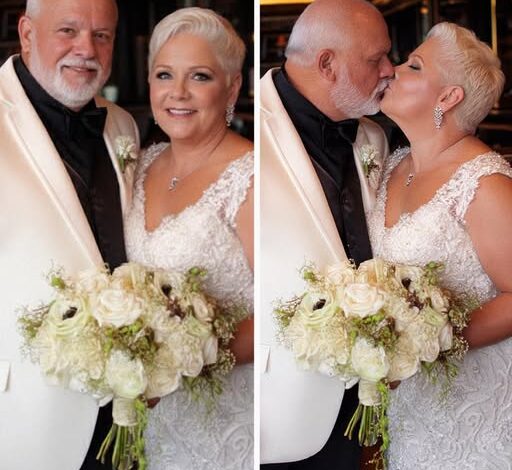
The photos were online within hours: perfect lighting, champagne flutes, a lace dress, captions about healing and new beginnings. They looked like a couple in a bridal magazine, not two people stepping over a fresh grave. The flowers were peonies.
My mother’s favorite.
That detail hit me like a slap, because it wasn’t just careless. It was a choice. It was theft dressed up as romance.
And then I remembered the necklace.
My mother’s gold necklace—heavy, warm against the skin, tiny diamonds set along the clasp. She wore it every holiday. Every family photo. It was the one piece of jewelry she never took off unless she was sleeping. When I was little, she let me hold it and I’d marvel at the weight, like it was proof she belonged to something solid and good.
“One day,” she’d told me, “this will be yours.”
I called Paul.
“Where’s Mom’s necklace?” I asked.
A pause too long to be innocent.
“The gold one,” I said, voice tightening. “Where is it?”
“We had to make decisions about the estate,” he said carefully, like he was reading from a script.
“Did you sell it?”
Silence again.
“You pawned my mother’s necklace?”
“We needed funds for the honeymoon,” he said, and there it was—the casual selfishness, the entitlement. “It was just sitting in a drawer.”
“Does it matter now?” he added, as if he were bored by my grief.
I hung up without another word.
Two days later, I ran into Linda outside the grocery store. She stood near the cart return, sunglasses perched on her head, looking tan already, like grief had never touched her.
“Was it worth it?” I asked. “Selling her necklace?”
Linda laughed. Not a nervous laugh. A real one, like I’d told a joke.
“Oh, that old thing?” she said. “We needed Maui money. Sentimentality doesn’t pay for honeymoons. Grow up.”
Then she checked her watch. “We leave in two hours.”
That’s when Sara touched my arm.
I recognized her from the hospital. She was one of the nurses who had been quiet at the funeral, standing in the back like she didn’t know if she was allowed to exist in our story.
“I didn’t know if I should tell you,” she said. Her voice was careful. “But it doesn’t feel right staying silent.”
We sat in my car, the grocery bags forgotten, and she told me everything.
The hand-holding in the parking lot when they thought nobody was watching. The kisses. The way Linda would slip into the hallway outside my mother’s room and whisper, too close to Paul, too familiar. The jokes, the complaints about how long appointments took. The conversations Sara overheard—plans for trips “once things were settled,” laughter about how much longer they’d have to pretend.
While my mother slept under medication, believing she was surrounded by love, they were rehearsing life without her, right outside her door.
My stomach didn’t flip. My heart didn’t race. It was worse than that.
Everything went calm.
Not peaceful. Surgical.
I didn’t scream. I didn’t drive to their house and throw something through a window. I didn’t beg for explanations I didn’t want.
I called Paul.
“I owe you an apology,” I said, voice steady. “Grief made me irrational.”
He exhaled like he’d been waiting for my surrender. “Your mother would’ve wanted peace.”
“She would,” I said. “I want to bring you a wedding gift when you’re back.”
They agreed instantly, because people like them always think they’ve won when you stop shouting.
While they sipped cocktails on a beach, I drove to the house. I still had a spare key—my mother had given it to me years earlier and told me to never lose it. Paul’s laptop sat on the desk, no password, because he’d never had to be careful. He’d never considered that consequences might have hands.
I didn’t do anything dramatic. I did something effective.
I searched email archives. I downloaded messages. I photographed receipts. I found the pawn documentation. Linda’s signature was right there, neat and confident. I pulled bank records that showed transfers made during the last months of my mother’s illness, money moved with suspicious timing. I printed everything and built a binder that told the truth the way a courtroom prefers it: organized, labeled, dated.
A week later, they returned, sunburned and smug, as if the world owed them congratulations.
I stood in their living room holding a gift bag.
Linda reached for it first, smiling like she expected jewelry.
Inside was the binder.
Paul’s smile slipped as he opened it. Linda’s face tightened when she saw the pawn receipt.
On top was a note:
Copies have been sent to the estate attorney, the executor, and Paul’s employer. I believe in transparency. Don’t you?
For a few seconds, nobody spoke. The only sound was the faint hum of their expensive refrigerator, packed with food my mother used to buy and they probably didn’t even notice.
Paul’s mouth moved like he was trying to form a defense, but there wasn’t one. There was only what they had done and what I had documented.
The fallout didn’t take long.
The estate was frozen pending review. The necklace was recovered and returned to me. Paul’s company opened an internal investigation after learning he’d used work hours and work resources while his wife was dying to plan an affair and a “new life.” Linda’s social circle, so loyal when it was just gossip, went cold when it smelled like scandal with receipts.
They didn’t just lose money.
They lost the narrative that kept them comfortable—that they were two grieving souls who “found love” in darkness.
They were exposed for what they actually were: opportunists who waited for a woman to die and treated her life like an inconvenience between them and a vacation.
The necklace sits in my jewelry box now. Sometimes I take it out and run my fingers along the clasp, remembering how my mother used to fasten it without looking, like it was part of her. I remember her letting me try it on when I was little, laughing as it slipped down my wrist because my hands were too small.
“One day,” she’d said, “this will be yours.”
It is.
And every time I wear it, I remember something else, too: love doesn’t stop when someone dies. But betrayal doesn’t vanish just because people dress it up in white lace and call it a new beginning.