My Son Told Me What Happened That Night — Then One Unexpected Call Revealed a Hidden Family Secret
The voice from the life I had abandoned made one thing clear: my family was not entirely unfamiliar to the people now surrounding us. In that moment, Jake’s injury stopped feeling like one terrible incident with a beginning and an end. There were questions behind it, and I had no idea how many answers were waiting for me.
A few hours earlier, my biggest concern had been whether my eight-year-old son would make it to soccer practice on time.
Now he was in a hospital bed recovering from a serious concussion, his face swollen and bruised, while I tried to understand how a family gathering had turned into something that left my child frightened and hurt.
The hospital lights were the first thing that stayed with me.
Not the footsteps in the hallway or the rolling carts. It was the steady hum of the fluorescent lights above us while everything I thought I understood about my family seemed to become uncertain.
My phone kept vibrating in my pocket.
Christine had called eight times.
I had seen every call.
I had answered none of them.
My wife was not sitting beside me. She had not followed the ambulance, and she had not arrived at the hospital asking about our son.
She was still at her father’s house, where Jake had been earlier that evening.
That fact kept returning to me.
A neighbor had found Jake alone outside, shaken and struggling to stay upright. One of his shoes was missing, and he had a small injury near his ear.
I kept thinking about that missing shoe.
It was such a simple detail compared with everything else, but somehow it made the situation feel painfully real.
Kids lose shoes while running around, playing sports, or rushing home.
Jake had lost his while trying to get away from people he should have been able to trust.
The doctor explained that Jake had a concussion and would need observation and additional checks. I listened carefully, asked questions, and tried to remain calm.
But hearing medical information about your own child is different from hearing it about anyone else.
That morning, Jake had been thinking about soccer.
That night, he was a patient.
When the doctor finally told me that Jake was awake and asking for me, I stopped outside his room for a moment.
I had a choice.
I could carry my anger inside with me, or I could leave it in the hallway long enough to be the father my son needed.
So I pushed it aside.
Not because it disappeared.
Because Jake needed me more than I needed to express how angry I was.
His face looked worse up close.
There was swelling around one side, bruising across his cheek, and a few small cuts near his hairline.
Then he looked at me.
“Dad.”
That single word nearly broke my composure.
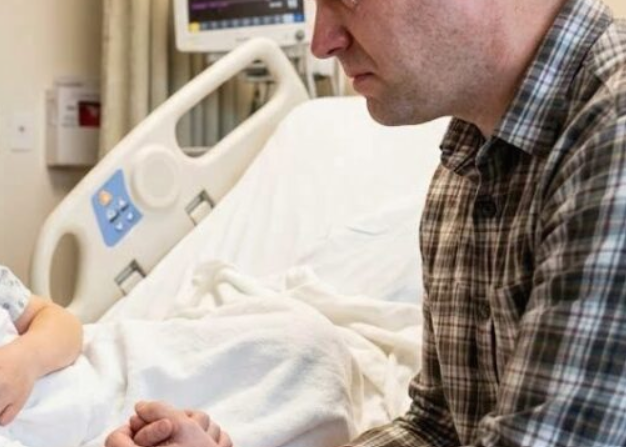
I sat beside his bed and carefully took his hand.
“I’m here, buddy. I’ve got you.”
His fingers tightened around mine.
“I tried to run,” he whispered.
I wanted to tell him he should never have needed to run.
Instead, I asked what had happened.
Jake explained that his grandfather had become angry during an argument.
“He said you think you’re better than everybody.”
I kept my voice calm.
“What happened next?”
Jake took a breath.
“Uncle Brian grabbed my arms, and Uncle Scott held my legs.”
The room seemed quieter after that.
I had known Brian and Scott for years. I had disagreed with them before. I had seen their tempers and their stubbornness.
But hearing my son describe what happened changed the way I looked at them.
These were adults.
Jake was eight.
Then he told me that his grandfather had pushed him down during the confrontation, causing him to hit his head.
I focused on Jake’s hand in mine.
He was not telling me the story because he wanted revenge.
He was telling me because he needed his father to understand what had happened when his father was not there.
Then he repeated something his grandfather had said.
“Your daddy isn’t here to protect you.”
That sentence stayed with me.
The injury was serious enough.
But those words showed me that Jake had also been frightened emotionally.
He had been made to feel alone.
I leaned down and kissed his forehead.
“I’ll always come for you.”
His eyes moved toward the door.
Then he said something that left me without an immediate answer.
“Mom didn’t stop them.”
I wish I could say I knew exactly what to tell him.
I didn’t.
I had not heard Christine’s explanation yet. I did not know what she had seen, what she had understood, or what she believed had happened.
All I had at that moment was my son’s account, my wife’s absence, and the unanswered calls on my phone.
Those were the facts I could confirm.
And facts were suddenly more important to me than assumptions.
I stepped into the hallway for a moment but kept looking through the glass.
Jake was watching me.
He wanted to know whether I was still there.
That hurt more than I expected.
Before that night, I had thought fatherhood was mostly about providing, keeping promises, fixing problems, and showing up for important moments.
In that hospital hallway, I understood something simpler.
Sometimes being a father means staying exactly where your child can see you.
My phone was still in my hand.
Christine’s name was on the screen.
So was her father’s number.
I called neither.
There would be time for questions later.
Right then, my priority was making sure Jake felt safe.
But another thought had already begun forming.
There was a part of my past I had deliberately left behind.
Years earlier, I had known people and lived a life that required me to pay close attention to details. I had walked away from that world because I wanted something different.
A quieter life.
A family.
A home where my biggest concerns were school schedules, soccer games, groceries, and weekend plans.
Christine knew me as that man.
The ordinary father.
The husband who tried to avoid unnecessary conflict.
The person who preferred solving problems quietly.
But there was another side of my past that I had never completely forgotten.
It had taught me that anger often made situations worse.
It had taught me to separate what people said from what could actually be established.
Most importantly, it had taught me to ask questions before making decisions.
That was why I opened an encrypted application on my phone that I had not used in years.
There was one contact inside.
No name.
No photograph.
Just a number I had memorized long ago.
I stared at it for several seconds.
I had promised myself I would never use it again.
Then I looked through the glass at Jake.
I pressed the call button.
The connection opened almost immediately.
A familiar voice answered.
“I was wondering if I’d ever hear from you again.”
I looked at my son.
“I need your help.”
There was a pause.
Then came the question I expected.
“Who are we dealing with?”
I gave the names.
My father-in-law.
His sons.
And Christine.
I expected questions about what had happened.
Instead, the first question was about Jake.
“Does your son still trust you?”
I looked at him through the glass.
He had pulled the blanket closer around himself.
“He does,” I answered.
The voice on the phone became calm.
“Then that’s where you start.”
It was not what I expected to hear.
The angry part of me wanted immediate action.
It wanted confrontation.
But the father in me understood the point.
Jake needed safety before explanations.
He needed to know that the next adult entering his room would not create another argument.
He needed consistency.
And most of all, he needed to know that I had listened to him.
When I returned to his room, Jake looked at me.
“Dad?”
“Yeah, buddy?”
He hesitated.
“Are they going to come back?”
Everything else suddenly became secondary.
Not Christine’s calls.
Not her father’s reaction.
Not what Brian and Scott might say later.
My son was lying in a hospital bed wondering whether the people who had frightened him would return.
I sat beside him.
“No one is coming in here without permission,” I told him. “You’re safe.”
I stayed beside him until his breathing became slower.
I did not ask him to be brave.
I did not ask him to explain anything else.
He had already told me enough.
Outside the room, my old contact was still waiting.
That call was no longer about anger.
It was about understanding.
I needed to know whether this had been an isolated family conflict or whether something deeper had been developing without my knowledge.
I needed answers about why Christine had remained at her father’s house.
I needed to understand why her relatives had behaved the way they did.
And I needed to know whether there was anything else that could affect Jake’s safety.
The voice on the phone told me something that made me pause.
The people around my family were not completely unknown to them.
There was history.
There were connections.
And there were details I had not yet discovered.
I did not have a complete explanation.
I did not have proof for every suspicion.
I had no intention of filling the empty spaces with assumptions.
That was one lesson my old life had taught me well.
When the truth matters, you do not invent the missing pieces.
You find them.
I looked at Jake again.
His fingers were curled around the edge of his blanket.
Earlier that night, someone had tried to make him believe his father would not come.
Now I was sitting close enough for him to reach me without leaving his bed.
That was where I started.
Not with threats.
Not with revenge.
Not with a dramatic confrontation.
I started with my son.
I started with making sure he was safe.
Then I started looking for the truth.
The people who had frightened Jake might have believed anger was the only power I had left.
They were wrong.
Anger could not explain what happened.
It could not tell me why Christine stayed behind.
It could not tell me what her family knew.
And it could not reveal why someone from my abandoned past recognized their names.
Only patience, evidence, and careful questions could do that.
So I listened.
And as the familiar voice continued on the other end of the phone, I realized that the night at the hospital was not simply about what had happened in a driveway.
It was about everything I had failed to see before that moment.
Jake had taught me where to begin.
My past might help me understand where to look next.
And for the first time in years, I was willing to open a door I had once believed should remain closed.
Not because I wanted to become the man I used to be.
Because I needed to protect the life I had built.
My son was depending on me.
And this time, I was going to make sure I understood the truth before deciding what came next.