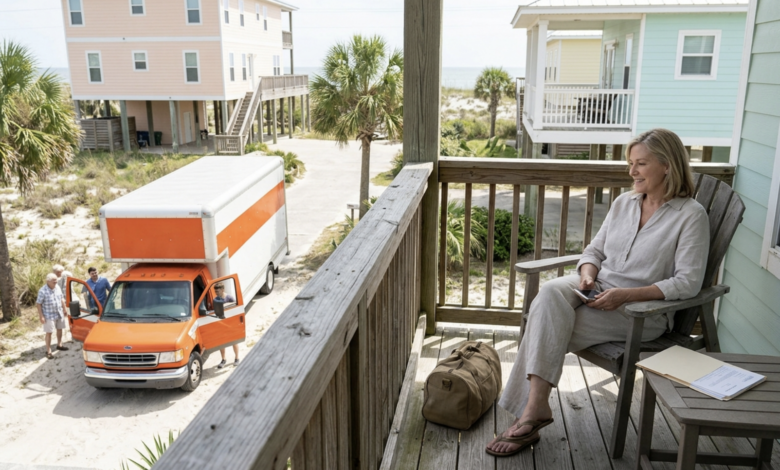
My Son Told Me I Was No Longer Welcome in the Beach Villa I Built—But He Didn’t Know I Had Protected It Six Years Earlier…
“Go ahead.”
He sounded exhausted.
“The bank contacted me. They want to investigate the loan application.”
“I know.”
“Robert didn’t have to involve them.”
I put my cup down.
“Derek, did you sign my name?”
Silence.
Then he said, “I didn’t think it would become a problem.”
That wasn’t an answer.
“Derek, did you sign my name?”
“I was going to tell you.”
“When?”
“When the loan was approved.”
I closed my eyes.
For a moment, I couldn’t hear anything except the clock above the refrigerator.
“You used my signature without my permission?”
“I was desperate, Mom.”
“That doesn’t answer my question.”
He started speaking faster.
“My business was failing. I had employees to pay. I had bills. Megan was worried about her parents. I thought I could borrow the money, fix everything, and pay it back before anyone even noticed.”
I felt something inside me break.
Not loudly.
Not dramatically.
Just a quiet, final breaking.
“You planned to borrow money against a house you didn’t own.”
“I wasn’t going to take the house from you.”
“Then why did you tell me it belonged to Megan’s parents?”
He had no answer.
I continued.
“Why did you tell me I wasn’t welcome?”
“Mom, I was trying to solve everything.”
“No, Derek. You were trying to solve your problems with something that belonged to me.”
He began crying.
“Please don’t destroy my life over this.”
I stared at the photograph of Arthur hanging on the wall.
“Your life isn’t being destroyed by me, Derek. You’re facing the consequences of decisions you made.”
Then I ended the call.
The following week brought more revelations.
Robert received the lender’s original records.
The forensic document examiner was able to identify significant similarities between the disputed signature and a copy of the old quitclaim deed.
But the examiner also found indications that the signature on the loan document had likely been reproduced rather than independently signed.
The lender suspended the application and began its own investigation.
Robert also discovered that Derek had provided the bank with an outdated property valuation and a copy of the unrecorded quitclaim deed.
The documents appeared designed to make the lender believe Derek had ownership rights he did not possess.
The situation was now much bigger than a family disagreement.
Derek hired an attorney.
The lender referred the suspected document fraud to the appropriate authorities.
I did not celebrate.
I didn’t feel victorious.
I felt tired.
A mother should never have to sit in a lawyer’s office discussing whether her son had falsified her signature.
But I also knew that protecting him from the consequences would not undo what he had done.
For the first time in my life, I decided that loving Derek did not mean rescuing him.
Two weeks later, Megan called me.
Her voice was different.
Quiet.
Almost unrecognizable.
“Vivien, can I come see you?”
I hesitated.
“Why?”
“I need to tell you something.”
I agreed to meet her at a small café near the beach.
She arrived alone.
Her eyes were swollen, and she looked as though she hadn’t slept properly in days.
She ordered coffee but barely touched it.
“I left Derek,” she said.
I didn’t respond immediately.
She continued.
“I found out about the debts. There were more than he told me. Credit cards, business loans, personal loans. He had been hiding everything.”
I listened.
“My parents are furious. They blame him for making them give up their apartment. They had to find temporary accommodation, and they’ve been arguing with him constantly.”
She lowered her head.
“Everything I believed about our finances was a lie.”
I looked at her.
“Did you know he was using my property on the loan application?”
She shook her head.
“No. I swear I didn’t.”
I believed she might not have known about the forged signature.
But I remembered her standing in my kitchen, telling me that her parents needed my house more than I did.
“You still helped him try to take my home,” I said.
Her eyes filled with tears.
“I know. And I’m ashamed of it.”
She took a folded piece of paper from her purse.
It was a handwritten letter.
“I wanted to apologize properly.”
I didn’t take it immediately.
She pushed it toward me.
“I should never have spoken to you that way. I should never have measured your bedroom or discussed changing your house as if you weren’t there. I treated you like an inconvenience.”
I finally picked up the letter.
“Why?”
She looked out the window.
“Because I thought Derek had everything under control. And because I wanted to help my parents. I convinced myself that what we were doing was reasonable.”
She paused.
“But it wasn’t.”
I folded the letter.
“An apology is a beginning, Megan. Not a guarantee that everything goes back to the way it was.”
“I understand.”
We sat quietly for a while.
Before she left, she said something that surprised me.
“Your house is beautiful, Vivien. I understand now why you fought for it.”
I looked at her.
“Thank you.”
Then she walked away.
The legal situation continued for several months.
The lender formally rejected Derek’s loan application.
The disputed signature and ownership representations remained under investigation, and Derek had to respond through his attorney.
He also faced financial consequences from his failing business.
I didn’t pay his debts.
I didn’t offer the villa as collateral.
And I didn’t let him use my savings to make the situation disappear.
Some people might think that was cruel.
But I had spent most of my life teaching Derek that actions had consequences.
It would have been wrong to abandon that lesson simply because he had finally become old enough to need it.
Meanwhile, Robert helped me complete several additional protections for the property.
We reviewed the trust, updated the supporting records, confirmed the insurance arrangements, and made sure the ownership documentation was securely maintained.
He also helped me prepare an estate plan that clearly stated my wishes.
The villa would remain in the trust.
No one could sell it, borrow against it, or claim ownership simply because they were related to me.
I also made a decision about the future.
I would no longer allow family members to confuse inheritance with entitlement.
Six months after the morning of the U-Haul, I invited Tommy Guidry over for lunch.
He arrived carrying a toolbox.
I laughed.
“Tommy, I invited you for sandwiches, not construction.”
He grinned.
“Old habits.”
We spent the afternoon repairing the small scratches left by the movers.
Then I asked him to help me restore the master bedroom.
The gray paint was removed.
The original coral returned.
I ordered new curtains in the same soft cream color Arthur and I had chosen years earlier.
I replaced the bedroom furniture Donna had tried to select with the old wooden dresser that had belonged to Arthur.
And I bought fresh gardenias for the back porch.
When everything was finished, I stood in the doorway.
For the first time in months, the room looked like mine again.
Tommy leaned against the doorframe.
“Looks better, Vivien.”
I smiled.
“It feels better.”
He looked around.
“Arthur would have liked it.”
I swallowed.
“Yes. He would.”
Then, one afternoon in early spring, Derek appeared at my front door.
He wasn’t carrying flowers.
He wasn’t carrying documents.
He was holding a small wooden box.
I opened the door but didn’t invite him inside immediately.
“Hello, Mom.”
“Hello, Derek.”
He looked thinner.
His clothes were simple, and the confidence he once carried seemed to have disappeared.
“Can we talk?”
I stepped aside.
We sat at the kitchen table.
He placed the wooden box between us.
“I found this in the storage unit.”
I opened it.
Inside was Arthur’s old pocket watch.
I remembered the day Arthur gave it to Derek when he graduated.
It had belonged to his grandfather.
Derek had kept it for years.
“I thought you should have it,” he said.
I touched the silver cover.
“Thank you.”
He looked down at his hands.
“Mom, I’ve been seeing a counselor.”
I said nothing.
“I’ve been trying to understand why I thought I could do what I did. I kept telling myself I was helping everyone. But the truth is, I was ashamed of my financial situation. I didn’t want Megan to know how bad things had become. I didn’t want Ray and Donna to think I was a failure.”
He took a breath.
“So I convinced myself that if I could get the house, everything would be fine.”
I looked at him.
“And what did you learn?”
He struggled to answer.
“That I treated you like an asset instead of my mother.”
Those words stayed between us.
Then he began to cry.
“I’m sorry, Mom.”
I reached for my coffee.
I had imagined this moment many times.
Sometimes I imagined shouting at him.
Sometimes I imagined telling him never to contact me again.
Sometimes I imagined embracing him immediately and pretending none of it had happened.
But the real moment was different.
I felt sadness.
I felt love.
And I felt a boundary I had never been brave enough to establish before.
“Derek, I love you. You are my son. Nothing changes that.”
He looked up.
“But I will never again put my security, my home, or my future at risk because you need something.”
He nodded.
“I understand.”
“I also need you to understand that trust isn’t restored because someone says they’re sorry. It takes time. And it takes actions.”
“I know.”
I looked at the pocket watch.
“Your father believed in giving people second chances. But he also believed people had to earn them.”
Derek wiped his face.
“I want to earn yours.”
For the first time that afternoon, I smiled.
“Then start by living honestly.”
He nodded.
We talked for another hour.
Not about the house.
Not about money.
We talked about Arthur, childhood memories, and the little fishing trips they used to take together.
When Derek finally stood to leave, he hugged me.
It wasn’t the same hug he used to give me when he wanted something.
It was quieter.
More genuine.
I didn’t know what the future would bring.
But I knew I had made the right decision.
One year after the morning the U-Haul arrived, I hosted a small dinner at the villa.
Tommy came.
Robert came.
Doris Palmer, my old friend and the retired judge who had helped me establish the trust, came with a bottle of sparkling cider.
I invited Derek too.
He arrived alone.
He didn’t bring Megan’s parents.
He didn’t ask about the property.
He simply brought a homemade lemon cake and helped Tommy arrange the chairs.
At sunset, we gathered on the porch.
The Gulf shimmered in the distance.
The gardenias were blooming again.
And the white-oak swing moved gently in the evening breeze.
Doris raised her glass.
“To a woman who understood that protecting herself wasn’t the same as giving up on her family.”
Everyone smiled.
I looked at the people around me.
Then I looked toward the house.
For years, I had thought of the villa as a place I built because Arthur and I had dreamed of retiring together.
But now I understood something else.
I had built it as proof that a woman could begin again after losing everything.
I had rebuilt the foundation.
I had repaired the walls.
I had laid the floors.
I had painted the rooms.
And when someone tried to take it away, I had finally learned that I was allowed to protect what I had created.
Later that evening, Derek approached me while I was sitting on the swing.
“Mom?”
“Yes?”
“Thank you for inviting me.”
I smiled.
“You’re welcome.”
He looked toward the ocean.
“I know things will never be exactly the same.”
“No,” I said gently. “They won’t.”
He nodded.
“But maybe they can be better.”
I looked at my son.
“Maybe. One day at a time.”
He kissed my forehead before walking back toward the others.
I remained on the swing for a while.
The same swing where I had been sitting when he called to tell me I was no longer welcome.
The same swing where I had once watched the sunset and wondered how my own child could say such a thing.
Now the ocean was turning copper again.
I thought about Arthur.
I thought about the years I had spent building the villa.
And I thought about the lesson I wished I had understood sooner.
Being a mother does not mean surrendering everything you own. Being generous does not mean allowing people to use you. And loving your family does not mean giving them permission to destroy your peace.
I had lost my husband.
I had nearly lost my relationship with my son.
But I had not lost myself.
And that evening, as the Gulf breeze moved through the gardenias, I finally felt completely at home.
Not because the house belonged to me.
But because I had remembered that my life belonged to me, too.
THE END.