My Neighbor Kept Stealing Gas From My Pickup Because I Was Retired, So I Finally Taught Him a Lesson
We taped the box shut but left the lid so it would pop open easy the second he pulled the ribbon.
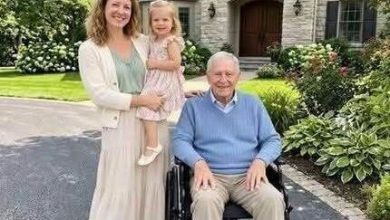
We finished a little after dark. Katie stood back and looked at our handiwork and shook her head slow.
“Grandpa,” she said. “Grandma would’ve loved you for this.”
“Grandma would’ve told me to let him have the gas,” I said.
Katie smiled. “Yeah. But she’d have loved you for it anyway.”
Now, the timing had to be right.
We didn’t just set the box out that night. That would’ve been too soon, and Clark might’ve opened it alone in the dark. No. We waited.
We waited until the next time Clark came for my gas. Because I wanted him to have done it fresh. I wanted him to have that red can full of my gas sitting in his garage when the whole thing came down. That felt right to me. That felt like the circle closing.
It took two nights.
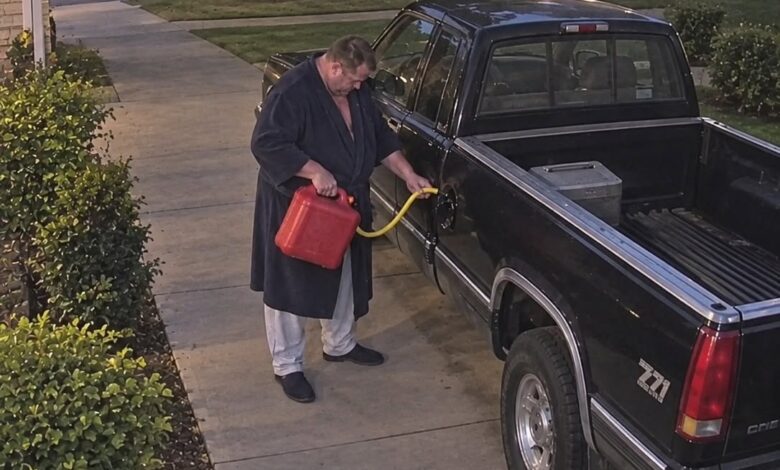
On the second night, a little after two in the morning, my phone buzzed on the nightstand. The camera. Motion in the driveway.
I got up. I didn’t turn on the lights. I stood at my bedroom window in my undershirt and watched the real thing with my own eyes for the first time.
There he was. Clark. Kneeling by my truck like it was his own. Feeding the hose in. Filling his can.
Part of me wanted to throw open the window and yell. But I didn’t. I just watched, and I felt calm. Calmer than I’d felt in weeks. Because I knew something Clark didn’t.
Tomorrow was going to be different.
He finished, capped my tank all neat and tidy like always, and walked home with my gas.
I texted Katie one word: Tonight.
She was staying in the guest room. She texted back a thumbs up and a single word of her own: Showtime.
We set the box on Clark’s porch at 6:45 the next morning.
I did it myself. Katie wanted to, but I told her no — this was mine to do. I walked across that lawn in the gray morning light, my heart going like a drum, and I set that bright wrapped box right in the middle of Clark’s welcome mat, dead center, bow up, where he couldn’t possibly miss it on his way out to work.
Then I walked back home, and Katie and I sat on my front step with two cups of coffee and waited.
It was a beautiful morning, actually. Cool and clear. Birds going. The street slowly waking up. Old Mrs. Petrova across the way came out to get her paper. Walt — my friend Walt, who I’d told the whole story to and who wouldn’t have missed this for a million dollars — happened to be “out for a walk” and stopped to chat with Mrs. Petrova on the sidewalk, both of them casually facing Clark’s house. A couple of other neighbors were out. A man loading his car. A woman walking her dog. A little morning crowd, all going about their business.
At 7:10, Clark’s door opened.
He came out in his work clothes — pressed shirt, nice pants, coffee in a travel mug, keys jingling in his hand. A man on his way to a good job. He took two steps and stopped.
He saw the box.
I watched his whole body change. First, confusion. He looked around, up and down the street, like maybe it was meant for someone else. Then — and this is the part I’ll treasure till the day I die — he smiled. He actually smiled. Because a wrapped present on your porch, well, that’s a nice thing. That’s a good surprise. Maybe it was from a client. Maybe his wife had ordered something. Maybe, and I’d bet money this crossed his cheap little mind, maybe the greedy old neighbor had finally come to his senses and left a peace offering.
He set his coffee down on the railing. He crouched down. And he pulled the ribbon.
The lid popped open.
And the smell hit him first.
I have never in my life seen a man recoil like that. His head snapped back. His whole face folded up on itself. He made a sound — this strangled, gagging, horrified sound — and he threw his hands up, and in throwing his hands up he knocked the box, and the box tipped, and all that thick blue dye went sloshing out, over his hands, up his sleeves, down the front of that pressed white shirt, splattering across his nice pants and his shiny shoes and the welcome mat and the whole porch.
Bright, electric, permanent blue.
And then he screamed.
I mean he screamed. A grown man in a business shirt, screaming at seven in the morning on his own front porch like he’d stuck his hand in a wasp nest. The kind of scream that stops traffic. The kind of scream that a whole street hears.
And a whole street heard it.
Doors opened. Heads turned. Walt and Mrs. Petrova came hustling over — for their safety, of course, purely concerned. The man loading his car came jogging. The woman with the dog stopped dead. Denise, Clark’s wife, came flying out the front door in her bathrobe.
“Clark?! What happened?! What is it?!”
And there was Clark. In the middle of his porch. Covered — covered — in bright blue dye, gagging and coughing from the smell, that awful skunk stink now clinging to him, to his clothes, to his skin, to everything within twenty feet.
And on the ground in front of him, face up, splattered but perfectly readable, was the paper.
Denise saw it first.
She bent down, one hand over her nose against the smell, and she picked up the sheet. She read it. Her eyes went to the three photographs clipped to it. Her husband, kneeling by my truck. Her husband, hose in his mouth. Her husband, walking home with a stolen can of gas.
I watched her face go from panic to confusion to something else. Something cold.
“Clark,” she said, and her voice carried clear across the yard, “what is this?”
“It’s nothing — Denise, it’s nothing — that crazy old man, he—”
“Have you been stealing gas from Frank?”
“It’s not — it’s a couple of gallons, it’s not a big—”
“There are pictures, Clark!” She was holding the paper up now, turning it so the neighbors could see. “There are pictures of you! Doing it! At two in the morning!”
And now the neighbors were reading it too. Passing it hand to hand. Walt made a great show of squinting at the photos and saying, loud, “Well would you look at that. Stealing gas from a seventy-year-old widower. From Frank. That’s about the lowest thing I ever heard.”
Mrs. Petrova, who has lived on this street for thirty years and knows everything about everyone, put her hand to her chest. “From Frank? After his wife just passed? Oh, that poor man.”
The word “Frank” and the word “stealing” and the word “widower” went around that little crowd like a current. And Clark stood in the middle of it, dyed blue, reeking of skunk, smearing dye across his own face as he tried to wipe it off, and there was nowhere for him to go and nothing for him to say.
He looked up. Across the two lawns. Right at me, sitting on my step with my coffee.
And I lifted my cup to him. Just a little. A neighborly little toast.
I didn’t smile. I didn’t have to. He understood.
Katie, sitting next to me, was shaking silently, trying so hard not to laugh out loud that tears were running down her face.
“Grandpa,” she whispered. “Grandpa, it’s blue. It’s so blue. Look at his face.”
“I see it,” I said.
“Grandma is up there losing her mind right now.”
“I know she is,” I said. And I had to look down at my coffee for a second, because my eyes had gone hot, and it wasn’t from laughing.
Clark and Denise had a screaming fight on that porch. Right out in the open. I won’t repeat all of it, because some of it was between a husband and wife and isn’t mine to tell. But the short of it was this: Denise was mortified. Not just angry — mortified. Because for Denise, like for Clark, the worst thing in the world was for the neighbors to think badly of them. And now the whole street had seen her husband, blue and stinking, exposed as the man who crept out at night to rob the old widower next door.
“Do you know what everyone is going to say?” she kept saying. “Do you have any idea? At the school? At church? Everyone knows now, Clark. Everyone.”
That was the thing that finally got him, I think. Not the dye. Not the smell. Not even getting caught. It was that everyone knew.
Which was exactly the point.
He didn’t come to my door that day. Or the next. He was too busy, I heard, trying to scrub blue dye off his skin, which — thanks to Ellen’s industrial-strength Easter concentrate — did not come off. Not that day, not that week. I saw him leave for work a few days later with his hands and neck still faintly blue, wearing long sleeves in September, and I have to admit, that gave me a small dark pleasure I’m not entirely proud of.
But here’s where the story turns, and here’s where it stops being just a story about revenge.
About a week after the porch, there was a knock on my door.
I opened it, and it was Clark. Alone. No blue on his face anymore, just a faint bluish tint at the edge of his jaw if you looked close. He was holding his hands in front of him like a boy called to the principal’s office.
I didn’t invite him in. I just stood in the doorway.
“Frank,” he said. And then he stopped. He looked down at his shoes. This was a man who had never once in six years struggled to talk to me, and now he couldn’t find a single word.
“Yeah,” I said. I let him stand in it.
“I, uh.” He rubbed the back of his neck. “That was— you got me pretty good.”
“Denise hasn’t let me hear the end of it. My kids think it’s the funniest thing that ever happened. My daughter drew a picture of me blue. It’s on the fridge.”
I didn’t laugh, but something in my chest loosened a little.
“I came to say I’m sorry,” he said. And then, quieter, “I mean it. I’m sorry, Frank. What I did was— it was wrong. Taking your gas. And the way I talked to you on the porch that morning. Calling you greedy.” He shook his head. “You weren’t the greedy one. I knew that even when I was saying it. I don’t know why I said it.”
“Because it was easier than admitting what you were,” I said.
He looked up at me. He didn’t argue. “Yeah,” he said. “Yeah, probably.”
We stood there a second.
“Can I ask you something?” I said.
“Why me? You’ve got money, Clark. You’ve got a good job. It was twenty dollars of gas a week. Why would you sneak around in the dark to steal twenty dollars of gas from an old man?”
He was quiet a long time. And when he finally answered, it wasn’t the answer I expected. It was, I think, the first honest thing he’d said to me in six years.
“Because I told myself it didn’t matter,” he said. “Because you’re— no offense— you’re quiet. You keep to yourself. You never make a fuss about anything. Even the ladder, the pressure washer, all of it, you never really pushed. And I just— I figured you wouldn’t notice. Or you’d notice and you wouldn’t do anything. I figured you were kind of— done. You know? Just an old guy running out the clock.”
He heard how it sounded as he said it. I watched him hear it.
“That’s an ugly thing to think about a person,” I said.
“It is,” he said. “I know it is.”
And I’ll tell you, standing there, I felt a lot of things at once. I felt angry all over again. But underneath the anger, I felt something sadder and truer, because Clark had just said out loud the exact thing I’d been afraid of. The thing that had really scared me, more than losing my mind, more than the gas.
That I’d become invisible. That the world had looked at me — seventy, widowed, alone, driving a beat-up truck — and decided I didn’t count anymore. That I was, in Clark’s words, just running out the clock.
And the thing is, before all this, I’d half-believed it myself. That’s the part nobody tells you about getting old. You start to disappear, and after a while, you start to agree to it.
But I hadn’t disappeared. I’d caught him. I’d outsmarted him. I’d stood on that step with my coffee and watched a man half my age crumble because I refused to be taken from.
“Clark,” I said. “I’m going to tell you something, and I want you to actually hear it, because I don’t say this kind of thing twice.”
“I am not done,” I said. “I’m seventy years old and I’ve forgotten more than you’ll ever learn, and I am not done. I’ve got a granddaughter who’s smarter than both of us and a truck full of my late wife and a whole lot of life left in me that you don’t get to write off just because I’m quiet. Quiet isn’t weak. You understand? Quiet isn’t the same as gone.”
He swallowed. “I understand.”
We stood there another second, and then he stuck out his hand. It still had the faintest blue tint to it, right at the knuckles. I looked at it.
And then I shook it. Because Ellen would have wanted me to. Because keeping the peace, when the peace is finally offered honestly, is a different thing than keeping the peace by rolling over. And because forty years on the same street is a long time, and I didn’t want to spend whatever years I had left glaring over a fence.
“There’s a can of my gas in your garage,” I said as he turned to go.
He stopped. “Right. Yeah. I’ll— I’ll fill it up and bring it back. And I’ll pay you for— for all of it. Everything I took. I did the math. It’s about two hundred dollars. I’ll get it to you.”
“You do that,” I said.
And to his credit, he did. Two days later there was an envelope in my mailbox with two hundred and twenty dollars in it, and a full red gas can sitting on my porch — my porch, this time — with a note that just said, Sorry, Frank. — Clark. He’d rounded up. And underneath, in different handwriting, a child had added in crayon: sorry my dad was blue. From Lily.
That one I kept. It’s on my fridge now, right where his daughter’s picture of blue Clark is on his.
Things changed after that. Not overnight, and not into some fairy tale. Clark and I didn’t become best friends. But something shifted on Maple Court.
The ladder came back the next time he borrowed it — the very next day, cleaned, without me having to ask. When my gutters needed doing that fall, Clark showed up with his own ladder and did them himself, no charge, and wouldn’t hear otherwise. When it snowed that winter, my driveway got plowed before I was even awake, and I never did catch him doing it, but I knew.
And the neighborhood — well. The neighborhood remembered. For months, Clark was “the blue guy.” Kids would ride by on their bikes and holler it. He took it better than I’d have guessed. I think, somewhere in there, getting caught and humbled had done something for him too. A man can go a long way pretending he’s better than everybody. It’s exhausting, actually. Sometimes getting knocked down to size is the kindest thing that can happen to a person, even if it comes covered in blue dye and skunk spray.
Katie stayed the rest of that weekend, and she comes around more now — not just Sundays on the phone but actual visits, sitting in my kitchen, telling me about her life. She says the whole thing with Clark made her look at me different. “I always thought of you as just Grandpa,” she told me once. “Sweet old Grandpa. I didn’t know you had all that in you.”
“Neither did I,” I told her. “Not anymore. I’d kind of forgotten.”
She got quiet then, and she reached across the table and put her hand on mine, and she said, “Well. Don’t forget again. Okay?”
I think about Ellen a lot through all of this. I think she’d have scolded me at first — “Frank, dye and skunk spray, honestly, what are you, twelve?” — but I think, underneath, she’d have been proud. Not because I got Clark. But because I stopped letting the world take from me. Because I stood back up.
Because here’s what I finally understood, sitting on that step with my coffee, watching a blue man scream on his porch while the whole street turned to look:
It was never really about the gas.
It was about being seen. About refusing to vanish quietly. About a man deciding, at seventy years old, that he still counted — that he was still here, still sharp, still worth reckoning with, no matter what an old truck in the driveway might suggest to a cheap neighbor in a fifty-dollar watch.
They’ll take from you what you let them take. Not just gas. Your time, your dignity, your sense of your own worth. They’ll take it a little at a time, in the dark, and screw the cap back on nice and neat so you won’t notice.
Until one day you install the camera.
And you look at the footage.
And you decide, once and for all, that you are not done.
I still drive that old blue pickup. It’s got a full tank now, and it stays full. Every Tuesday I fill it up at the Shell on Hollis, same as always. And every so often, when I’m out in the driveway checking the gauge out of pure old habit, I glance over at Clark’s house, and if he’s out there, he gives me a wave.
We’re neighbors, after all.
Neighbors are supposed to share.