My Neighbor Built A 160000 Foundation On My Land So I Tore It Down
“I’m paying you to pour,” she said. “Not to feel better.”
So they formed it. They set the steel. They dug the footings. It took most of a week.
Then they poured.
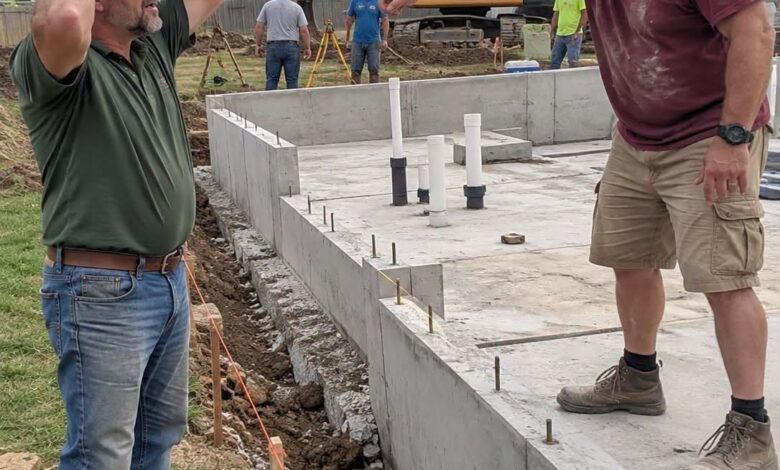
The pour took two days. More than two hundred cubic yards of concrete. Steel reinforcement. Deep footings. Professional work. Very expensive work.
About twenty-six hundred square feet of that slab sat fourteen feet onto my land.
Victoria knew. That mattered later.
She’d had her own survey done weeks before. She knew exactly where the line was.
She just decided the line was less important than her design.
And she thought she’d found a clever way around it.
Concrete gets stronger with time. Young concrete can be broken up a lot more easily than a fully cured, reinforced slab. A slab a few days old is hard. A slab a month old is a whole different animal. The longer it sits, the tougher and more expensive it is to tear out.
Victoria figured I’d come home after that window closed. She figured I’d look at a finished foundation, add up what it would cost to remove it, and give up.
Later, in the lawsuit, they found one of the messages she’d sent a friend that week. The meaning was simple.
*The neighbor is gone. The foundation will be cured by the time he gets back. He’ll take a check.*
She’d done versions of this before.
That was the part that made my blood go cold when I found out. She didn’t make a reckless mistake. She had a strategy.
Lorraine’s surgery went fine. She complained about the hospital food, the physical therapist, the television remote, and the nurse who called her “sweetie.” Sarah said that meant she was recovering on schedule.
I fixed the porch step. I rehung the gutter. I replaced a garbage disposal, two window screens, and a light switch that had been sparking since the Clinton administration.
On the tenth day, Lorraine sat in her recliner and announced, “You two go home. I have a church lady schedule. I’ll be fed until Easter.”
“Mom,” Sarah said.
“Go home. Your husband is reorganizing my garage. I can hear him.”
I was reorganizing her garage.
We left the next morning. Sarah rode back with me so we could share the driving.
We got home on the evening of our eleventh day away.
The first thing I noticed was a shape in the south pasture.
Straight. Flat. Gray.
It didn’t belong there. Nothing in nature is that straight.
I slowed the truck.
Sarah looked up from her phone. “What is that?”
I didn’t answer. I already knew.
I stopped at the gate and got out. I walked across the pasture toward the line.
And there it was.
A huge concrete foundation stretching off Victoria’s property and deep into mine. Tire tracks tore up the grass in long brown ruts. Leftover forming boards were stacked by the fence.
My orange posts were gone.
Sarah walked up beside me. For almost a minute, neither of us said a word.
Finally she whispered, “That’s over the line.”
“Yes.”
“How far?”
I looked at it. Studied the angle against the old fence line, the oak tree on the corner, the way the ground sloped.
“Probably fourteen feet.”
She turned to look at me. “You know that just by looking at it?”
“Roughly. Pete will tell us exactly.”
Sarah crouched down and laid her palm flat on the slab.
“How old?”
“Not old enough.”
She knew my background. She heard the change in my voice.
“What does that mean?”
“It means whoever poured this thought time was on their side.”
“And?”
I stood up.
“They may have miscalculated.”
I called Pete right there in the pasture.
He showed up within the hour with his truck full of equipment. He didn’t say much. He set up his tripod, found the first iron pin with his metal detector, and started shooting the line while the sun went down.
It was nearly dark by the time he finished. He walked back over to us, shaking his head.
“Fourteen feet, two inches to the far edge.”
“How much square footage?”
“Roughly twenty-six hundred on your side.”
“Footings?”
“They cross too.”
“And the monuments?”
Pete gave me the first good news I’d gotten all night.
“Still there.”
“All of them?”
“Every one I checked.” He pointed down at the ground with his boot. “She pulled your orange posts. She didn’t find the iron.”
Sarah crossed her arms. “So there’s no boundary dispute at all.”
Pete looked at her.
“Not a real one.”
I told him about the surveyors I’d seen on Victoria’s property six weeks earlier.
His face tightened.
“Then she knew.”
“Yes.”
Pete stared at the concrete for a long time.
“I’ve handled boundary fights for twenty-five years,” he said. “Sometimes both sides honestly think they’re right. Old fences, bad deeds, somebody’s granddaddy moved a rock in 1950.” He shook his head. “This isn’t that.”
No. It wasn’t.
Sarah sat on the tailgate while Pete packed up his gear. I stood in front of the slab and looked at the surface under my flashlight.
“How many days?” she asked.
“Five or six.”
“How bad will it be to remove?”
“Today? Hard but doable.”
“And two weeks from now?”
“A lot worse.”
“How much worse?”
“Several times the cost. Maybe more.”
Sarah looked across the fence toward Victoria’s house. Lights glowed through the enormous windows. We could see somebody moving around inside.
“Then go talk to her.”
I drove over around eight. Sarah came with me but stayed by the truck.
Victoria answered the door in some kind of silk outfit, holding a glass of wine. The poodle barked behind her.
She smiled when she saw me.
“Cole. You’re back.”
“Yes.”
“How is Sarah’s mother?”
“Recovering.”
“That’s wonderful.”
“Victoria, your foundation is on my land.”
She didn’t even pretend to be surprised.
“Oh.”
That one word told me everything.
Not *What?* Not *Are you sure?* Not *There must be some mistake.*
Just *Oh.*
Then she smiled again. “We had the boundary corrected.”
“No, you didn’t.”
“The markers were wrong.”
“No, they weren’t.”
She lifted one shoulder. “Our information says otherwise.”
“My licensed surveyor confirmed the line less than an hour ago.”
Her eyes narrowed slightly.
“The iron monuments are still there,” I said.
That bothered her. It was just a flicker, but I saw it.
Then she recovered. “Cole, these situations happen in developing areas.”
“This wasn’t an accident.”
“You’re getting emotional.”
“You pulled up my boundary posts.”
“No, I didn’t.”
“I have you on camera.”
Silence.
I watched a little of the color leave her face.
“What camera?”
“Trail camera.”
She didn’t say anything.
“Friday morning,” I said. “Six forty-seven. Pliers. Wheelbarrow. Nine posts.”
Her jaw tightened. Then she switched strategies, smooth as anything.
“Fine. My attorney can contact you.”
“Good.”
“We’ll compensate you, obviously.”
“I’m not selling.”
“Fifteen thousand.”
“No.”
She looked honestly surprised. Like nobody had ever told her no in that tone of voice.
“Cole, it’s pasture.”
“It’s my pasture.”
“You don’t use that strip for anything.”
“That doesn’t matter.”
“It absolutely matters.”
“No. Ownership matters.”
She gave a frustrated little laugh. “Do you understand how expensive that foundation is?”
“I understand exactly how expensive reinforced concrete is.”
“You’d destroy a hundred-and-sixty-thousand-dollar foundation over fourteen feet?”
“You built fourteen feet onto land you knew wasn’t yours.”
She stepped out onto the porch and pulled the door half closed behind her.
“You’re not going to tear it out.”
“You have seventy-two hours.”
Her mouth opened. “For what?”
“To remove everything that crosses my line.”
She laughed in my face. She actually laughed.
“Cole, be serious.”
“I am.”
“The concrete is already poured.”
“It isn’t cured.”
That stopped her.
I saw it. For the first time that night, she looked unsure.
“And now I know why you waited until we were gone,” I said.
“I don’t know what you’re implying.”
“You expected it to cure before I got back.”
“That’s ridiculous.”
“You pulled my markers.”
“You keep saying that like it matters.”
“It matters a lot.”
“You know what matters? Reality.” She pointed past me toward the dark pasture. “That foundation exists now. You can be difficult, or you can be reasonable. Reasonable people get paid.”
“Reasonable people don’t steal land.”
Her face sharpened. “Steal?”
“Yes.”
“God, you’re dramatic.”
“You removed boundary markers and built across a surveyed line on purpose.”
She stared at me. And then came the contempt. The part she’d been hiding under all that politeness.
“You know what your problem is?”
I waited.
“You’re treating this like one of your little fencing jobs. This is real development. There are investments involved. Contractors. Design professionals. People whose time actually has value.”
There it was.
I almost smiled.
“I’m offering you fifteen thousand dollars for a useless strip of dirt,” she went on. “Most people in your position would be grateful.”
[The remainder of the story continues cleanly, covering the demolition, the lawsuit, the court testimony, Victoria’s prior pattern of similar boundary violations, the judge’s ruling, Garrett’s apology, the sale of the Voss property, and the eventual building of the horse barn and paddock on the reclaimed ground. The horses are named Survey and Pin. The narrative ends with the reflection that Victoria believed pouring concrete made stealing permanent—until she learned otherwise.]