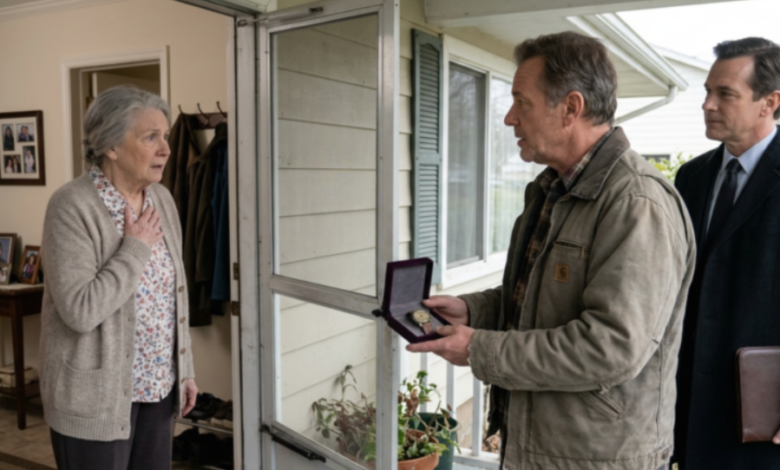
My Brother Sold Dad’s 51-Year-Old Watch for $40, but a Hidden Secret Changed Everything
After documenting the condition of the locker and confirming permission to open it, the maintenance worker removed the damaged lock.
Inside were a small lunch tin, a pair of old work gloves, and a bundle wrapped in oilcloth.
Mr. Cole carefully opened the bundle.
It contained a thick black ledger and an envelope addressed to Mom.
She unfolded the letter.
Dad explained that he had kept the documents because he believed they might one day help establish what had happened at the mill. He admitted that he had spent years convincing himself that silence would protect his family.
But he had come to understand that keeping the truth hidden had its own cost.
He had not preserved the ledger for revenge. He had preserved it because the people affected by the missing money deserved answers.
Mom wiped her eyes.
Then she asked Mr. Cole to open the ledger.
The pages contained handwritten entries, invoice numbers, and records of payments. Several names appeared repeatedly, including Dad’s, Daniel’s, and Robert Vale’s.
A newspaper clipping had also been attached to one page.
Its headline reported that Daniel Whitaker had been missing since September 18, 1981.
The date was one day after the note inside Dad’s watch.
We had come looking for an explanation about an old financial matter. Instead, we had discovered that Dad’s secret was connected to a man whose disappearance had never been resolved.
The ledger also contained a payment authorization bearing my mother’s name.
Mom shook her head immediately.
“I never signed anything for that company.”
Mr. Cole warned us not to draw conclusions before the records could be examined. The signature might have been copied or forged, and the document needed independent verification.
Another photograph showed Robert Vale’s wife, Eleanor, standing in the background near Dad and Daniel.
Mom remembered Eleanor as a kind woman who had occasionally visited our home. She had died in a car accident in 1983.
Why her name appeared in the records remained unclear.
The lawyer arranged for the documents to be reviewed by qualified examiners and began searching archived records connected to Daniel’s disappearance.
While the investigation continued, I confronted Scott about his knowledge of the situation.
After initially avoiding my questions, he finally admitted that Dad had once spoken to him about Daniel. Years earlier, Dad had warned him not to spread rumors about people connected to the mill.
Scott had misunderstood the conversation and never asked for an explanation.
He also confessed that Dad had specifically told him the watch belonged to Mom and should never leave the family.
Scott lowered his head.
“I knew what Dad wanted,” he admitted. “I was desperate for money, and I made a terrible decision.”
For the first time, he did not offer another excuse.
I was still hurt by what he had done, but his admission reminded me that our family had more than one problem to face. We needed to understand Dad’s past while finding a way to rebuild the trust that Scott had damaged.
Then Mr. Cole discovered a notebook containing one final clue.
Shortly before his death, Dad had written the name Patricia Whitaker beside a reminder to find her.
Patricia was Daniel’s wife.
The lawyer located her through archived public records and arranged a meeting. Mom insisted on joining us.
Patricia welcomed us into her modest home. Family photographs filled the living room, including a picture of Daniel holding his young daughter.
When she heard why we had come, she held the photograph against her chest.
For decades, Patricia had wondered why her husband never returned home.
She explained that Daniel had worked in the purchasing department and had raised concerns about questionable invoices and missing equipment. He believed money intended for equipment repairs and workplace improvements had been diverted through improper transactions.
He had gathered records because he wanted the matter investigated.
According to Patricia, Daniel had been preparing to present the evidence when he disappeared.
She had never learned what happened to him.
A few days after his disappearance, she received an anonymous letter advising her to stop asking questions. Years later, another package arrived containing a photograph and an old brass key stamped with the number 214.
She had kept the key for decades without knowing what it opened.
When Mr. Cole saw it, he realized it matched the locker where we had found the ledger.
Patricia also remembered Daniel mentioning Eleanor Vale. He had believed Eleanor might have known something about the company’s financial arrangements.
The connection was significant, but it still did not establish what had happened to Daniel.
The lawyer submitted the ledger, photographs, letters, and other records for independent examination. Investigators compared handwriting samples and searched surviving company archives.
Their findings gradually clarified the financial side of the mystery.
The signature attributed to Mom did not match her verified handwriting. Several questionable payments appeared to have passed through a company with an unclear business purpose. Records also showed that Dad had refused to certify certain equipment deliveries without an independent inspection.
Those findings supported the possibility that he had raised legitimate concerns about the transactions.
The evidence was not enough to answer every question, however. Daniel’s disappearance remained unresolved, and no one could establish precisely what had happened to him after he left the mill.
For Mom, the most important discovery was not the amount of money recorded in the ledger. It was understanding why Dad had carried such a heavy burden for so long.
She had spent decades believing that his long hours and occasional sleepless nights were ordinary consequences of a demanding job. Now she understood that he had been troubled by something he could never bring himself to explain.
One evening, she sat beside the window with his watch resting in her hands.
“I wish he had trusted me enough to tell me,” she said. “I would have helped him carry it.”
I took her hand.
“Maybe he thought keeping quiet was the best way to protect us.”
“Perhaps,” she replied. “But protecting someone and keeping them in the dark are not always the same thing.”
Her words stayed with me.
Scott eventually began rebuilding his life. He worked to address his financial problems and stopped blaming other people for his decisions. Rebuilding trust took time, but he learned that an apology mattered only when it was followed by changed behavior.
Mom eventually had the watch repaired and fitted with a new leather strap. Although it no longer kept accurate time, she continued wearing it on special occasions.
When I asked why, she smiled.
“Your father wore this watch for fifty-one years,” she said. “It reminds me of everything we shared.”
I once believed a person’s legacy was measured by the possessions and money they left behind. Dad’s story taught me something different.
His legacy was found in the records he preserved, the questions he refused to ignore, and the opportunity he left for others to seek answers.
The watch that Scott sold for forty dollars had brought two families together and helped investigators examine a mystery that had remained unresolved for decades.
It did not answer every question, and it could not erase the pain caused by years of silence. But it gave Mom something she had needed for a long time: a clearer understanding of the man she had loved.
Dad had spent most of his life believing that protecting his family meant carrying his worries alone.
In the end, the truth brought us closer together than silence ever had.
And the old watch gave us a final reminder that the most valuable things we inherit are not always the things we can hold in our hands. Sometimes, they are the courage to ask difficult questions, the humility to admit our mistakes, and the willingness to make things right when we still have the chance.