I Thought My Daughter Was Just Cold—Until I Noticed Something Was Wrong
Annie was my second child and my quiet one. Her older brother Brady could tell complete strangers in the checkout line at Walmart what we had eaten for supper, listing meatloaf and canned corn as proudly as if he were giving a news report. Annie was different. She kept most of her thoughts to herself.
If she wanted something, she pointed. If she didn’t like something, she turned toward the wall and waited quietly until she felt better.
That spring had been difficult from the beginning. My mother had undergone a hip replacement in Syracuse, and after leaving the hospital, she came to stay with us while she recovered. Vince Pruitt, a longtime family acquaintance, brought her to our brick duplex and offered to help with the stairs and household chores. I was working long shifts at Mercy Laundry, and with everything happening at once, I convinced myself that having another adult around would make life easier.
Vince was always willing to help. He repaired a leaking pipe, carried groceries inside, and handled small jobs around the house without being asked. But he also had very firm ideas about children. He often said Annie needed to be tougher and complained when she became upset over little things. I told myself he was simply from another generation. I was exhausted, and I let the days blend together.
Then one afternoon, I noticed something I could no longer explain away.
It was unusually warm outside, yet Annie stepped off Bus 14 wearing a heavy coat zipped all the way to her chin. Her hood was pulled forward, and she kept her sleeves covering her hands. The other children were carrying their sweaters or leaving them by the mailbox.
Mr. Coleman, the longtime school-bus driver, didn’t immediately pull away.
“Mrs. Haskins,” he called gently. “Could you look at this?”
He handed me a folded sheet of yellow notebook paper. Several dates were marked in blue ink, each followed by a short note. Annie had seemed unusually nervous on the bus. She had avoided sitting with the other children. She had become upset when someone accidentally bumped her shoulder. One note mentioned that she had asked another child whether it was possible to get in trouble for being sent somewhere alone.
I read that sentence twice.
“Did she say that?” I asked.
Mr. Coleman nodded. “I heard it while checking the mirror.”
I tried to explain that children sometimes picked up unusual ideas from television or other conversations. He listened patiently before saying something that stayed with me.
“Kids usually have a reason when they suddenly become afraid of ordinary things.”
I brought Annie inside and helped her take off the coat. She wouldn’t look at me. Her arms stayed close to her body, and she seemed unusually tense.
For the first time, I stopped making excuses.
Instead of confronting anyone, I called the school and asked to speak with Nurse Darlene, who had known Annie since kindergarten.
“Bring her in,” Darlene said immediately.
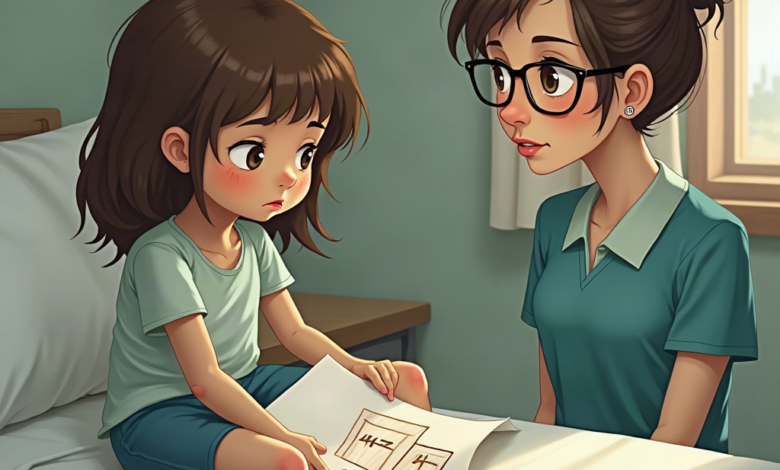
A short while later, Annie sat quietly in the nurse’s office while Darlene asked her gentle questions. She didn’t pressure her or demand answers. Instead, she placed a sheet of paper and a yellow crayon in front of her.
“Why don’t you draw somewhere you feel worried?” Darlene asked softly.
Annie remained silent for several seconds.
Then she began drawing.
She didn’t draw her bedroom, the playground, or the classroom. She drew our hallway closet.
It was simple: a brown rectangle, a small circle for the doorknob, and a tiny figure inside. Beneath the drawing, Annie carefully wrote the number 47.
Darlene studied the picture, then looked at me.
Her expression wasn’t dramatic. It was calm and professional, but I immediately understood that she was taking Annie’s drawing seriously.
A few minutes later, the phone on Darlene’s desk rang.
She listened quietly before covering the receiver with her hand.
“Helen,” she said, “Principal Alvarez wants to speak with us. Mr. Coleman has brought another concern to the office.”
I looked down at Annie’s drawing.
For weeks, I had told myself that our family was simply going through a difficult season. I had convinced myself that tired children behaved differently, that adults sometimes had old-fashioned ideas, and that everything would eventually settle down.
But sitting in that small nurse’s office, I realized something important.
When a child suddenly becomes fearful, withdrawn, or uncomfortable, the safest response isn’t to dismiss it or invent an explanation.
It’s to listen.
And that afternoon, I decided I was going to listen to Annie.